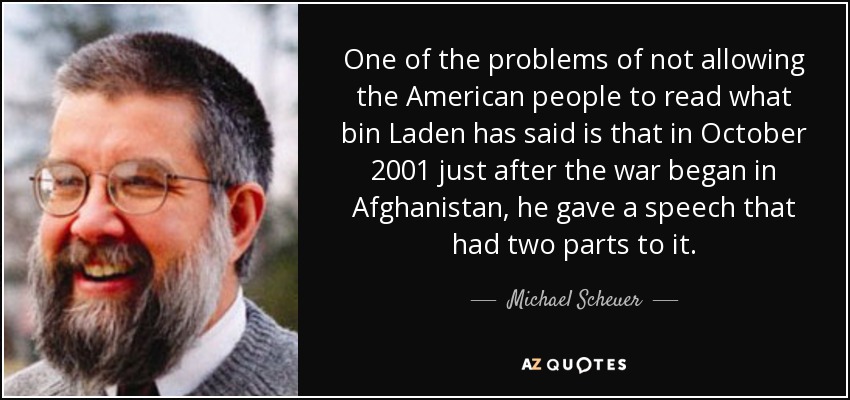
One of the problems of not allowing the American people to read what bin Laden has said is that in October 2001 just after the war began in Afghanistan, he gave a speech that had two parts to it.
The best way to get Americans to focus on what's happening in Afghanistan is by using the example of their own.
Liberia is not at the center of a massive geopolitical game. Afghanistan is and has always been. The history is dramatic, the politics are dramatic, the landscape is incredibly dramatic.
When you go and you tour Europe, or you go and you tour Egypt, or you go and you tour Iraq, or you go and you tour Afghanistan, or India, or whatever. Governments get to a point where they're illegitimate because people just give up on them as far as being leaders who have their country's interests at heart.
Afghanistan is just one of those countries that no group can conquer. It's so challenging to live, and the people are so close among their own tribes, their own groups, that you can't rule them all, you can't get an accord from all of them.
By releasing these five top Taliban commanders, the U.S. is demonstrating that it is throwing in the towel in the long struggle against the Taliban and its al-Qaeda allies in Afghanistan.
Those organisations, al-Qaeda being the first one, have all settled in areas full of mining and oil resources or in geostrategic zones. They settled in Afghanistan which underground is filled with oil and lithium. North Mali is filled with mining resources (uranium). It is essential to question the impact and role of some international players that create or let those organisations settle there.
The question about the Salafi is an important question as I say in Arab Awakening, and have often repeated since. I am really underlining the importance of this, because we really don't have very good memories. Remember - the Taliban in Afghanistan were not at all politicised in the beginning. They were just on about education. And then they were pushed by the Saudi and the Americans to be against the Russian colonisation, and as a result they came to be politicised.
Obviously what I think Senator [John] Kerry was pointing to, which is absolutely correct, which is the essential part of the strategy or a key component or a leg on the stool, is an Afghan partner that is ready to take control of both the security situation in Afghanistan, and the civilian side of that.
I've not been to Afghanistan or - but what people are clearly pointing to is that it becomes more difficult to have it. You could do it. I think weather is a factor. The most important factor though is credibility and legitimacy. What I wanted earlier to say is what I think Senator [John] Kerry is pointing to, which is important, is the strategic review on whether to send more troops is only one piece of the puzzle, important piece.
The Afghan - obviously the parties will decide which course of action. The most important there, get a government that is seen as legitimate to the people and has the credibility to be a partner in the effort to secure Afghanistan so it's not a haven for al Qaeda or other type of terrorists or international terrorist organizations.
We've been at war for many years in Afghanistan following 9/11. We know that we've got young men and women on the ground now. We've got our blood and treasure at stake there already.
At some point, deliberation begins to look more like indecisiveness which then becomes a way of emboldening our enemies and allies and causing our allies to question our resolve. So we shouldn't let one component of this determine our national security here which depends on providing an Afghanistan which denies a safe haven to terrorists as well as stabilizing Pakistan. Those are our two national security interests at stake in Afghanistan.
The problem is, you have to look at Afghanistan also in a global context where we've canceled basically our missile defense system undercutting the Czech Republic in Poland. We've I think not dealt with Iran with the kind of resolve that would show that we understand the nature of that threat.
We need to deal with the problem of al Qaeda, make sure that they can't have a sanctuary in Afghanistan and guarantee that we have regional stabilization and particularly focused on Pakistan.
And the last thing that I want to see us do is ask more and more of our troops [in Afghanistan ] without guaranteeing that we're providing more and more of what's necessary to make the mission successful.
I think indeed our response on counterinsurgency needs to be finely tuned to the needs of Afghanistan. This is not Iraq. We don't have a Sons of Iraq here. We don't have the same divisions here that we had between Sunni and Shia.
Counting the numbers of troops is not going to define our success here.There is no military success, ultimately, to Afghanistan. The Afghans themselves are going to define what happens here. And we have to convince ourselves that we have a strategy in place that empowers them to do that and that is realistic in what our expectations are from them and on what schedule.
The chaotic situation in Libya is definitely creating a threat. Libya now connects the jihadists in Africa with those in the Middle East and in Afghanistan. This could have been avoided.
The Islamists had control over territory that was about half the size of the Federal Republic of Germany. For years, we have been putting the lives of our troops on the line, we have taken huge losses and the Europeans cut the budget? If money is more important than the lives of our children, what else is this than the usual arrogance and superficiality? And where is all this terror coming from? It is a result of mistakes the West committed in Pakistan and Afghanistan in the 1980s, when they armed the Islamic rebels against the Soviet troops.
America's foreign policy lacks the backbone to do the right thing in Afghanistan - which is leave.
In Afghanistan this week, outnumbered Northern Alliance rebels on horseback defeated Taliban forces armed with tanks. Experts say the victory is just like the story of David and Goliath and David's friend, the Stealth Bomber.
John Walker Lindh, a twenty-year-old American studying in Pakistan, was captured in Northern Afghanistan fighting for the Taliban. Experts call it the worst semester abroad program ever.
Immediately after the September 11th attacks, I volunteered to go to Afghanistan in any capacity that the CIA wanted me. Four months passed before I was able to go overseas, just because my skill set was not one that was important in those really early days after the attacks.
I think 9/11 was a couple of thousand assholes in Afghanistan who ran rampant and just kind of did their thing and we could have gotten them in Tora Bora if that was handled better.
Follow AzQuotes on Facebook, Twitter and Google+. Every day we present the best quotes! Improve yourself, find your inspiration, share with friends
or simply: