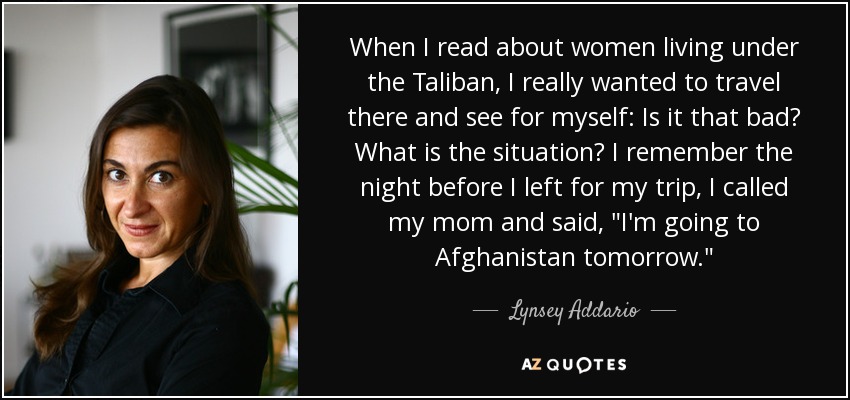
When I read about women living under the Taliban, I really wanted to travel there and see for myself: Is it that bad? What is the situation? I remember the night before I left for my trip, I called my mom and said, "I'm going to Afghanistan tomorrow."
I can't imagine how Afghanistan's fall isn't going to be ten times faster than Iraq's.
In a place like Afghanistan where the society is completely segregated, women have access to women. Men cannot always photograph women and cannot get the access that I get.
The warlords took part in atrocities during the civil war in Afghanistan. They looted, they raped, they killed. They have become incredibly empowered and entrenched. They live in mansions, they have jobs in the government, and they're incredibly powerful. In Kabul, people don't want to speak about it too publicly, because these people are essentially like Tony Soprano.
As a filmmaker coming from one of the youngest lands in the world, New Zealand - safe, green and democratic - I was intrigued by Afghanistan, with its literature and poetry, its old land and its deep history.
It might sound crazy, but filming in a conflict zone, in Afghanistan, and being a female filmmaker was the easy part. I found people open and understanding of the importance and beauty of filmic storytelling. I never had to explain why Jake Bryant, my Director of Photography, and I were climbing up a ladder to get a high shot, or running ahead to get an arrival shot, or filming weeks after weeks, months after months, collecting so much material. The process was respected and honored.
People say the war in Iraq is a bad war, and the war in Afghanistan is a good war, but what's the difference between them? Democratic people around the world cannot accept that this is a good war. This is just endless war.
In those years,'80 was the, at the turn of '79/'80 you had the invasion of Afghanistan. It was the period in which the Americans attempt to liberate, to, to liberate the hostages in Iran and all these, all these things, the atmosphere was freezing - boycott of the Olympic Games and all that.
I remember, on the medevac helicopter, I said to myself, "I am not f - - g dying in Afghanistan." People talk about having flashbacks; I began having flash-forwards. I began thinking of all the things I still wanted to do.
There're some places that are more difficult or dangerous to navigate and I wouldn't look forward to going back. Like I'd much rather go back to Afghanistan - which fascinates me - quicker than I'd go back to spend a week walking around Nairobi, Kenya, which is a great and easy way to get yourself killed.
As far as Iraq, the important thing is that the Taliban is gone in Afghanistan, three-quarters of the al-Qaida leadership is either dead or in jail, and we now have Saudi Arabia working with us, Pakistan working with us.
The most dangerous thing I've ever encountered was a run-in with Boko Haram around 2007 in a small town in Nigeria. I got caught along with the photographer I was working with, the same one I worked with on the Afghanistan book, Seamus Murphy. We were caught in an attack by a mob after Friday prayers. And the level of violence was so extreme. It was more violent than any other mob violence I have ever seen.
I had earlier concluded that a war with Iraq would be a distraction from the successful and expeditious completion of our aims in Afghanistan. Now I had come to question whether the White House was telling the truth.
We ought to recognize that we have an offensive responsibility to take the war to the terrorists where they are. That responsibility has waned in the last year as military and intelligence resources were withdrawn from Afghanistan and Pakistan to be used in Iraq.
Bin Laden was, though, a product of a monumental miscalculation by western security agencies. Throughout the 80s he was armed by the CIA and funded by the Saudis to wage jihad against the Russian occupation of Afghanistan. Al-Qaida, literally "the database", was originally the computer file of the thousands of mujahideen who were recruited and trained with help from the CIA to defeat the Russians.
A democratic and stable Iraq and Afghanistan are essential to our broader efforts to make no place safe for terrorists and to win the War on Terrorism.
We are so appreciative of the men and women in uniform who are protecting us, whether in Afghanistan or Iraq or on ships around the world. For our security, they are taking the offensive to the terrorists overseas.
It's always a mistake for writers to key their submissions to world events, because they move so quickly and unpredictably, as has certainly proven the case in Afghanistan.
Let us also reflect on the honorable service of our men and women of the U.S. Armed Forces currently serving our country overseas in Iraq and Afghanistan, and around the world.
From the War for Independence to today in Iraq and Afghanistan, I am inspired by the courage, professionalism and patriotism of our men and women in uniform.
From 2001 to 2012 at least 6,410 women were murdered by an intimate partner using a gun. That`s more than the number of U.S. troops killed in action in the wars in Iraq and Afghanistan combined.
I was in Afghanistan and then obviously in Iraq. And I realized that you can't control life. You can do a lot to prepare. You can train, and at the end of the day there's an element that's always going to be beyond your control.
Yes and no. Because America has only about 1 percent of the population serving in the military, it is hard for many civilians to understand the sacrifices military families make. However, my experience is that after the Vietnam War, the public learned that they should support the military whether or not they support the war. You've seen that outpouring of support for the veterans of both Iraq and Afghanistan.
The president made clear when he was a candidate for this office and when he took this office, that unfortunately prior to his taking office, because of the focus on Iraq, and the U.S. efforts there, that the original war, if you will, in Afghanistan had been neglected, the strategy there was unclear, and that it was not properly resourced.
The U.S. couldn't play a military role in different areas like Iraq and Afghanistan without huge quantities of oil. So a shortage or disruption in oil would not only damage the U.S. economy; it would undercut American military supremacy.
Follow AzQuotes on Facebook, Twitter and Google+. Every day we present the best quotes! Improve yourself, find your inspiration, share with friends
or simply: