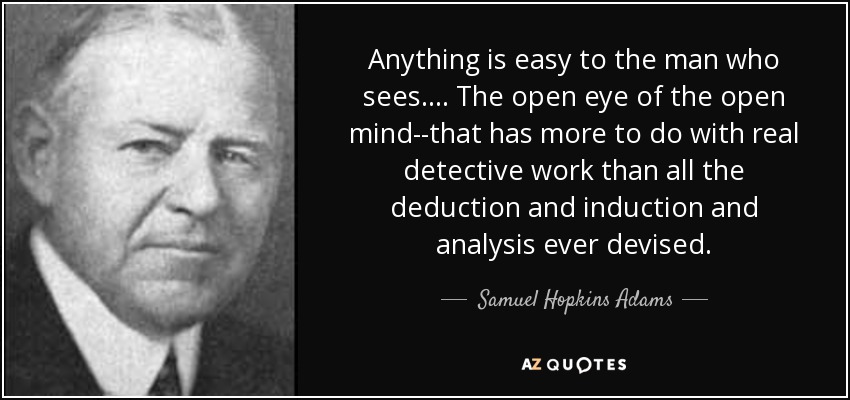
Anything is easy to the man who sees.... The open eye of the open mind--that has more to do with real detective work than all the deduction and induction and analysis ever devised.
Mathematical Analysis is... the true rational basis of the whole system of our positive knowledge.
This is a serious analysis of a ridiculous subject, which is of course the opposite of what is usual in economics.
Western civilization presents one of the most difficult tasks for historical analysis, because it is not yet finished, because we are a part of it and lack perspective, and because it presents considerable variation from our pattern of historical change.
To know is not too demanding: it merely requires memory and time. But to understand is quite a different matter: it requires intellectual ability and training, a self conscious awareness of what one is doing, experience in techniques of analysis and synthesis, and above all, perspective.
It would be naïve to imagine that any analysis of experience is dependent on pattern expressed in language. Any concept, whether or not it forms part of the system of grammatical categories, can be conveyed in any language. If a notion is lacking in a given series, it implies a different configuration and not a lack of expressive power.
The assertion fallacy is the fallacy of confusing the conditions for the performance of the speech act of assertion with the analysis of the meaning of particular words occurring in certain assertions.
Changing behavior is less a matter of giving people analysis to influence their thoughts than helping them to see a truth to influence their feelings.
Mathematical analysis is as extensive as nature itself; it defines all perceptible relations, measures times, spaces, forces, temperatures:;; this difficult science is formed slowly, but it preserves every principle which it has once acquired; it grows and strengthens itself incessantly in the midst of the many variations and errors of the human mind. It's chief attribute is clearness; it has no marks to express confused notations. It brings together phenomena the most diverse, and discovers the hidden analogies which unite them.
The effects of heat are subject to constant laws which cannot be discovered without the aid of mathematical analysis. The object of the theory is to demonstrate these laws; it reduces all physical researches on the propagation of heat, to problems of the integral calculus, whose elements are given by experiment. No subject has more extensive relations with the progress of industry and the natural sciences; for the action of heat is always present, it influences the processes of the arts, and occurs in all the phenomena of the universe.
Art is precisely that condition which pertains when, after all analysis and reduction to parts has taken place, there remains a 'quality' which is more than the sum of those parts, which could not exist in any other form, and which cannot be caught, or held, or contained.
In all the talk in the Principles (as opposed to the formal analysis) it is not the saving of rentiers but the energy of entrepreneurs which governs accumulation.
Inevitably I came to associate any wine I met with a specific place and a particular slant of history. I learned to perceive more than could be deduced from an analysis of the physical elements in the glass. For me, an important part of the pleasure of wine is its reflection of the total environment that produced it. If I find in a wine no hint of where it was grown, no mark of the summer when the fruit ripened, and no indication of the usages common among those who made it, I am frustrated and disappointed. Because that is what a good, honest wine should offer.
History teaches us that a given view has been abandoned in favor of another by all men, or by all competent men, or perhaps by only the most vocal men; it does not teach us whether the change was sound or whether the rejected view deserved to be rejected. Only an impartial analysis of the view in question, an analysis that is not dazzled by the victory or stunned by the defeat of the adherents of the view concerned - could teach us anything regarding the worth of the view and hence regarding the meaning of the historical change.
To avert the danger [posed by theory] to life, Nietzsche could choose one of two ways: he could insist on the strictly esoteric character of the theoretical analysis of life - that is, restore the Platonic notion of the noble delusion - or else he could deny the possibility of theory proper and so conceive of thought as essentially subservient to, or dependent on, life or fate... If not Nietzsche himself, at any rate his successors [Heidegger] adopted the second alternative.
I think it's perfectly OK to exploit the moon. Largely for two reasons: there's no life there, and it is close enough and rich enough in resources to be economically useful to Earth. In the final analysis, everything we do in space, if it does not help the people of Earth, all the people, it's not going to happen.
The virtual suppression of ethical discussion after 1845 produces the semblance of purely descriptive analysis, dressed in the mantle of positivist objectivity, analysis which is, in fact, strung to a framework of crude, because unexplicated, moral assumptions.
Lost in the barrage of images and self-serving analysis are the economic and social causes of the conflict.
In the final analysis, we count for something only because of the essential that we embody. If we do not embody that, life is wasted.
The opposition of instinct and reason is mainly illusory. Instinct, intuition, or insight is what first leads to the beliefs which subsequent reason confirms or confutes; but the confirmation, where it is possible, consists, in the last analysis, of agreement with other beliefs no less instinctive. Reason is a harmonizing, controlling force rather than a creative one. Even in the most purely logical realms, it is insight that first arrives at what is new.
Dostoevsky's visible world was a world of sensationalism. He may in the last analysis be a great mystic or a great psychologist; but he almost always reveals his genius on a stage crowded with people who behave like the men and women one reads about in the police news.
The belief that value judgments are not subject, in the last analysis, to rational control, encourages the inclination to make irresponsible assertions regarding right and wrong or good and bad. One evades discussion of serious issues by the simple device of passing them off as value problems, whereas, to say the least, many of these conflicts arose out of man's very agreement regarding values.
Michael made his debut in John Carpenter's 1978 horror classic, Halloween, possibly the best scare movie to come along in the last twenty-five years. With the release of the sixth (and hopefully final) movie to bear the Halloween moniker, we see how far the mighty have fallen. In the final analysis, The Curse of Michael Myers is a horrific motion picture just not in the way the film makers intended.
Graphology is another in a long list of quack substitutes for hard work. It is appealing to those who are impatient with such troublesome matters as research, evidence analysis, reasoning, logic, and hypothesis testing.
Whole great chunks of written history are of little value to the psychohistorian, while other vast areas which have been much neglected by historians - childhood history, content analysis of historical imagery, and so on - suddenly expand from the periphery to the center of the psychohistorian's conceptual world, simply because his or her own new questions require material nowhere to be found in history books.
Follow AzQuotes on Facebook, Twitter and Google+. Every day we present the best quotes! Improve yourself, find your inspiration, share with friends
or simply: