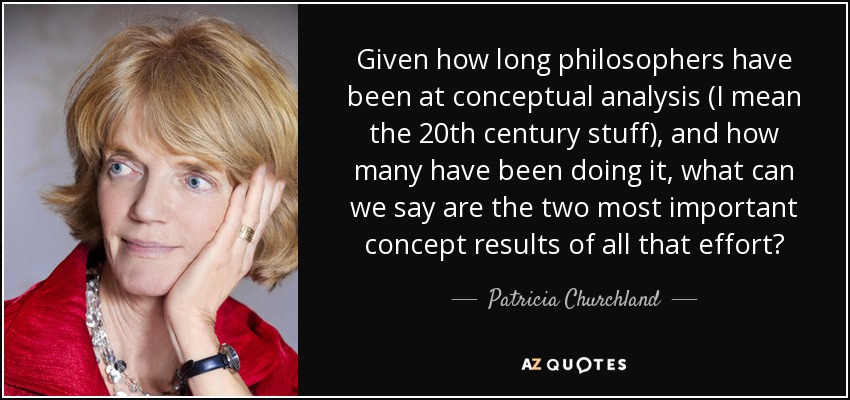
Given how long philosophers have been at conceptual analysis (I mean the 20th century stuff), and how many have been doing it, what can we say are the two most important concept results of all that effort?
I made the assumption, wrong of course, that conceptual analysis was a brief preliminary on the road to finding out about the nature of free will, consciousness, the self, the origin of values, and so forth.
Living in the world of the workshop, which I do as a teacher, you have to be articulate about craft. And that often involves imposing analysis on work that's in a pretty raw state.
"There is no analysis here," the most brutal of them wrote. Now I wonder if my papers lacked critical thought, or if it was really more about my inability/refusal to write in the convoluted style that they wanted me to. I remember the initial shock upon reading my peers' papers. I seriously could not understand them, and I couldn't understand why the writing had to be so unclear in order to be considered smart.
Buddhist epistemologists do argue that rational analysis leads to the conclusion that rational analysis cannot give us infallible access to truth, including that one. That's not self-defeating, though; it only induces an important kind of epistemic humility and a clearer view of what we do when we reason. We engage in one more fallible human activity among many.
Since substance is infinite, the universe as a whole, i.e., god, Hegel is telling us that philosophy is knowledge of the infinite, of the universe as a whole, i.e, god. You cannot get more metaphysical than that. I think that Hegel scholars have to admit this basic fact rather than burying their heads in the sand and trying to pretend that Hegel is concerned with conceptual analysis, category theory, normativity or some such contemporary fad.
I view myself in the narrowest possible terms, but I don't watch anything I've been in, and I don't read reviews or analysis of movies I've been in, or my plays.
I saw brilliant ideas coming out of the [Chipko] movement that needed better articulation, that needed elaboration and systematic analysis. I just followed that and it's been very exciting.
I believe that the visit of the Queen to the United States is an admirable occasion to produce an historical, truthful, sincere, genuine analysis of how the British Monarchy evolved into its present situation.
Because I am so intensely identified with opinion and analysis and contextualization, I think I just need, for my own psychological benefit, a small island in which I can stand and say, 'I'm going to sit this one out.'
When philosophers try to understand consciousness, much of what they claim is not conceptual analysis at all, though it may be shopped under that description.
I was told over and over the poetry in forms was "conservative" but there was no analysis of why this was so.
As far as Marx's analysis of capitalism, there's a lot of very useful ideas in it, but he's developing an abstract model of 19th century capitalism. It's abstract and it's changed.
I had the analysis of a million or so SNPs [single nucleotide polymorphisms] just to see what was there. That's partly because I was writing a book about DNA and personalized medicine and I thought it would be a little bit disingenuous to talk about what could be done without actually having the experiment done on yourself.
The Logos was both that which thought, and the thing which it thought: thinker and thought together. The universe, then, is thinker and thought, and since we are part of it, we as humans are, in the final analysis, thoughts of and thinkers of those thoughts.
A silly comedy needs a straight guy, and that guy needs to be as straight as possible. The moment you start playing straight you're not straight anymore, you're bent straight, so it really requires the usual serious, straight-forward analysis and research, looking into it and finding the dramatic function, all of what you do until you feel you've collected enough points to safely and securely play the part.
I find that an entertainer is quite content to sit still, and I think an artist always has a little motion, always going somewhere. May not know where it is, but there is some sort of unnamed destination. There is some pulling, some movement. So I just found myself in that category according to my own analysis.
I'm a curious guy. I can't turn away from an investigative story, when it comes to the forensic analysis. I've done 33 dives, to the titanic wreck site. I've spent over 50 hours piloting robotic vehicles at that wreck trying to piece together what happened during the disaster. How the ship broke up, comparing the historical record with the forensic record. Documentaries are kind of my new life. I love documentary filmmaking.
I have a profound passion for the act of flying. It's very freeing, with an intense physicality, but it also gives an Olympian, god's-eye view, which fuels a larger cerebral and structural analysis.
There's only one critic whose opinion I really value, in the final analysis: Johnny Carson. I have never needed any entourage standing around bolstering my ego. I'm secure. I know exactly who and what I am. I don't need to be told. I make no apologies for being the way I am.
God is known by many names. And in the last analysis God's names were as many as human beings.
Take away material prosperity; take away emotional highs; take away miracles and healing; take away fellowship with other believers; take away church; take away all opportunity for service; take away assurance of salvation; take away the peace and joy of the Holy Spirit... Yes! Take it all, all, far, far away. And what is left? Tragically, for many believers there would be nothing left. For does our faith really go that deep? Or do we, in the final analysis, have a cross-less Christianity?
I'm trying to teach people of all ages to, number one: how to criticize, how to offer creative analysis on top of that, how to try to build things in a new direction and how to compliment people when the thing gets done.
Regression analyses show that self-efficacy contributes to achievement behavior beyond the effects of cognitive skills
In the last analysis, then, we believe that we all know and think about and talk about the same world because we believe our PERCEPTS are possessed by us in common
Follow AzQuotes on Facebook, Twitter and Google+. Every day we present the best quotes! Improve yourself, find your inspiration, share with friends
or simply: