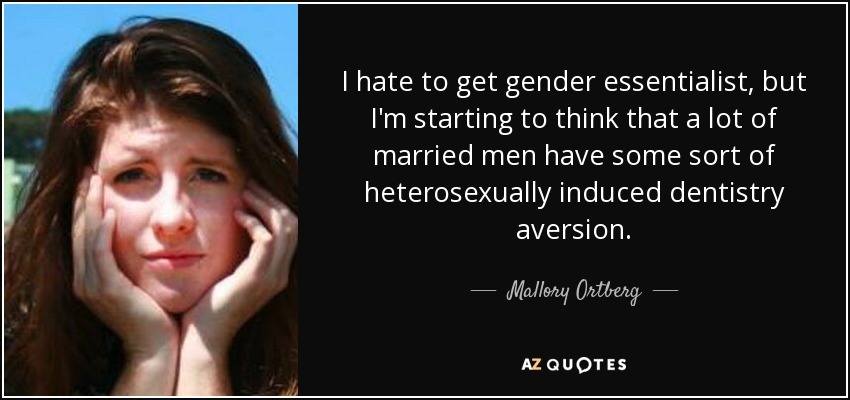
I hate to get gender essentialist, but I'm starting to think that a lot of married men have some sort of heterosexually induced dentistry aversion.
Aversion is a form of bondage. We are tied to what we hate or fear. That is why, in our lives, the same problem, the same danger or difficulty, will present itself over and over again in various prospects, as long as we continue to resist or run away from it instead of examining it and solving it.
I have an aversion to conformity.
The church is an organisation that institutionalises an aversion to homosexuality, it institutionalises gender inequality and it speaks from a place of teaching people being ashamed of their sexuality.
The aversion to lying is often a hidden ambition to render our words credible and weighty, and to attach a religious aspect to our conversation.
I have a real aversion to sentimentality, but I also really want to write about love and friendship.
Deeply buried in the mind, there lies a mechanism that accepts what the mind experiences as beautiful and pleasant and rejects those experiences that are perceived as ugly and painful. This mechanism gives rise to those states of mind that we are training ourselves to avoid-- things like greed, lust, hatred, aversion, and jealousy.
Every moment think steadily as a Roman and a man to do what thou hast in hand with perfect and simple dignity, and feeling of affection, and freedom, and justice; and to give thyself relief from all other thoughts. And thou wilt give thyself relief, if thou doest every act of thy life as if it were the last, laying aside all carelessness and passionate aversion from the commands of reason, and all hypocrisy, and self-love, and discontent with the portion which has been given to thee.
Value investing is risk aversion.
Success breeds conservatism, and that means a love affair with the status quo and an aversion to change.
Pleasure is our first and kindred good. It is the starting point of every choice and of every aversion, and to it we always come back, inasmuch as we make feeling the rule by which to judge of every good thing.
There is a decided prejudice on the part of the general public against being piloted by a woman, and as great an aversion, partially because of this, by executives of those companies whose activities require employing pilots.
Moral philosophy is nothing else but the science of what is good, and evil, in the conversation, and society of mankind. Good, and evil, are names that signify our appetites, and aversions; which in different tempers, customs, and doctrines of men, are different.
The concept of loss aversion is certainly the most significant contribution of psychology to behavioral economics.
Beneath it all, desire of oblivion runs: Despite the artful tensions of the calendar, The life insurance, the tabled fertility rites, The costly aversion of the eyes from death- Beneath it all, desire of oblivion runs.
Some things are up to us [eph' hêmin] and some things are not up to us. Our opinions are up to us, and our impulses, desires, aversions–in short, whatever is our own doing. Our bodies are not up to us, nor are our possessions, our reputations, or our public offices, or, that is, whatever is not our own doing.
My high-tech aversion caused me to make fun of the typical biotech enterprise: $100 million in cash from selling shares, one hundred Ph.D.'s, 99 microscopes, and zero revenues.
My only supporter and comrade-in-arms was Georg Helm, who had endeavored to formulate an energetic conception of science before me and had presented his results in a treatise [Die Lehre von der Energie] exhibiting great independence of thought. But we were separated by his aversion to a realistic conception of energy. Consequently, each of us considered the other only a half ally, toward whom an attitude of caution was necessary.
The mind spends most of the time lost in fantasies and illusions, reliving pleasant or unpleasant experiences and anticipating the future with eagerness or fear. While lost in such cravings or aversions, we are unaware of what is happening now, what we are doing now.
All experience and phenomena are understood to be a dream, this should not be just an intellectual understanding, but a vivid and lucid experience...Genuine integration of this point produces a profound change in the individual's response to the world. Grasping and aversion is greatly diminished, and the emotional tangles that once seemed so compelling are experienced as the tug of dream stories, and no more.
Each [of my wives] was jealous and resentful of my preoccupation with business. Yet none showed any visible aversion to sharing in the proceeds.
I have an aversion to being mislabeled. Here's a label I'd accept: I'm an 'individual.' I'm someone who can't follow, and doesn't want to lead.
I have a congenital aversion to failure.
Genuine recollections almost invariably explain oneself to oneself. Suppose, for example, that you feel an instinctive aversion to some particular kind of wine. Try as you will, you can find no reason for it. Suppose when you explore a previous incarnation, you remember you died by a poisoned administered in a wine of that kind, your aversion is explained by the proverb: 'A burnt child dreads the fire.'
Those of us forced to read the London papers sometimes speculate about which is greater: the average British hack's sloth, mendacity, ignorance, obsequiousness, capacity for drink, or aversion to paying for that drink. Smart money tends to split between the latter two.
Follow AzQuotes on Facebook, Twitter and Google+. Every day we present the best quotes! Improve yourself, find your inspiration, share with friends
or simply: