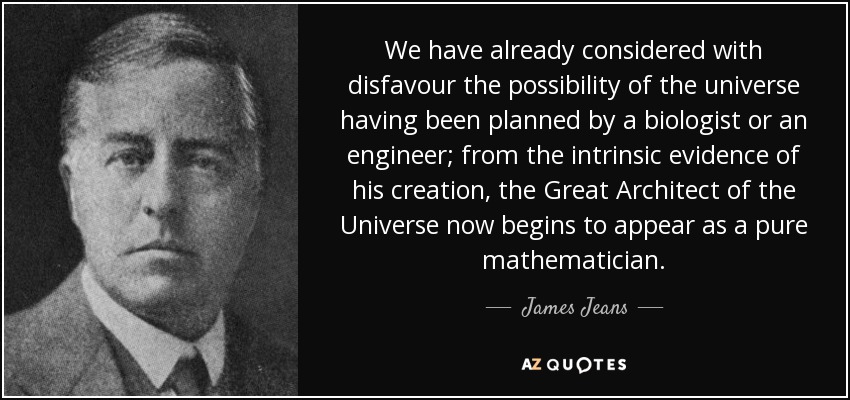
We have already considered with disfavour the possibility of the universe having been planned by a biologist or an engineer; from the intrinsic evidence of his creation, the Great Architect of the Universe now begins to appear as a pure mathematician.
By profession a biologist, [Thomas Henry Huxley] covered in fact the whole field of the exact sciences, and then bulged through its four fences. Absolutely nothing was uninteresting to him. His curiosity ranged from music to theology and from philosophy to history. He didn't simply know something about everything; he knew a great deal about everything.
I suspect the reason is that most people [...] have a residue of feeling that Darwinian evolution isn't quite big enough to explain everything about life. All I can say as a biologist is that the feeling disappears progressively the more you read about and study what is known about life and evolution. I want to add one thing more. The more you understand the significance of evolution, the more you are pushed away from the agnostic position and towards atheism. Complex, statistically improbable things are by their nature more difficult to explain than simple, statistically probable things.
Evolutionary biologists have been able to pretend to know how complex biological systems originated only because they treated them as black boxes. Now that biochemists have opened the black boxes and seen what is inside, they know the Darwinian theory is just a story, not a scientific explanation.
There is nothing in biology yet found that indicates the inevitability of death. This suggests to me that it is not at all inevitable and that it is only a matter of time before biologists discover what it is that is causing us the trouble.
The hold of the evolutionary paradigm is so powerful that an idea which is more like a principle of medieval astrology than a serious twentieth century scientific theory has become a reality for evolutionary biologists.
It is understood that nonhuman creatures adapt to their places or they don't live. And for some reason that I can't figure out, even the biologists have excused our own species from that obligation. I think there's going to be a biological penalty to be paid for that eventually.
We naturally assume that our mental structures are universal. But I suppose an outside biologist looking at us would see something very different. He would see that, like other organisms, we have a narrow sphere within which we are very good, but that sphere is very limited. And that, in fact, the very achievements we can have within that sphere are related to lack of achievements in other spheres.
For us, we are all very different, our languages are very different, and our societies are very different. But if we could extract ourselves from our point of view and sort of look down at human life the way a biologist looks at other organisms, I think we could see it a different way.
Life, individual or collective, personal or historic, is the one entity in the universe whose substance is compact of danger, of adventure. It is, in the strict sense of the word, drama. The primary, radical meaning of life appears when it is employed in the sense not of biology, but of biography. For the very strong reason that the whole of biology is quite definitely only a chapter in certain biographies, it is what biologists do in the portion of their lives open to biography.
If I wasn't a writer, I don't know what I'd be. Probably a marine biologist or something.
Frogs will eat red-flannel worms fed to them by biologists; this proves a great deal about both parties concerned.
It gives evolutionary biologists great status if they champion competition and the economists have to consult them. The economists have to consult the evolutionary biologists, because they are the ones who invented the idea of competition. It comes from the field of evolution.
I'm a biologist, so... Which I think should be mandatory. Biology should be mandatory. Mathematics? They say we don't know enough about math and science. Well we don't know enough about science and particularly biology, which is such a huge field.
I've always been very aware of environment. When I was a kid I wanted to be a marine biologist until I realized I hated being underwater. I think a lot of that came from traveling and seeing the levels of waste produced by so many factories around the world.
There is not a moral to every story in animal behavior. Sometimes a snake is just a snake, and sometimes snake sex is only about sex in snakes, or sex in egg-laying reptiles. Although a biologist's job in part is to interpret what organisms do in a broader context, that context does not, and should not, need to include a lesson for human beings. This is true regardless of whether the lesson is something we would like to teach, which means that using animals as vehicles for nonsexist thinking is just as out of bounds as using them to keep women barefoot and pregnant.
Dawkins asserts that final causes and design don't really exist. Unguided evolution explains it all. Francis Crick thought the same thing but was afraid people would be misled by what they actually saw. So he issued this warning: "Biologists must constantly keep in mind that what they see was not designed, but rather evolved." What? A warning to ignore the obvious? Absolutely. Because if we don't ignore the obvious, we might be tempted to follow common sense and attribute the "appearance" of design to actual design.
There was an op-ed piece in The New York Times by an evolutionary biologist or somebody - which was a curious place for the opinion to come from - and he said that there's no such thing as a completely free, uncensored medium, that people censor themselves all the time, in deference to hurting other people's feelings, or offending other groups, or in their own, not to provoke a fight. And you do self-censor certain things, and it's not necessarily a bad thing. That's just the way human social interaction works.
You have to realize the truth of biologist Julian Huxley's idea that 'Life is just one damn relatedness after another' "So you must have the models, and you must see the relatedness and the effects from the relatedness.
You need some reason why Beethoven, Mozart and Haydn in the 18th century all flocked to Vienna. What was it about Vienna? They must have known on some level that that is where they would flourish. It's what biologists call "selective migration."
A certain kind of methodologically-minded philosopher of science is quick to read off metaphysical conclusions from features of scientific practice. Chemists don't derive their laws from fundamental physics, so reductive physicalism must be false. Biologists refer to natural numbers in some of their explanations, so numbers must exist. I think that this kind of thing makes for bad philosophy.
Evolutionary biologists often appeal to parsimony when they seek to explain why organisms "match" with respect to a given trait. For example, why do almost all the organisms that are alive today on our planet use the same genetic code? If they share a common ancestor, the code could have evolved just once and then been inherited from the most recent common ancestor that present organisms share. On the other hand, if organisms in different species share no common ancestors, the code must have evolved repeatedly.
Evolutionary biologists often avoid using the term "race" because there is so much racist baggage that comes with the term. However, they are often okay with the idea that the genealogy of human groups within our species can sometimes be inferred in much the same way as the genealogy of different species.
I think one of the things we learned from the physicists and also the theoretical biologists is the idea that when you're dealing with very complex systems you're going to get a large variety of behavior which can be interpreted as hill climbing, but hill climbing with a lot of modifications, hill climbing with big jumps occasionally.
Having been brought up among the biologists and having followed various debates about ways to improve the human template and other debates about the true nature of our nature, I began seriously to wonder: What if? We hold in our hands a tool that is more powerful - for good or ill - than any we have wielded before.
Follow AzQuotes on Facebook, Twitter and Google+. Every day we present the best quotes! Improve yourself, find your inspiration, share with friends
or simply: