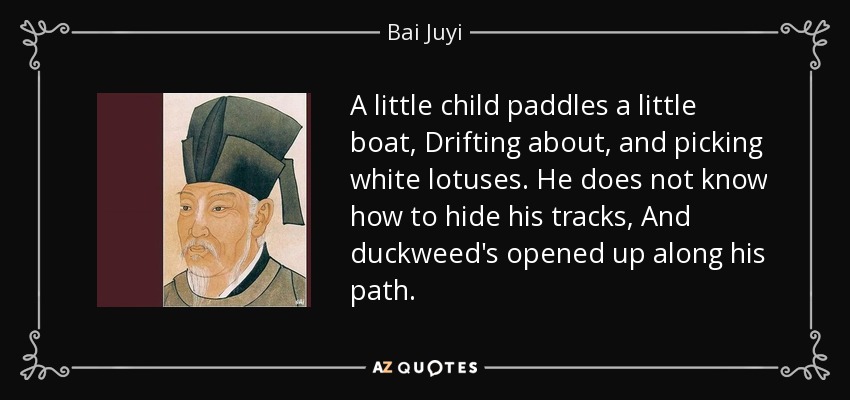
A little child paddles a little boat, Drifting about, and picking white lotuses. He does not know how to hide his tracks, And duckweed's opened up along his path.
Scientists who do deny their politics—who claim to be objective and unemotional about gender while living in a world where even boats and automobiles are identified by sex—are fooling both themselves and the public at large.
Even through you and I are in different boats, you in your boat and we our canoe, we share the same river of life. What befalls me befalls you. And downstream, downstream in this river of life, our children will pay for our selfishness, for our greed, and for our lack of vision.
A thousand hills, but no birds in flight, Ten thousand paths, with no person's tracks. A lonely boat, a straw-hatted old man, Fishing alone in the cold river snow.
My God, look at the size of this man! Quick! Tell the other villagers we're going back to the boats!
On June 14, 1998, I pushed off under quiet gray skies from Nags Head, N.C, in the American Pearl, a 23 foot long boat made of plywood and fiberglass. I planned to row 3,637 miles across the North Atlantic to France. I was alone. There were no chase vessels. No one planned to drop food or equipment to me along the way. The physical goal was easy to explain: I was attempting to do something no American and no woman had ever done - to row solo across an ocean.
When you are rowing well and hard, the rhythm of the stroke takes over. It drives your days and restores your nights. It imparts cadence and direction. You feel like you and the boats are one, you feel that no obstacle will put up any more resistance than the water does to your oars, you feel that hard work and grit and mental toughness will always win it for you in the end.
A boat is the hardest think I know of to put into perspective. It is so much like a human figure, there is something alive about it.
The feel of a good row stays with you hours afterward. Your muscles glow, your mind wanders from the papers on you desk and goes back, again and again, to that terrific power piece at the end of the workout when it felt as if you and the boat were flying, as if you legs were two cannons and your arms were two oars and the great lateral muscles of your back were pterodactyl wings and the brim of your baseball cap was a harpoon.
[He] would drive his sculling boat through mile after mile, in a silent brutal programe of conditioning - he would work all alone, at first light, punishing himself without mercy. His was the private dignity of the lone athlete, with a grim purpose, fighting a solitary war with himself, toward a goal only he can see.
Unless you've also had some experience dragging around a boat trailer, [topping off the gas tank] may not sound important. But trailer driver's know: a gas stop can be a traumatic experience. You need enough clearance on every possible side. You can't cut the turn too sharp or you'll clip the gas pump. Getting back on the freeway can be as challenging as sending a man to the moon.
The slow boat-I know it's the slow boat because I've been watching them for thirty-three weeks-won the first piece by a full length. Then the fast boat won the second piece. And so it went for the next four pieces, back and forth. Conclusion: I hate seat racing.
Rigging is like Zen meditation. You must bend over the boat until your back is breaking, until your brain is filled with numbers and fractions of numbers, until you can accurately measure an oarlock's pitch without bothering to use the pitch meter. Only then will you see the way of eternal rigging happiness.
Hundreds of feet above us, cars whisked by, oblivious to our drama. Up there were the shortcuts, the excuses, the world of infinite possibilities separating man and his potential. We had four miles and the best competition in the nation. We linked hands in the boat and committed ourselves to each other.
Another boat, a straight-four, four sweep oarsmen without a coxswain, raced through our flotilla. I looked at them as they jetted past, and I quickly looked again. This boat appeared to be manned by four skeletons. Their cheek bones stood out like knots, their ribs were clearly defined as if they were painted on. Every leg and arm muscle showed as taut as steel cabling. Four pairs of deep-set eyes peered at us, conveying 'the look.' The four men who were rowing that shell were a special breed of oarsmen known as 'lightweights'.
A rower knows the underlying presence that moves a boat; it is quite simply force and energy. The force needs to be penetrating, and the energy needs to be driving and uninhibited.
To follow the drops sliding from a lifting oar, Head up, while the rower breathes, and the small boat drifts quietly shoreward.
As for me, tough duty though it may be, I continue to do my part for the commercial recreation industry. Fishing, boating, tennis, golf, running, hunting, and all of this. Horseshoes. It's tough duty. Somebody has to do it, and I'm going to keep on.
Towards thee I roll, thou all-destroying but unconquering whale... from hell's heart I stab at thee.
Our future is like that of the passengers on a small pleasure boat sailing quietly above the Niagara Falls, not knowing that the engines are about to fail.
Here in Miami, on weekends, amusement-seekers will come to the marina, set up folding chairs, and spend a highly entertaining day watching boat owners perform comical maneuvers such as forgetting to set their parking brakes and having their cars roll down the ramp and disappear, burbling gaily, below the surface.
You need to understand plant chemistry, be inured to discomfort and awesomely flexible. When something breaks down-the plane, the boat, you just have to roll with it.
It takes a minimum of six people, working in close harmony, to successfully flush a nautical toilet. That's why those old ships carried such large crews.
It was not easy victory in the America Cup. Our boys spent years experimenting with different designs for their boat before they came up with the innovative idea of having a submerged nuclear submarine tow it.
Fortunately the boat we rented had a motor in it You will definitely want this feature on your sailboat too, because if you put up the sails, the boat tips way over, and you could spill your beer.
Follow AzQuotes on Facebook, Twitter and Google+. Every day we present the best quotes! Improve yourself, find your inspiration, share with friends
or simply: