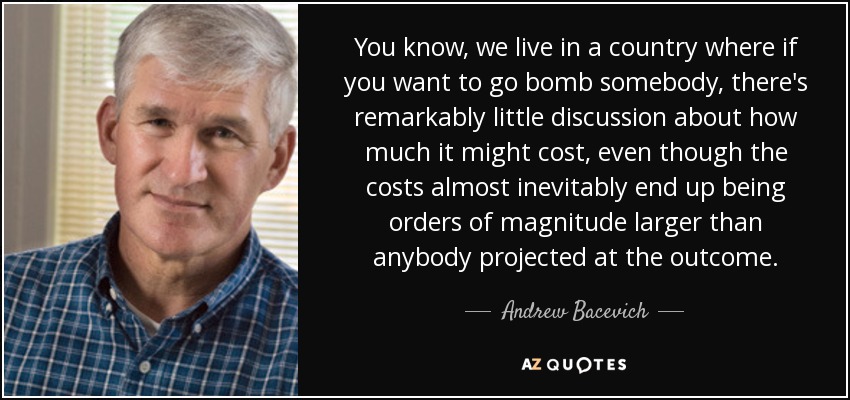
You know, we live in a country where if you want to go bomb somebody, there's remarkably little discussion about how much it might cost, even though the costs almost inevitably end up being orders of magnitude larger than anybody projected at the outcome.
You know why the French don't want to bomb Saddam Hussein? Because he hates America, he loves mistresses, and he wears a beret. He is French, people.
It has passed over mountain ranges and The waters of the seven seas. It has shown upon laborers in the fields, Into the windows of homes, And shops, and factories. It has beheld cities with gleaming towers, And also the hovels of the poor. It has been witness to both good and evil, The works of honest men and women and The conspiracy of knaves. It has seen marching armies, bomb-blasted villages And "the destruction that wasteth at noonday." Now, unsullied from its tireless journey, It comes to us, Messenger of the morning. Harbinger of a new day.
The word "now" is like a bomb through the window, and it ticks.
Of course, some will say the goal [of abolition] is a utopian dream of human perfection. We needn't worry. There will be more than enough sins left for everyone to commit after we have taken nuclear bombs away from ourselves.
There has been a transition from a nuclear-annihilation scenario to an isolated-terrorist-nuclear-bomb scenario. But we're still locked into a mind-set that nuclear war would be so overwhelming that any kind of preparedness would be futile.
We have to build bridges that are stronger than the bombs that other people might throw
To talk of atomic energy in terms of atomic bombs is like talking of electricity in terms of the electric chair.
Whether we ever get to know about them or not, there are very probably alien civilizations that are superhuman, to the point of being god-like in ways that exceed anything a theologian could possibly imagine. Their technical achievements would seem as supernatural to us as ours would seem to a Dark Age peasant transported to the twenty-first century. Imagine his response to a laptop computer, a mobile telephone, a hydrogen bomb or a jumbo jet.
When we blew the first atomic bomb at White Sands near the end of the war, nobody knew what was going to happen. There was a theory that the chain reaction would continue forever. And we would have created a little tiny sun out there in the desert that would burn until the end of the universe. It wasn't a widely held theory but it was a theory that nobody had a way of disproving. There were people who thought it wouldn't go off at all, that it would simply sit out there and melt and produce a great big dirty cloud of radioactivity. Nobody knew.
I was born in the middle of the Second World War when the United States dropped their atomic bombs in Hiroshima and Nagasaki, when millions of people were dying in concentration camps, when half the planet were colonies that belonged to empires. The word feminism didn't exist. And in my lifetime I have seen all these things improved, changed. We are more connected, more informed. We can fight against stuff together in ways we couldn't before.
I remember thinking as I was doing the jokes for the first time, "If I can hear that very clearly, I'm not hearing laughter." It just became deafening, this buzzing noise. I mean, it was brutal. It was really terrible. Then I remember thinking, "At least nobody important, or anyone who I really respect, saw that." And then literally right when I went off the stage, Jerry Seinfeld got up and went on. So I was like, "Oh great. Seinfeld saw me bomb." On the other hand, I thought, "At least no one will be thinking of me anymore. They'll just be focusing on him."
I've worked with five Presidents in America, all of them I ask the same question always: Why didn't the American allies bomb the railways going to Auschwitz?
I think if a man can create something like an atom bomb, he can surely create something with his own mind.
A religious act cannot be performed with the aid of the bayonet or the bomb.
Peace through superior violence inevitably leads to the atom bomb and all that it stands for.
The bomb-throwers have discredited the cause of freedom, in whose name they threw the bombs.
The moral to be legitimately drawn from the supreme tragedy of the bomb is that it will not be destroyed by counter bombs even as violence cannot be by counter-violence.
A bomb fell on Italy. It slid off!
Democracy never comes by the barrel of a gun, or by cluster bombs.
My fear is that that's what's going to happen with robotics and the military. Importantly, this discussion has to involve not just the scientists, but also the political scientists. It's got to be a multidisciplinary discussion. You can't have it be another repeat of what happened with the people working on the atomic bomb.
In the long term, Israel's security rests on only one pillar: the Palestinians' acceptance of the country. It isn't the atom bomb that makes Israel secure.
Growing up in the fifties, having to wear a dog tag, having to take shelter in a bomb shelter. That turned me toward the road, I did not want to live in fear of that, I was gong to work somehow against what that vision was, and what that horror was. It was poetry, art, music.
The atom bomb fueled the entire world that came after it. It showed that indiscriminate killing and indiscriminate homicide on a mass level was possible ... whereas if you look at warfare up until that point, you had to see somebody to shoot them or maim them, you had to look at them. You don't have to do that anymore.
Our enemies are fully aware that they can use oil as a weapon against America. And if we don't take this threat as seriously as the bombs they build or the guns they buy, we will be fighting the War on Terror with one hand tied behind our back.
Follow AzQuotes on Facebook, Twitter and Google+. Every day we present the best quotes! Improve yourself, find your inspiration, share with friends
or simply: