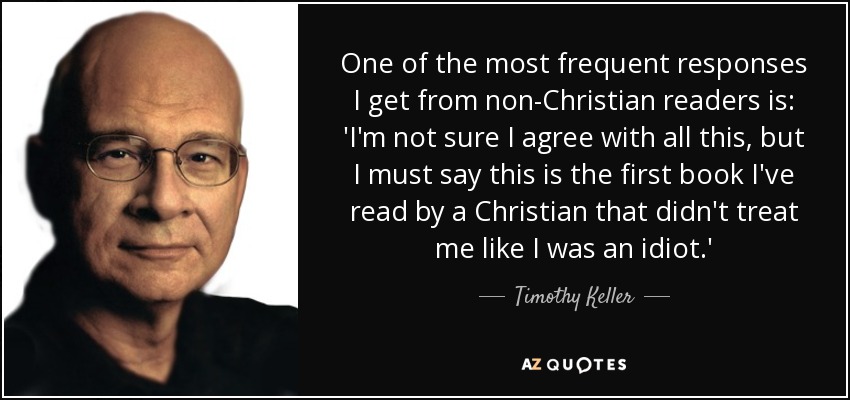
One of the most frequent responses I get from non-Christian readers is: 'I'm not sure I agree with all this, but I must say this is the first book I've read by a Christian that didn't treat me like I was an idiot.'
I love reading - inspirational books, leadership books, biographies. I exercise a lot and put on my audio book. Even If you would offer me a million dollars for my iPod I wouldn't give it to you, because I have some great things on it.
I had some friends commenting me books, but mostly it was people I didn't know. But they're fans. They're fans of the books, so they have a working knowledge of how I write, and they know what they like and what they don't like. I'm really grateful for their feedback.
When you write, you're alone in a room. And when someone reads a book, they're alone in a room, too, usually. It's a really intimate exchange. And so people ask me where I get the boldness to talk about this or that, but I didn't feel like it required any sort of courage, because I was alone. Sometimes it feels weird for people to read it.
If you have no love, do what you will - go after all the gods on earth, do all the social activities, try to reform the poor, the politics, write books, write poems - you are a dead human being. Without love your problems will increase, multiply endlessly.
Hinduism does not rest on the authority of one book or one prophet, nor does it posses a common creed like the Kalma.
Storytelling is how history is passed. It's what our ancestors did, it's what everybody's done. It has to come back into a story because otherwise, it's stuck in this book and it's boring and it's academic and I'm not against intelligence and I'm not against education, I don't want to be misunderstood, but we have tell the stories to our young people a little bit early and history gives us a lot of things.
Knowing that books are something that is hidden, that almost has that alchemical quality to it. There is a secret society in here, and if you belong to it, you'll be able to transform your lead into gold. I have that rather magical sense about books - that they do, somehow, have special powers.
Untouchability, I hold, is a sin, if Bhagavadgita is one of our Divine Books.
Fiction allows for moral questioning, but through the back door. Personally, I like books that make you think - books you're still wondering about three days after you finish them; books you hand to a friend and say "Read this, so we can talk about it."
If it was wrong to seek God in a stone, how was it right to seek Him in a book called the Gita, the Granth Sahib or the Koran?
To me the Mahabharata is a profoundly religious book, largely allegorical, in a way meant to be a historical record.
As a writer, you always read in two minds: You read as a reader and you enjoy it, and you look at it as a writer, and you just admire the architecture and the construction.
Christians remind me of schoolboys who want to look up the answers to their math problems in the back of the book rather than work them through.
The point of the Book of Job is not suffering: where is God When It hurts? The prologue (chapters 1-2) dealt with that issue. The point of the Book of Job is faith: Where is Job when it hurts?
Quit smoking in the hope of growing old. It takes a long time to write. People go to books for wisdom and older authors tend to have more of it.
The way I challenge myself is by writing something that really engages me, that doesn't have an easy answer, and isn't always an easy book to write.
I don't write the same book over and over - I think if I did that, I would stop writing. I couldn't write a series with the same character, and I couldn't write a romance novel over and over again that takes place at a different beach every year. That's not who I am.
It is always hardest for me to write a book that has kids in it close to my kids' ages. It is always hardest for me to write a book that has kids in it close to my kids' ages.
Each book is a different staging post on the writer's journey, and each book stands by itself, regardless of the writer's relationship to it.
We shall all die, and our lives will be irrelevant then. If we make anything that lasts, it outlives us, and it outlives its personal moment. All of my work is deep-dug from me, and every book has to stand or fall without me.
I learned capacity for self-reflection very early, finding it through interior monologues that books are so good at and that visual media is so bad at because it's so boring - nothing's happening. In a book, you can be inside the narrator's head for 50 pages, and nothing needs to happen. Then you learn to be inside your own head without something needing to happen. It's a very good antidote to a crazy, restless, "what's next?" culture - that you can just be in your own head and nothing is happening except that this is a rich place. I love that.
I love the apparent quiet of reading a book. You sit there; you're not really moving. It looks very solitary. It looks very boring, but actually it's the most exciting place because it's going on for you, and you're in that relationship. In that sense, it's like being with a lover. Nobody else can intrude on that space. It's the two of you. It's your own world.
It's not progress to take books off shelves. If one more person says this [ebooks] is the new Gutenberg, I will probably commit homicide, because the whole point of Gutenberg was to put books on shelves, not to take them off.
We have a generation of kids who may never see a bookshelf or never see books in houses. What are they going to think about books? How will books become meaningful in their lives except as yet another form of digitalized content? A book is not just digitalized content.
Follow AzQuotes on Facebook, Twitter and Google+. Every day we present the best quotes! Improve yourself, find your inspiration, share with friends
or simply: