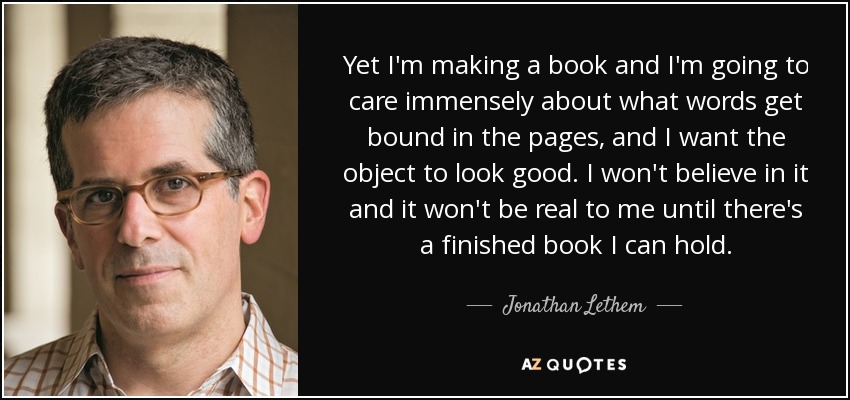
Yet I'm making a book and I'm going to care immensely about what words get bound in the pages, and I want the object to look good. I won't believe in it and it won't be real to me until there's a finished book I can hold.
The computer is the way I'm making books, but I still think about the physical properties. I visualize the length of a book, the proportions of a book, in material terms.
Whatever solidarity I have established with other writers individually, it is usually organized around books. We connected as readers, as it were, not writers.
To me, the solidarity of readers is far more important than the solidarity of writers, particularly since readers in fact find ways to connect over a book or books, whatever they may be.
Ron Karenga wrote a book back in 1968, and in that book, he said that the reason, part of his motivation for starting Kwanzaa was because he felt that Christianity was the white man religion, and he didn't like Jews, and so he made up this lie. And he called it an African holiday because he was concerned that if he didn't call it an African holiday, that black Americans would not participate in it.
Death is a big theme in the book, illness. What is that? It's a fact that human beings - no matter who they are, no matter how healthy or strong or beautiful they are - are going to age and become weak and ugly by a certain standard, and die. And I think that's a terrifying idea for people to get their minds around.
Aldous Huxley took the drug mescaline and then chronicled his experience in the book The Doors of Perception. Now, I don't actually think that's the first thing he wrote: he probably wrote 'my brain is melting' ten thousand times, but it was the book that the critics latched on to.
Community college is like a disco with books: "Here's ten dollars; let me get my learn on!"
I hate libraries for the way they put stickers on things. I don't approve of folding over pages, or of writing in books. God, forget scissors - that's beyond the pale.
I've just finished my book, I wrote it on penguins. Come to think of it, paper would have been better.
Every now and then I'll read a book, I'll be so proud of myself, I'll try and squeeze it into conversation. People will be like, "Hey Jim, how ya do-" "I read a book! Two hundred and fifty pages!" "That's great, what was it about?" "No idea! Took me three years!"
I immediately went out and bought a book on anger management. And now I have that book, and I don't know if I'll get to the book. But I'm certainly excited about the day where I can't find the book, and I get to say, 'Where the hell is my anger management book?!'
Most of my books came from when I was telling stories.
Writing is a bit like swimming. You learn writing by doing it and you learn swimming by doing it. Nobody learns how to swim by reading a book about swimming and nobody learns how to write by reading a book about writing. If you want to learn how to write, write a lot and you will get better at it.
I'd worked on a series of Chicken Soup for the Teenage Soul books called The Real Deal for HCI books, which featured essays and poems from teens.Finding the right authors for the series has been no easy feat, mostly because I'm looking for a perfect blend of a teen girl with an interesting story or hook, fantastic writing talent, and the confidence to commit to writing a 30,000+ word book in a matter of months. It's a huge commitment and I recognize that, so the fit has to be there from all these different angles.
All the authors who've ultimately published Louder Than Words memoirs have been very happy to be chosen and excited about the possibility of having their memoir published. Even though these books deal with serious, often painful, issues, in all cases the authors felt as though writing their story would be an empowering and healing experience.
All you need is the blues. To me, the blues is the book, it's the bible, it's everything.
I find Japanese books quite baffling when I read them in translation. It's only with Haruki Murakami that I find Japanse fiction that I can understand and relate to. He's a very international writer.
There are two schools. The school where you go and open a book, and then there's the school of life. When you learn hands-on, often you don't understand why you do what you do and what's the word for that action.
When I'm blogging, I think book writing is easier and vice versa. Writing is lonely work, and the good thing about blogging is that you have immediate feedback from commenters.
I get my inspiration from books, pictures, art. I might find a vintage scarf and say, "I think this should be our color palette."
Every free minute away from dance (my main focus) I was memorizing new English words, either showering, walking or on the toilet. I started reading English books even though I had very limited vocabulary.
You can't judge a book by its cover, though. People think I'm bad because I got tattoos or snort a little cocaine here and there. They think I'm a killer. But what if I wasn't a killer? Then what? Don't be tripping on me. I pay my damn taxes, OK? Chill.
I have a very big apartment in Paris but you can't really move around there anymore; piles of books everywhere. I don't want any more books. I have too many books; sometimes I have to buy another copy of a book that I know I have somewhere in my house or office because I can't find it.
Chapter books are often written in series and kids have come to expect that they'll come out once a year, so publishers want to keep the momentum going. It's the kind of art I love to make, except that the time frame is really nutty.
Follow AzQuotes on Facebook, Twitter and Google+. Every day we present the best quotes! Improve yourself, find your inspiration, share with friends
or simply: