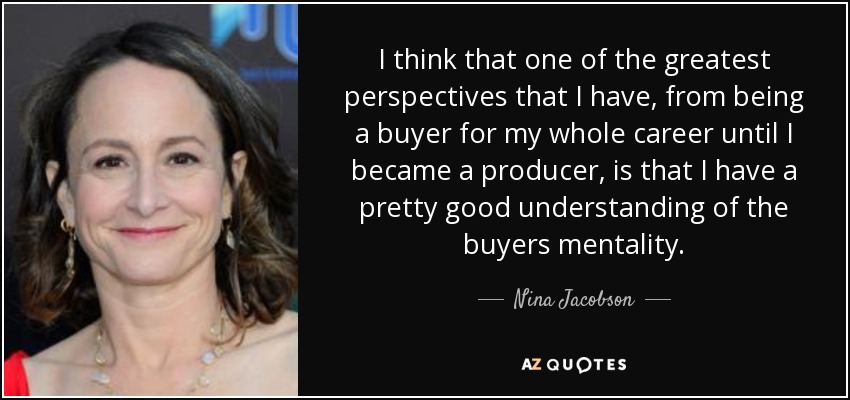
I think that one of the greatest perspectives that I have, from being a buyer for my whole career until I became a producer, is that I have a pretty good understanding of the buyers mentality.
It means eating your words, this thing of refusing to be a fence-sitter, but I'd rather eat my words than get calluses from sitting. No one who has not experienced the condescension of a buyer toward an ordinary salesgirl can have any conception of its withering effect.
Actually,the nightmarish thought occurred to me that with electronic delivery of books becoming a norm, soon writers may be expected to provide several versions of their book, ranging from the Easy to the Complex, and buyers will choose what they're in the mood for with the click of a button! I do hope not.
He who duly esteemeth Christ, is a noble bidder, and so a noble and liberal buyer.
It is our argument that a sufficiently low price can turn a security of mediocre quality into a sound investment opportunity - provided that the buyer is informed and experienced and he practices adequate diversification. For, if the price is low enough to create a substantial margin of safety, the security thereby meets our criterion of investment.
Astrology ... makes vague predictions that can always be adapted after the fact to fit observations, as we'll see. Astrologers don't seek causes at all, for a good reason: There isn't any cause to astrology. If you look for some underlying reason, some connection between the stars and planets and our lives, you won't find any. For astrology to sell, buyers must not seek out the fundamental principles behind it, because if they do they'll see that there is none.
NELL. Because that's what an employer is going to have doubts about with a lady as I needn't tell you, whether she's got the guts to push through to a closing situation. They think we're too nice. They think we listen to the buyer's doubts. They think we consider his needs and his feelings.
An honest design communicates solely the functions and values it offers. It does not attempt to manipulate buyers and users with promises it cannot keep.
Cars, toys, aspirin, meat, toasters, water - nearly every product sold has passed basic safety regulations well in advance of being marketed and sold. But consumer credit is a kind of buyer-beware, wild west. That is partly the result of history.
Each of the films, whether it’s Magic Mike or Dallas Buyers Club, was a challenge for me. I had to dig deeper. Also, my decision to shake things up came after my first child was born. I had taken nearly two years off and I thought that I would enjoy my time as a dad and wait until something interesting came along.
Entrepreneurs don't really make mistakes, though. We just make decisions that seem right at the time, but which sometimes turn out to have been the wrong path to take. For example, we allowed a buyer to place a huge opening order and later had to take some product back. We didn't have our sell-through programs in place, so in hindsight, it would have been wiser to sell in less product at the outset. The scary thing is you are always making decisions without knowing the future.
My dad was a cotton buyer and cotton buyers always considered themselves superior to the rest of the world.
When a thing is bought not for its use but for its costliness, cheapness is no recommendation. As Sismondi remarks, the consequence of cheapening articles of vanity, is not that less is expended on such things, but that the buyers substitute for the cheapened article some other which is more costly, or a more elaborate quality of the same thing; and as the inferior quality answered the purpose of vanity equally well when it was equally expensive, a tax on the article is really paid by nobody: it is a creation of public revenue by which nobody loses.
As part of our ongoing series of reports on the environment, 'America Goes Green,' we take on the question that can make otherwise competent adults quake with fear. We've all been there. You come to the end of the checkout line and then comes that question: 'Paper or plastic?' For that one brief moment, we grocery buyers are made to feel like the fate of the planet hinges on our decision.
Let's treat politicians like Twinkies. They have to disclose their ingredients - i.e., where their money is from - but beyond that, let the buyer beware.
Despite a lingering low inventory and increasing prices, consumers still have the confidence to purchase a home. More and more people recognize the many opportunities in this market and the significant value of low interest rates. As job creation and wages continue to improve, many more first-time buyers are now making the decision to become homeowners.
We will step up support for the non-commodity export sector, working more closely with potential buyers of Russian goods. We do have something to offer in the IT sphere, the nuclear power industry, aircraft manufacturing, the aerospace industry and a number of other sectors
Salesmanship consists of transferring a conviction by a seller to a buyer.
...book-buyers aren't attracted, by and large, by the literary merits of a novel: book-buyers want a good story...something that will first fascinate them, then pull them in and keep them turning the pages.
In the market economy the worker sells his services as other people sell their commodities. The employer is not the employee's lord. He is simply the buyer of services which he must purchase at their market price.
At some point the Japanese, Chinese and Saudi buyers of US and European Government bonds will see just what miserable value they offer. Then governments may have to stop all the runaway spending and bailouts and even put up interest rates.
The time will come, and probably during 2009, that the only way the U.S. will be able to fund its deficits is to create money by printing it. The Treasury will have to sell bonds, and, in the absence of foreign buyers, the Fed will have to print the money to buy them. The consequence will be runaway inflation, increasing interest rates, recession, and inevitable tax increases on all Americans.
One third of the $15 trillion of mortgages in existence in 2008 are owned, or securitized by Fannie Mae, Freddie Mac, Ginnie Mae, the Federal Housing and the Veterans Administration. Wall Street buyers of repackaged loans didn't mind buying risky paper because they assumed that they would be guaranteed by the federal government: read bailout from the taxpayers. Today's housing mess can be laid directly at the feet of Congress and the White House.
You must buy on the way down. There is far more volume on the way down than on the way back up, and far less competition among buyers. It is almost always better to be too early than too late, but you must be prepared for price markdowns on what you buy.
If an asset has cash flow or the likelihood of cash flow in the near term and is not purely dependment on what a future buyer might pay, then it's an investment. If an asset's value is totally dependent on the amount a future buyer might pay, then its purchase is speculation.
Follow AzQuotes on Facebook, Twitter and Google+. Every day we present the best quotes! Improve yourself, find your inspiration, share with friends
or simply: