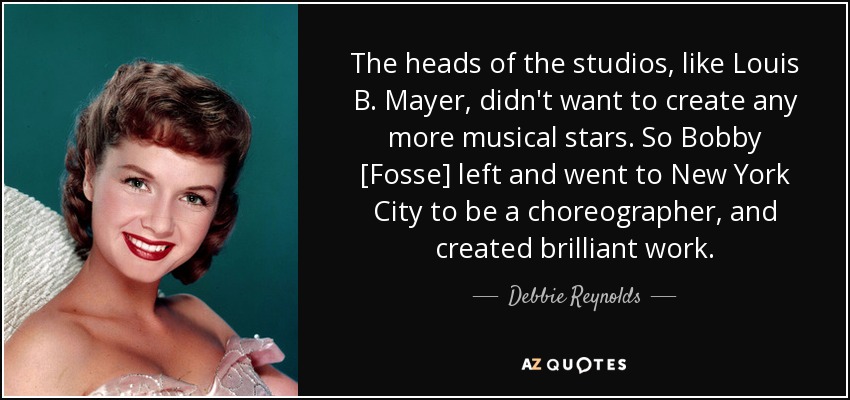
The heads of the studios, like Louis B. Mayer, didn't want to create any more musical stars. So Bobby [Fosse] left and went to New York City to be a choreographer, and created brilliant work.
I want to really stress this, I am a director, an actor, producer, action choreographer, and I'm also an investor.
The people that have inspired me the most were dancers and choreographers.
Back in the Bruce Lee era, and in my era, Kung-Fu stirred up a kind of frenzy, and many people were learning martial arts from us. But about a decade ago, Hollywood began bringing in a number of our action choreographers, including two from my own stunt crew, where they became martial arts directors. Now, a decade later, Hollywood has learned it all, so when you look at the action films they're making now, they all use our action, our martial arts, and then add to that their own technology which is ten times better than ours, and it has to leave us dumbfounded: how did they film that?
As a dancer I had worked with really hard choreographers, Jerome Robbins being the toughest. And you learned what it is to hit against a brick wall. And you learned pretty quickly to go around the wall or say, "I can't take this job."
You are not a female or a male - you are a dancer. And when I started going into choreography I became part of a team of people making movies. I wasn't a woman choreographer. I was a choreographer.
I was a choreographer in the '80s and I was doing these videos. I did an Extreme video, which was really weird having them here. I did "Get the Funk Out".
I mean, yeah, Anne Fletcher was a choreographer, but she was born to be a director. You need to have the ability to figure out people's rhythms. It all starts from the script.
Mia Michaels is to my mind one of the most interesting choreographers alive right now and my colleague and my friend from So You Think (You Can Dance).
Unlike a lot of choreographers, I don't always start with the music. I often start with a visual artist, and then find music that fits the world of that visual artist.
Now I want to become an artist, rather than one thing, like a dancer, or a movie star, or a choreographer.
You had to give, uh, a lot of consideration to the fact that, uh, the artist had to come back into the mike area and start singing, especially the background singers, you know. And you had to make sure they had a couple of bars of music in order to catch their breath. And uh, in many cases a lot of choreographers didn't give that, uh, the proper thought.
We are just at the studio, me and my choreographers, we are spending like 30 nights and we are thinking, what is my next dance move? Because in Korea there are huge expectations about my dancing. So it was a lot of pressure.
The one reason people don't take dance seriously is because a lot of choreographers don't take dance seriously.
Sure, I could give advice; I could, say, travel the world, listen to music. But all I can really say is do something you want to do and do it well. And if you want to be a choreographer, then you have to make dances.
A choreographer deals with the movement that you create, and with a creative director it's about the story, the stage, the lighting, the costuming, executing someone's idea, choosing how far to go or how little to go, and blending it so that you feel it, you're emotionally effected.
Kun-Yang Lin is a young Taiwanese choreographer with strong American modern dance roots. (His) New York debut at the Cunningham studio were notable for their craft and sturdy spirituality.
Dance in the most perishable of the arts. Ballets are forgotten, ballerinas retire, choreographers die--and what remains of that glorious production which so excited us a decade ago, a year ago, or even last night?
The choreographer cannot deliberately make a ballet to appeal to an audience, he has to start from personal inspirations. He has to trust the ballet, to let it stand on its own strengths or fall on its weaknesses. If it reaches the audience, then he is lucky that round!
Dancing was always part of my culture growing up in Barbados. When I shot my 1st video I worked really hard with my choreographer to perfect the routines.
I'm not a good choreographer: I can't remember what I put down.
Neo-Hoodoo is the 8 basic dances of 19th century New Orleans' Place Congo- the Calinda the Bamboula the Chacta the Babouille the Conjaille the Juba the Congo and the VooDoo- modernized into the Philly Dog, the Hully Gully, the Funky Chicken, the Popcorn, the Boogaloo and the dance of great American choreographer Buddy Bradley.
We must first realize that dancing is an absolutely independent art, not merely a secondary accompanying one. I believe that it is one of the great arts. . . . The important thing in ballet is the movement itself. A ballet may contain a story, but the visual spectacle . . . is the essential element. The choreographer and the dancer must remember that they reach the audience through the eye. It's the illusion created which convinces the audience, much as it is with the work of a magician.
I get into the studio and I try to make visible what's in the choreographer's mind. Sometimes a choreographer wants you to have an idea, and sometimes you are the idea.
All writers, musicians, artists, choreographers/dancers, etc., work with the stuff of their experiences. It's the translation of it, the conversion of it, the shaping of it that makes for the drama.
Follow AzQuotes on Facebook, Twitter and Google+. Every day we present the best quotes! Improve yourself, find your inspiration, share with friends
or simply: