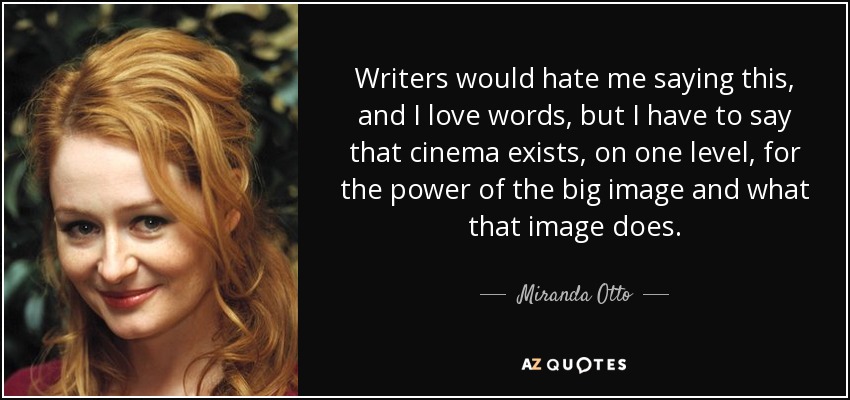
Writers would hate me saying this, and I love words, but I have to say that cinema exists, on one level, for the power of the big image and what that image does.
You don't have to be musician to listen to music, and you don't have to be a filmmaker to go to the cinema, but somehow when we think of science, we think of it only as an academic discipline.
I'm like a weird actor. I feel like I'm vastly uneducated when it comes to the cinema.
If you look at the Oscars and look at the Best Foreign Language series, you see that the films are coming from everywhere - from Quebec, Israel, Poland, and Belgium. It's not the usual French, German, etc. This category is opening up to socially engaged and political films. I think we're going to see a cross over to the main categories also. It's part of this global environment now and I'm grateful that the Academy is having this window on world cinema.
That's the funny thing about cinema, it is an intellectual medium, but it's also sort of anti-intellectual.
Blade Runner is one of my favorite films. But, so many thing influenced me that aren't science fiction because they were just good drama. I grew up watching a lot of French cinema. I was in love with The English Patient, and movies that are very romantic in nature and have a positive message. That's a large part of my fingerprint.
People go to the cinema to be moved; they wanna laugh, they wanna cry, they wanna feel something deeply, especially if they're not feeling deeply in their own lives.
Most big concerts sound disgusting and awful and insultingly bad. It's like going to the cinema and been shown a scratchy film which is upsidedown and the bulb had gone on the projector. The quality of large-scale live music is so shocking.
My cinema - the '50s, '60s - is different from the cinema today so I thought that it would not be bad to show that kind of cinema where we could dream.
When you go to the cinema you look up, when you watch television you look down.
You do remember things that people say in movies. You remember particular lines and things that are funny. But, you also remember really strong images. Images have a way of bypassing your brain and hitting you emotionally. There are so many things from movies that are remembered, that are just looks on people's faces or incredible vistas or beautiful pictures. That is a very important part of cinema.
The pay window will be: you can choose how and when you see, whether you see it on Comcast or Warner's Cable delivery system or Sky in the UK or you can buy it through Apple, or you might even buy it directly from the studio's site. Who knows? But that will be it. You'll go to the cinema and you'll find a way of digitally interacting with the piece; you'll either buy it or rent it or whatever.
I've always been a big proponent of point of view in cinema. Not necessarily that the point of view has to be subjective, but that in all great films the point of view has been taken into account and established.
I think that there's a very lucid side in cinema: entering a theater and seeing the film.
I think that I prefer to shoot characters even if they are not good people. I don't think that cinema is a place where you can do sentences like in a court.
There was a period of cinema, in the mid-90's, that I was a huge fan of, with Heat and Seven, and the Tarantino era. If I've ever been fanatical, it was about those films.
Being the director is really something. It's a statement of something and you have to stand up for that. Okay, this is what I see. This is how I see the world. This is how I see cinema. And you have to be able to talk about that and explain it and be responsible.
Jeff always says, "In the cinema, everybody goes to sci-fi. Those are the biggest movies. But, in television, nobody wants to touch it with a barge pole." It's strange. I think it's because maybe there's a legacy of television shows that depicted sci-fi in a certain way that turns off a lot of viewers, so maybe there's a negative connotation.
The Germans were much more graphical. The expressionism is much more than cinema. It was a movement with artists, painters, music and architecture, so it's really graphic and visual. And the French were something else.
Hollywood is a town; it's not a medium. And cinema is a medium you can practice anywhere.
I'm working in a form of cinema that can be described, and has been described, as a diaristic form of cinema. In other words, with material from my own life. I walk through life with my camera, and occasionally I film. I never think about scripts, never think about films, making films.
I think it’s important that nobody forgets that although Hollywood commercially dominates the world cinema, in fact what comes out of the filmmaking here is only a tiny slice out of the massive amount of operation that goes on around the world.
I was raised in a family where cinema was a way of life. It was not only about making films, it was relationship, passion, love, everything at the same time.
Cinema is gambling. It is better to gamble on a unique film even if it seems like suicide.
The cinema is there to heighten the imagination; I have always tried to make sure it does so.
Follow AzQuotes on Facebook, Twitter and Google+. Every day we present the best quotes! Improve yourself, find your inspiration, share with friends
or simply: