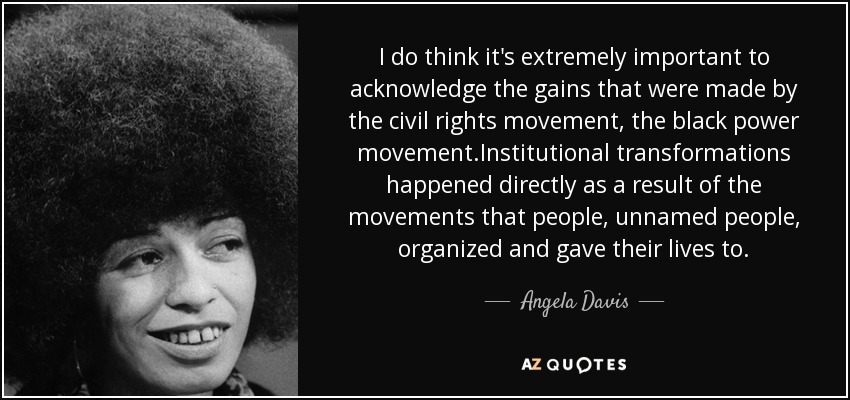
I do think it's extremely important to acknowledge the gains that were made by the civil rights movement, the black power movement.Institutional transformations happened directly as a result of the movements that people, unnamed people, organized and gave their lives to.
In college, I got interested in news because the world was coming apart. The civil rights movement, the antiwar movement, the women's right movement. That focused my radio ambitions toward news.
Many heroic things happened during slavery. And remember that there was a national movement away from it even at the time. The era of Reconstruction and then the subsequent dismantling of Reconstruction sent us in a tailspin. Then we had the Civil Rights movement. Now we have our first non-white president. We have a pattern of moving apart and then coming back together throughout the history of this country. Each time, we come closer.
The elites hate to acknowledge it, but when large numbers of ordinary people are moved to action, it changes the narrow political world where the elites call the shots. Inside accounts reveal the extent to which Johnson and Nixon's conduct of the Vietnam War was constrained by the huge anti-war movement. It was the civil rights movement, not compelling arguments, that convinced members of Congress to end legal racial discrimination.
The liberal psyche wants to protect minorities, to apologize for imperialism, colonialism, slavery, and the appalling treatment of black people during the civil rights movement. At the same time, they want to continue to defend the rights of individuals.
Obviously, In The Heat Of The Night was a landmark movie because the timing was perfect. It was in the middle of the Civil Rights Movement.
The civil rights movement didn't deal with the issue of political disenfranchisement in the Northern cities. It didn't deal with the issues that were happening in places like Detroit, where there was a deep process of deindustrialization going on. So you have this response of angry young people, with a war going on in Vietnam, a poverty program that was insufficient, and police brutality. All these things gave rise to the black power movement. The black power movement was not a separation from the civil rights movement, but a continuation of this whole process of democratization.
President Obama is a man who had certain advantages because of the civil rights movement. He had the opportunity to go to some of the best schools in this country - schools that train you how to run the political paradigm, not challenge it. The leaders of the Black Power Movement were challenging that paradigm.
Rosa Parks was primed, she had the Civil Rights Movement behind her, she didn't just decide to sit on the bus, it was strategic.
I've heard people in the Middle East tell me that the most inspiring thing for them as people struggling against dictatorship in the Middle East is the memory of the civil rights movement.
There's a pattern of the pathway opening in a certain way. We stared thinking, there's so many wonderful films about civil rights movements, but there isn't even one yet about the women's movement? It's hard to capture because it's so sprawling, and it's an ideology.
The slogan of the American Civil Rights Movement was "We shall overcome!" Donald Trump's new campaign slogan is "We shall overcomb!"
Newsman are the ones who - without them we don't have a civil rights movement, we don't have a women's movement, we don't have a Vietnam movement.
Some of the most moving experiences I've had are just in black churches in the South, during the Civil Rights Movement, where people were getting beaten, killed, really struggling for the most elementary rights.
The sad and tragic fact is that the civil rights movement, despite its honorable and courageous past, has over the years degenerated into a demagogic hustle, promoting the mindless racism they once fought against.
I think one of the tragedies of the civil rights movement was because the civil rights movement became so court-focused, I think that there was a tendency to lose track of the political and community organizing, and activities on the ground, that are able to put together the actual coalitions of power throughout which you bring about redistributive change. And in some ways, we still suffer from that.
For me, jazz will always be the soundtrack of the civil rights movement.
Now liberals compare their every riot, every traffic blockage, every Starbucks-window-smashing street protest to the civil rights movement -- which was only necessary because of them.
I think hip-hop has definitely brought the black experience to white kids more than the civil rights movement did and more than any teacher's well-intentioned lecture on Martin Luther King did.
When I speak to students about the Civil Rights Movement, I say that it is impossible to stop a determined movement that is captivating the American consciousness. I think the candidacy of Sen. Obama represents the beginning of a new movement in American political history that began in the hearts and minds of the people of this nation. And I want to be on the side of the people, on the side of the spirit of history.
The argument of those who are being criticized at any time, the civil rights movement forward, the anti-war movement forward, is, it's always outside agitators doing it.
One of the most important parts of the civil rights movement that people don't talk about was these mass meetings. It's like "Movement Church." It's a combination of the music of the movement and the church. Those mass meetings are where people got the energy to go on to the next day.
I had a fantasy as a child that I might be a writer someday. I always thought that meant you went to New York or Paris. But after that intense summer, I never thought that I wanted to live any place but Chicago. It also made me see what the stakes were in the civil rights movement. And it made me see what real hatred was like and the forms that it took. But it also made me understand how powerless ordinary people feel in their lives.
The next step has to be the necessary step. It's always to put the immigrant community and the civil rights movement ahead of partisan politics.
It was so crucial to the Civil Rights Movement that on June 23, 1963, Martin Luther King came to town, walked down Woodward Avenue with more than 100,000 people and delivered the first major public iteration of his "I Have A Dream" speech, two months before he did it in Washington.
Follow AzQuotes on Facebook, Twitter and Google+. Every day we present the best quotes! Improve yourself, find your inspiration, share with friends
or simply: