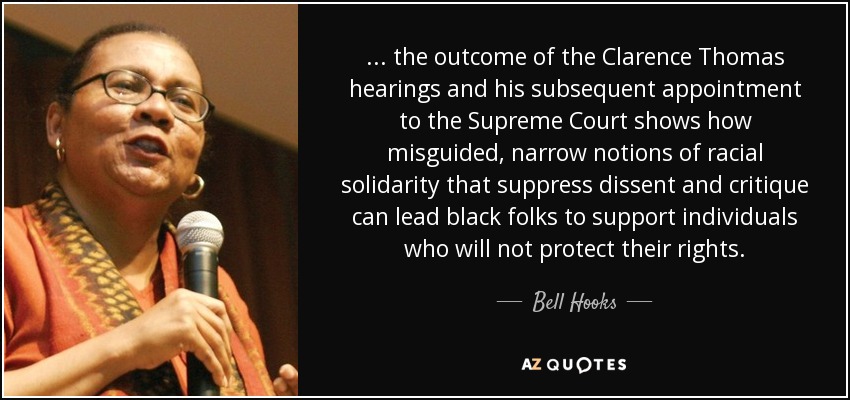
... the outcome of the Clarence Thomas hearings and his subsequent appointment to the Supreme Court shows how misguided, narrow notions of racial solidarity that suppress dissent and critique can lead black folks to support individuals who will not protect their rights.
Virtue and vice suppose the freedom to choose between good and evil; but what can be the morals of a woman who is not even in possession of herself, who has nothing of her own, and who all her life has been trained to extricate herself from the arbitrary by ruse, from constraint by using her charms?... As long as she is subject to man's yoke or to prejudice, as long as she receives no professional education, as long as she is deprived of her civil rights, there can be no moral law for her!
The whole reason for the success of Dr. King's civil-rights movement was that it was not a movement for itself. The civil-rights movement understood very clearly, and stated very beautifully, that it was a question of humanism, not a sectarian movement at all.
We know of no more crucial civil rights issue facing Congress today than the need to increase the federal minimum wage and extend its coverage.
Judge Samuel Alito was born and raised in the great state of New Jersey. Our state has a legacy of producing outstanding jurists, most notably the late William J. Brennan, who ushered in our nation's recommitment to civil rights in the latter half of the 20th century.
There was a resistance movement in the white community, and there was a determined civil rights movement by our neighbors and friends in the African-American community. They had right on their side. They conducted themselves in high standards, with courage and determination, and they were victorious. They overcame.
I've never been afraid to step out and to reach out and to move out in order to make things happen.
They don't worship at the altar of forced busing and mandatory quotas. They don't believe you can remedy past discrimination by mandating new discrimination. (Defending his nominees for Civil Rights Commission)
Black lives, of course, matter. I spent 50 years of my life fighting for civil rights and for dignity, but if you don't want me to be here, that's OK. I don't want to out-scream people.
I want some help on this. I'm being very honest, i want some ideas, as somebody who was arrested 50 years ago fighting for Civil Rights trying to desegregate schools in Chicago, who spent his whole life fighting against racism, I want your ideas. What do you think we can do? What can we do?
I have a long history in fighting for civil rights. I understand that many people in the African-American community may not understand that.
Governor Sanders showed true leadership and character by supporting civil rights for all during a time when many were not, His lasting positive impact on our state will be felt by many future generations of Georgians.
Look at the Civil Rights Movement. Look at any kind of fight for change. People had to keep fighting and taking their rights. Rights are never given to you. They have to be fought for and they have to be taken.
America certainly has made extraordinary progress. The collective unconscious of the nation has certainly shifted as a result of the civil rights movement and the developments in the '70s and '80s. We have witnessed a great expansion of the black middle class.
You could not be in the civil rights movement without having an appreciation for everybody's rights. That these rights are not divisible - not something men have and women don't and so on.
There's this big debate that goes on in America about what rights are: Civil rights, human rights, what they are? it's an artificial debate. Because everybody has rights. Everybody has rights - I don't care who you are, what you do, where you come from, how you were born, what your race or creed or color is. You have rights. Everybody's got rights.
As important as the civil rights movement was, I think what will rise to the top is that we left Earth in that time.
If those civil rights groups are going into those orphanages and offering to look after those children, then they have every right to make a stink about it. But they're not. They're not offering a solution.
One of the things I know about my family, my generation, and my ethic background is that we put in work and I'm not just talking about just to eat. You have to think about the civil rights movement, they were putting in work; marching, walking miles and miles, sacrificing, getting on the bus, feeding one another, they had schools, voter registration, they were working! They were hard workers so my advice is to work.
The vast majority of us don't want to face the fact that we're in the middle of a sweeping social revolution. In sex. In spiritual values. In opposition to wars no one wants. In opposition to government big-brotherhood. In civil rights. In basic human goals. They're all facets of a general upheaval.
I am very proud of the fact that I led the arts contingent on the civil rights march in the summer of '63. In many ways, I think it was the high-water mark of the civil rights movement.
I don't like calling myself a "feminist" only because I don't think I've done anything active enough to call myself one. It'd be like calling myself a civil rights activist just because I'm not racist.
Ever since the civil rights movement, the black church has always encouraged people to utilize their voting right, which is a right that was fought for.
I think art can really serve to inspire a movement - and, of course, it has in the past. The Civil Rights movement wouldn't have the same resonance without the songs from everyone from Pete Seeger to Odetta to James Brown.
My great grandmother threw herself in front of a bus. The police tried to say she was committed suicide but the family knew she was just trying to stop civil rights.
Follow AzQuotes on Facebook, Twitter and Google+. Every day we present the best quotes! Improve yourself, find your inspiration, share with friends
or simply: