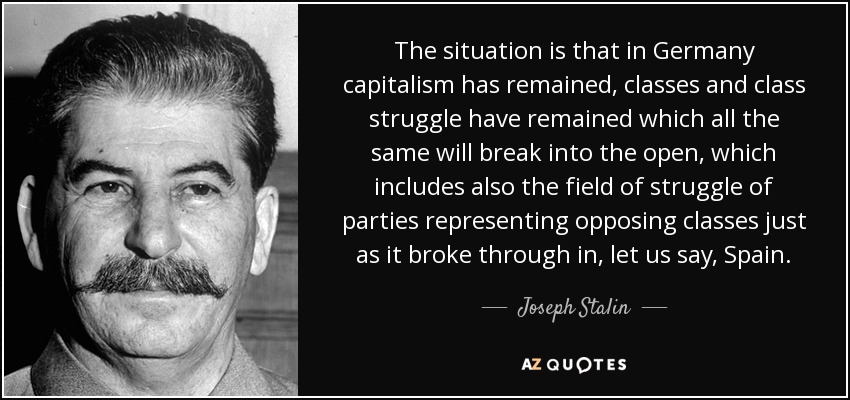
The situation is that in Germany capitalism has remained, classes and class struggle have remained which all the same will break into the open, which includes also the field of struggle of parties representing opposing classes just as it broke through in, let us say, Spain.
If somebody is considering being willing to go out and work in the field in global health, those are a particular class of heroes because it's hard to work in those places. Our foundation gets so many of our learnings from people who've been out there and seen, "this tool is not going to work there, there's more of a problem here than you know." You should really get involved in that.
One question is: Who is the working class today, and how has it changed? Where are we in that? I don't have a knee-jerk kind of 1930s thing about we must build the unions and that's the way to the future. I'm writing this book right now called Pallin' Around, and the subtitle is: "Talking to the Tea Party." And frankly I find talking to the Tea Party exhilarating, I love it.
In Cairo, these young men hanging around in the street, we're told these guys are lazy, they're uneducated, they don't care, they don't have any political instincts - just like the working class in America, apparently - and then suddenly what the hell happened? What was that? They changed the world by changing themselves. Now is that over? No. Is the civil rights movement over? No. These movements have not accomplished what they set out to accomplish.
I grew up in such a small area that there really weren't any acting classes. So I had to wait till I got to college, at the University of Washington. I was a theater major there and got my training. Then after college, I packed up my Honda Civic and kind of fulfilled the cliché of driving down to Los Angeles, and literally, brick by brick - you know, the slow and painful way - I built my career.
At the time, Jean-Claude [Juncker] was already an important man in Brussels. I was a young representative in the European Parliament. We talked for a long time and from that point on, our connection became increasingly deep. But our working-class origins are at least as important to our bond.
My greatest inspiration has to be a Thai lady called Kru Nam, 40, she is from an upper middle class family and degree educated who has chosen to dedicated her life to rescuing children. I met her just after she rescued 27 children, since then she has continued to rescue more children without money, influence and making connections.
As soon as there are no more classes, as soon as boundaries between classes are effaced, as soon as only a few but non-fundamental differences between various strata of the socialist society remain - there can no longer be nourishing ground for the formation of parties struggling among themselves.
Traveling around, it can get very stressful sometimes, and I found yoga, thank God, like a couple of years ago. I went to my first yoga class, and I got hooked on it, and I go almost every day when I'm in New York. I find that it really balances me. And also, morning meditation.
Look at the [Bill] Clinton Administration and now the [Barack] Obama administration more recently. What we believe is that we implement policies that help people reach the middle class which is the cornerstone of our economy.
In southern Italy, where my grandparents had lived, there were few opportunities. The society was static, with rigid social classes. Poor people, like my grandparents, had little chance to improve their lives, no matter their talents or willingness to work.
I trained and worked really hard all my life in dance classes. I always fell into the shadows of my mother, and it was hard for me to really realize that I had done the work. Yes, she took me to the best teachers, but I did the work.
I do this work for the common people and part of that work is creating a general awareness of such problems as they exist because my work is beyond class, religion and creed.
My father was brought to this country as an infant. He lost his mother as a teenager. He grew up in poverty.Although he graduated at the top of his high school class, he had no money for college. And he was set to work in a factory but, at the last minute, a kind person in the Trenton area arranged for him to receive a $50 scholarship and that was enough in those days for him to pay the tuition at a local college and buy one used suit. And that made the difference between his working in a factory and going to college.
In my class was an Annapolis graduate, several engineers, and most recent president of the University of Alabama.These were all small-town people who had good values. The families were tight. The schools reaffirmed the families and reaffirmed the church values that you were taught. I guess it was just one of those swell times to be a part of.
Since nobody upstages Rudolph Giuliani, his will be a Broadway-class show, perhaps his final bravura performance before November 2000, when he hopes to be turned out of the mayor's office by virtue of his election to the United States Senate.
Dalai Lama has made new opportunities for women that they never had in Tibet, introduced science into the monks' curriculum and had Tibetan students in exile take their classes in English after the age of ten so that they will know more about the outside world. But one of the great things he's done is to bring all the Tibetan groups together in exile, as perhaps they couldn't have been when they weren't in exile and they weren't under such pressure.
There's only one problem that bothers me. And that's something my theorem [ of Impossibility] really doesn't cover. In my theorem I was assuming people vote sincerely. The trouble with methods where you have three or four classes, I think if people vote sincerely they may well be very satisfactory. The problem is the incentive to misrepresent your vote may be high.
We have no parties standing in opposition to each other, just as we have no class of capitalists and a class of workers exploited by capitalists in opposition to each other.
I've refined it since [ was living in Beaumont, Texas], but I was just obsessed with the guitar. I remember one day sitting in class and it just came to me how the neck worked. I was enlightened to the scales, and the runs. I just saw it and thought; now I understand it!
I look forward to teaching the occasional class, 'cause I was a professor. And I had fun doing it.
We cannot be liberated as women in a society built on class oppression or gender oppression or religious oppression.
I was born in Oakland and grew up, probably about five miles from Oakland, in Hayward. And Hayward was OK. Like, Hayward wasn't - very much a working-class area and had definitely went through a decline and is now, seemingly, coming back around, which is nice to see.
Whether or not the working class came to Chicago in 1969 in the Days of Rage is not a measure of their commitment to stopping the war or to seeing life in certain way. There were very few of us who were there, and those of us that were had an illusion about ourselves.
Who's the big government guy? These labels are nonsense. And the Tea Party, if you want to call them working class, you know, a working-class insurgency from below, they are a mass of contradictions; they don't have a single consistent viewpoint; but part of their impulse is to be wary of government.
Follow AzQuotes on Facebook, Twitter and Google+. Every day we present the best quotes! Improve yourself, find your inspiration, share with friends
or simply: