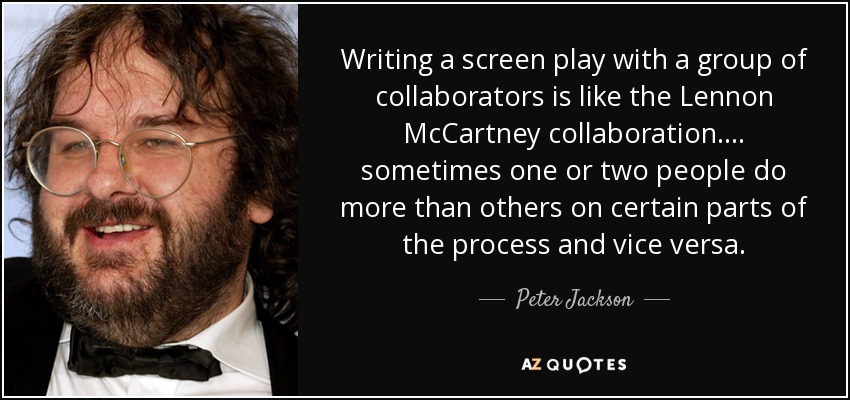
Writing a screen play with a group of collaborators is like the Lennon McCartney collaboration .... sometimes one or two people do more than others on certain parts of the process and vice versa.
The inherent non-linearity of the digital allows for more input from others, including the subject and reader as collaborators. The top-down, bedtime-style story is of limited use. A non-linear narrative that allows for increased complexity and depth, and encourages both subject and reader to have greater involvement, will eventually emerge more fully from the digital environment. This, in a sense, is the more profound democratization of media.
I made the transition to directing documentaries with the great help of my Co-Director on The World According to Sesame Street, Linda Hawkins Costigan. She was a gracious teacher, and a wonderful collaborator.
I have an incredible team of collaborators that work with me on all my films. I adore them and respect them tremendously. I can't wait to begin production on my next film so we can be reunited.
The goal is to align with your core group of collaborators, who understand your vision and aesthetics. I usually show them visual material of what I have in mind, as well as a color spectrum of mood boards.
It's always different, depending on the writer and the director. A collaborator like Graham Reznick delivers a fully finished piece, perfected in every way. Other writers direct the recording session and then leave quite a bit of the work to us.
We usually start by asking the collaborators to submit a couple of ideas. Then, Larry and I will sort through all the submissions and choose the ones based on what we think will add most to the collection. Once the scripts are written, the stages are: rehearse, record, edit, sound design, foley and finally, the mix.
On resigning as collaborator on the memoirs of the former Wallis Warfield Simpson, new summaries, 6 October 1955. You can't make the Duchess of Windsor into Rebecca of Sunnybrook Farm.
I did not set out to explain the extinction of the dinosaurs. I'm a particle physicist, and I was actually thinking about dark matter along with some collaborators.
James DeMonaco is one of my favorite directors I’ve ever worked with. I think he shoots really well and all that, but the work environment he creates – he makes everyone feel respected, he makes everyone feel appreciated, and he’s a true collaborator.
It would have to stand on the basis of what somebody had done to it and that would be the basis on which it would be judged. So it's a funny art form. You gain a great deal when you have good collaborators and sometimes people just don't understand what you've done.
I think one thing for sure that you learn the more films that you make is how important it is to choose your collaborators.
As a director myself, you want to have colleagues and collaborators that respect your authority as the director. I'm very comfortable with that, and I've done a lot of work in second unit.
Anton brings the camera. I'll bring a tuba, wear black, not shave, and take us to a burned-down Chinese restaurant. (On being photographed by his longtime photo collaborator Anton Corbijn)
God says, "Please, please help me realize this dream." And some of God's best collaborators are the young, because you dream. You dream God's dream.
The most advanced, creative and original thinking is always a product of historical context and the influences of previous geniuses, mentors, and collaborators on the mind of the originator.
Stephen Shadley is a great collaborator. Over the years I've seen him work with a wide variety of clients and stylistic approaches. He listens to people in a way that makes them feel like they're part of the process. Steve is an inspiration on all fronts, and, believe me, that's a rare quality.
I take a lot of inspiration from the people I work with, and having many collaborators keeps me challenged and inspired.
Every time you start a movie is to explore with a director and if you can with the actors and with the other collaborators and try to figure out what's the best way to tell the specific story.
I definitely enjoy working within different contexts, with different collaborators, and in different locations. I need to keep feeding myself as an artist by working with different people. I see continuing with that. I've also enjoyed getting to explore different kinds of music and instruments in the last couple of years.
I'd probably end up doing the same thing over and over. We're creatures of habit. We know what we know. With collaboration...and I'm not just talking about music, I'm talking about in life - if you're a good listener and you have your ears open, and to be a good collaborator you have to be able to listen, you can learn something from somebody else.
[On "John F. Kennedy" set] everybody was very interested in the accent. Even my collaborators were very curious to know if I was even going to do it. And I was, like, "You just can't not do it." I think everybody was worried that it was going to sound like the guy from... is it The Simpsons?
To work with Kaz on this kind of project is a fascinating process...He seems to be Dogen himself when offering the translations that we Western collaborators then refine with him.
In our world, it's a big deal when you have a favourite collaborator and share them.
When I'm sure I have a story, I call my collaborators and we begin to discuss it. And we conduct studies of certain subjects to make sure of our terrain. Then, finally, in the last month or two, I write the story.
Follow AzQuotes on Facebook, Twitter and Google+. Every day we present the best quotes! Improve yourself, find your inspiration, share with friends
or simply: