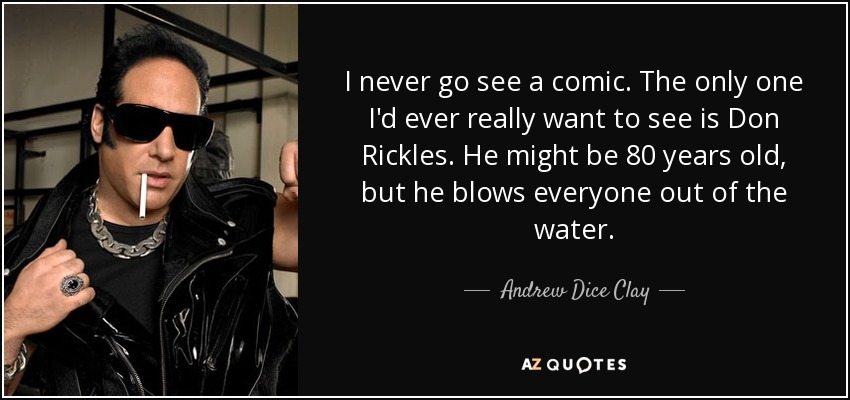
I never go see a comic. The only one I'd ever really want to see is Don Rickles. He might be 80 years old, but he blows everyone out of the water.
I'm one of those people that will walk into a bar, and if I wasn't a comic - because some people know who I am - I would just blend in.
Every single fat comic uses his weight as a punchline. There is something sad about that.
My introduction into Marvel world was Comic-Con 2014 where I really had to take a step back and go, 'What have I walked into? What is this place? It's wild, and there's all these crazy rockstars walking around - who are all older than me, which was really weird. I was like, 'I feel too old to be in a superhero movie,' and they're like 10 years older than me.
In the world of comic books, "troublemaker" means someone who has some sense of dignity.
It's not movies and it's not "fine art." The beauty of a comic is that it's clear, direct communication. My work is getting simpler and more cartoony because I'm much more interested in communication now than in any illustrative value.
I'm really interested with the way light plays on images and one of the artists that really reawakened my interest in comic books was Frank Miller and his treatment of Daredevil, and then Wolverine and, of course, Batman.
It's much harder to say "I'm going to kill three of the biggest characters in your universe in a gruesome bloodbath." There can be a lot of differing opinions in a mainstream comic book, you know? "Rogue would never do this!" But I can say, "No, Rogue suffered the death of Charles Xavier and it broke her down and she stumbled into a dark place and she started fixating on the Scarlet Witch as the cause of it all" which, there is a logical chain of events that lead to the Scarlet Witch. And in the confusion, she thought Wanda was up to doing it again and she did what she thought was best.
My mom taught me to read when I was two or three. When I was five I read and wrote well enough to do my nine-year older brother's homework in exchange for chocolate or cigarettes. By the time I was 10, I was reading Orwell, Tolstoy's War and Peace, and the Koran. I was reading comic books too.
If Shakespeare and Michelangelo were alive today, and if they decided to collaborate on a comic, Shakespeare would write the script and Michelangelo would draw it. How could anybody say that this wouldn't be as worthwhile an artform as anything on earth?
I used to be embarrassed because I was just a comic-book writer while other people were building bridges or going on to medical careers. And then I began to realize: entertainment is one of the most important things in people's lives. Without it they might go off the deep end. I feel that if you're able to entertain people, you're doing a good thing.
Some people will say, "Why read a comic book? It stifles the imagination. If you read a novel you imagine what people are like. If you read a comic, it's showing you." The only answer I can give is, "You can read a Shakespeare play, but does that mean you wouldn't want to see it on the stage?
The "problem" is that Comic-Con is so damned successful. People who are there seem to have a wonderful time. The very size of it makes it exciting. Wherever you look, there's something exciting. The attendees are always looking around for a familiar face. It's either 'There's a movie star!' Or, 'There's a TV star!' Or, 'There's the guy who drew the Green Lantern!' It means so much to the fans. It makes them feel like they're where it's happening. It's like Woodstock.
That's what everybody tells me. "I would've had a great comic-book collection, but my mother made me throw them away." But when I was growing up, my mother didn't care. As long as I was reading, she didn't care if my room was filled with comics. I could have saved everything. I was just too stupid to do it.
I despise the comic industry, but I will always love the comic medium.
The real challenge in acting is in comedy. It's easier to get that gasp in a drama. Not easy, because you still have to find that emotional pitch. And when you do something in drama and you hear that sob from the audience it's so fulfilling. But as a comic actor, when the laugh is supposed to come and you punch in that line and nothing happens it is dreadful. It's horrific and you feel like dying right there.
I think it's essential for comic writers to have a hate figure, a despot, a regime to react against, and I think Thatcher was perfect for me, I loathed everything she stood for.
Manner and morals have improved, improved wages and world travel during the war have had effect, and the farm labourer now is an intelligent, self respecting workman, on a level at least with the town artisan. The village rustic of the past no longer exists outside of the comic papers.
If you loved everything you were writing, you would be deluding yourself or a complete and absolute narcissist. It's not about liking what you write, it's about improving with every word, little by little, exploring your craft, becoming the artist you hope to be one day. And you can only do that by working at it every day. It doesn't happen overnight, it doesn't happen over a weekend, it is a lifelong pursuit.
But you have to look at your work with an honest critical eye. Work on the things that you need work on. Scare yourself. Surprise yourself. If you don't like the way it's going, you have complete control over changing the course. That's one of the best things about doing this.
Ultimately, any character you write - no matter how fantastic or alien - is an extension of yourself. When our characters reflect the truth of our souls and psyches, they become real and compelling. The wonderful paradox is that the characters then take on lives of their own, separate from their creators. That's where the magic comes in.
In a 22-page comic, figuring an average of four to five panels a page and a couple of full-page shots, a writer has maybe a hundred panels at most to tell a story, so every panel he wastes conveying a.) something I already know, b.) something that's a cute gag but does nothing to reveal plot or character, or c.) something I don't need to know is a demonstration of lousy craft.
I need to go where I'm not comfortable. I think that's the artist's job.
There is not one piece of artwork I have ever done that lived up to the vision I had for it in my head. That's why I keep on trying. Maybe someday I'll do it. I don't want to be in the past. I want to get to the next thing.
Form and content must never apologize for each other.
Follow AzQuotes on Facebook, Twitter and Google+. Every day we present the best quotes! Improve yourself, find your inspiration, share with friends
or simply: