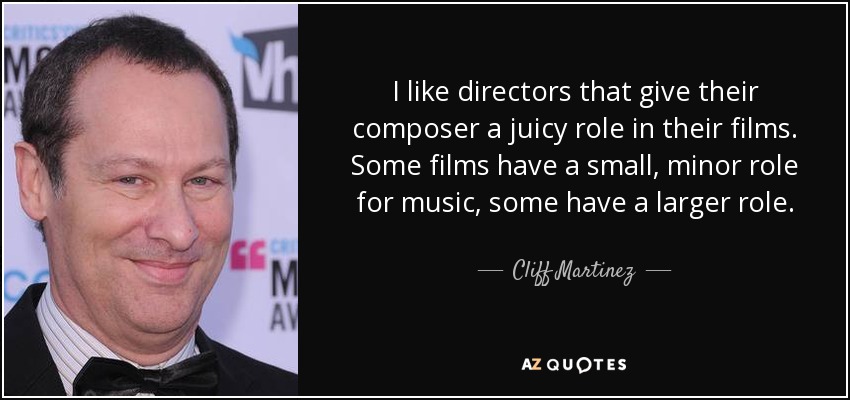
I like directors that give their composer a juicy role in their films. Some films have a small, minor role for music, some have a larger role.
In my years of working in theatre and TV I've learnt that my main skill is not the instrumental playing but the idea of what to play and my interest for so many kinds of music. Often people ask me to contribute to projects when they don't stay in just one genre. I feel more like a composer who just has to play his own things.
There are some composers - at the head of whom stands Beethoven - who not only do not know when to stop but appear to stop many times before they actually do.
I was starting a group of musicians and we had a group of young composers in Finland back in the '70s, and the real conductors, the professional conductors at the time were not interested in our stuff.
I usually work with the director and it's just a collaboration between me and the one person. I think you make good movies that way. If the director and the composer can have this common goal and this excitement about making something great, then you're going to do something good.
I had great inspiration from a Japanese composer named Toru Takemitsu. He wrote over 90 film scores and a lot of concert music, a lot of classical music, and he gave me a lot of inspiration, as well as composers from other countries.
We've always said we're a HEAVY METAL band. We've kinda branched out here and there - we've done a rap thing, we've done a rap-rock thing, we've done something with Angelo Belmonte, who's the primary composer of Twin Peaks. In fact, most of David Lynch's movies is Angelo. He did something with us and that was great. We've also acted, we've done an episode in Married with Children, which was awesome - so we're always looking to do things which you wouldn't expect.
Music and songs have always been a constant part of my life, and still are. My brother Michael, who is a songwriter and composer, is the one who most fully inherited the musical legacy of our family, but I got some part of it - mostly the feel.
Music is my natural language. I have always had a form of dyslexia. I never studied music formally, so emotions come directly from the source into song mode. As a composer, it may be fortuitous. What I feel is what you get.
Is there a gender gap in the music industry? It is true that there are more professional male music creators than female. For some reason, it's taking a lot longer in music than in literature and the visual arts to reach equilibrium. It was almost acceptable by the 19th century for female writers to be published, yet it's only in the last couple of decades, since about 1980, that historical female composers have really emerged.
Frank [Zappa] said he probably would have been a major criminal, given his brain power and his attention to detail, had he not been a composer. But being a composer is not something you can't help.
When you have a single composer writing his work, it shouldn't be doled out in singles based on the length of a piece.
I don't work with an outline, except a vague one in my head, a general idea of character, place, arc... I'm like a composer with a symphony in their head: I can hear the music, I just have to figure out how to put it down on paper. But I don't always know where my stories are going when I begin.
I think there's just been this "thing" that's developed, this way that we have of talking about our music that alienates people. And I fall into that too! I learned that in graduate school. You just talk about your music in a specific way, and that separates people from you. But some composers like that. Schoenberg liked that. He wanted to feel that he was making music for an elite few. That's fine for him, but I want to set myself free from that sort of attitude.
My greatest experiences in the theatre and the most religious experiences in my life - of which going to the opera is one for me - have been with the Romantic composers' repertoire: it's Wagner, it's Strauss, Verdi, Puccini. That era gets me every time.
The first part of my career was indeed as a performer and recording artist, and I am still keenly involved with both. While rummaging around in the British Library, I found many delightful and interesting compositions by 18th-century men and women composers.
Each one of us in Café Tacvba is a composer and we come to the group with songs written out, musically and lyrically. Occasionally, there's a collaboration between us. But each song is almost always written by one of us, and then we all figure out the arrangements. Up until now there hasn't been a moment where the composer explains the song and says, "I want to say this or that." It's always open for interpretation.
I was going to say is that I come from a rock background, but also I was super interested in jazz for a long time. I was training to be a jazz musician for quite a while. I never trained to be a classical composer or player, but I did train to play jazz.
The Violins waltzed. The Cellos and Basses provided accompaniment. The Violas mourned their fate, while the Concertmaster showed off. The Flutes did bird imitations…repeatedly, and the reed instruments had the good taste to admire my jacket. The Trumpets held a parade in honor of our great nation, while the French Horns waxed nostalgic about something or other. The Trombones had too much to drink. The Percussion beat the band, and the Tuba stayed home playing cards with his landlady, the Harp, taking sips of warm milk a blue little cup. “But the Composer is still dead.
Composer” is a word which here means “a person who sits in a room, muttering and humming and figuring out what notes the orchestra is going to play.” This is called composing. But last night, the Composer was not muttering. He was not humming. He was not moving, or even breathing. This is called decomposing.
Everything we do is music." (Classical Composer)(From: 4'33")
A great ancient poet was blind. A great classical composer was deaf. Many of us are dumb. What have we to show for it?
Outlaws, like lovers, poets, and tubercular composers who cough blood onto piano keys, do their finest work in the slippery rays of the moon.
Bad facts make bad law, and people who write bad laws are in my opinion more dangerous than songwriters who celebrate sexuality. Freedom of speech, freedom of religious thought, and the right to due process for composers, performers and retailers are imperiled if the PMRC and the major labels consummate this nasty bargain.
There is more to creative mastership than the surface of satisfaction and political certainty. The music of Joe Fonda is part of a living tradition of belief and dedication. Future historians will be surprised at the breadth of Mr. Fonda's offerings. This is a real virtuoso and composer of the highest order.
Follow AzQuotes on Facebook, Twitter and Google+. Every day we present the best quotes! Improve yourself, find your inspiration, share with friends
or simply: