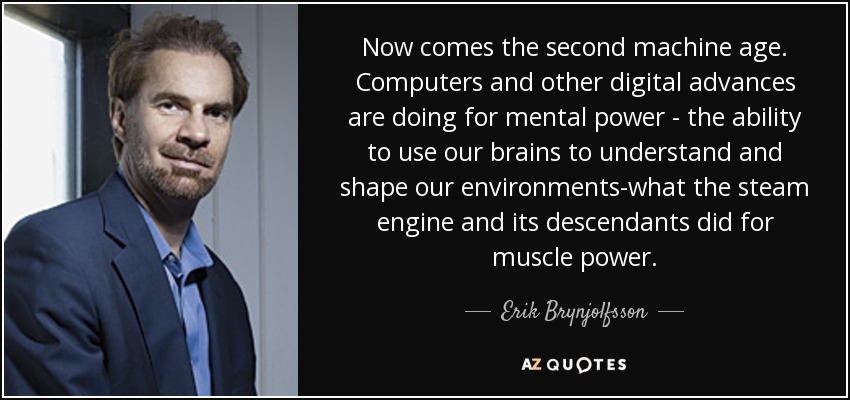
Now comes the second machine age. Computers and other digital advances are doing for mental power - the ability to use our brains to understand and shape our environments-what the steam engine and its descendants did for muscle power.
The kids know what I'm doing when I exercise, and that's powerful. So don't just tell your kids to go play outside. Take a moment off your computer, put on your tennis shoes, hop outside and help them start their game and run off some energy.
We are reaching the stage where the problems we must solve are going to become insoluble without computers. I do not fear computers, I fear the lack of them.
If true computer music were ever written, it would only be listened to by other computers.
My big dream back then was to buy an IBM Selectric. I still have that dream. I really ought to buy a word-processor. Half the cabbies at Rocky own computers. They tell me they can write failed novels ten times faster on a PC.
What, then, is the basic difference between today's computer and an intelligent being? It is that the computer can be made to seebut not to perceive. What matters here is not that the computer is without consciousness but that thus far it is incapable of the spontaneous grasp of pattern--a capacity essential to perception and intelligence.
The archetype of all humans, their ideal image, is the computer, once it has liberated itself from its creator, man. The computeris the essence of the human being. In the computer, man reaches his completion.
All our technology - whether we use fax machines or computers or speak on phones or watch programs on television - is based on the premise that the essential nature of the material world is non-material.
Without computers we will be stuck only proving theorems that have short proofs.
Computer assisted proofs are getting better and better and computers will play a bigger and bigger role in the future.
Theoretical Computer Science is just as useless as everything we mathematicians do.
The iPad - is that a phone or a computer? If I put it on my wall is it a TV?
The mind is an evolved computer program.
Thought, then, is the execution of this computer code.
The research reported on in our book "A=B", has moved a whole active field of mathematics from the province of human thought to the realm of computer-fodder. It is quite exciting to think about what other fields of pure mathematics, hitherto thought to be reserved to human intelligence, might be moved to that realm next. The goal is to put ourselves out of business completely, and the work is well underway.
If you think you're a really good programmer... read Knuth's Art of Computer Programming... You should definitely send me a resume if you can read the whole thing.
Why have computers? Politicians are far more calculating.
Some Socialists seem to believe that people should be numbers in a State computer. We believe they should be individuals. We are all unequal. No one, thank heavens, is like anyone else, however much the Socialists may pretend otherwise. We believe that everyone has the right to be unequal but to us every human being is equally important.
The book is here to stay. What we're doing is symbolic of the peaceful coexistence of the book and the computer.
Today's children are living a childhood of firsts. They are the first daycare generation; the first truly multicultural generation; the first generation to grow up in the electronic bubble, the environment defined by computers and new forms of television; the first post-sexual revolution generation; the first generation for which nature is more abstraction than reality; the first generation to grow up in new kinds of dispersed, deconcentrated cities, not quite urban, rural, or suburban.
Terrified of being alone, yet afraid of intimacy, we experience widespread feelings of emptiness, of disconnection, of the unreality of self. And here the computer, a companion without emotional demands, offers a compromise. You can be a loner, but never alone. You can interact, but need never feel vulnerable to another person.
One thing is certain: the riddle of mind, long a topic for philosophers, has taken on new urgency. Under pressure from the computer, the question of mind in relation to machine is becoming a central cultural preoccupation. It is becoming for us what sex was to the Victorians--threat and obsession, taboo and fascination.
Pinball games were constrained by physical limitations, ultimately by the physical laws that govern the motion of a small metal ball. The video world knows no such bounds. Objects fly, spin, accelerate, change shape and color, disappear and reappear. Their behavior, like the behavior of anything created by a computer program, is limited only by the programmer's imagination. The objects in a video game are representations of objects. And a representation of a ball, unlike a real one, never need obey the laws of gravity unless its programmer wants it to.
Both instruments are processors of information. Both appeared when nothing quite like them had existed before, and both began to make their effects felt immediately (a situation that isn't invariable with new technology). Both devices were less the result of a single breakthrough than of an evolving set of technologies. Like the computer, the printing press had no one certain inventor; it was a technology whose time had come.
I've never been that technologically savvy, my friends are actually amused by how infrequently I use computers.
Follow AzQuotes on Facebook, Twitter and Google+. Every day we present the best quotes! Improve yourself, find your inspiration, share with friends
or simply: