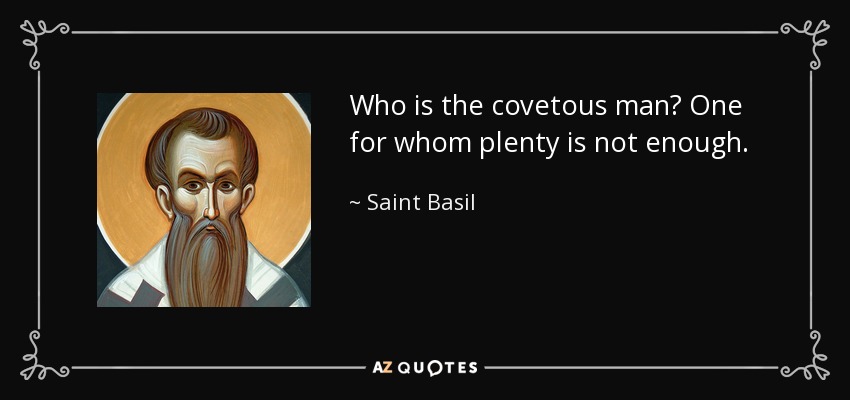
Who is the covetous man? One for whom plenty is not enough.
You have found that you were more secure before you accumulated so much. See what greed has imposed on you: You have filled your house and now you fear burglars. You have hoarded money and lost sleep. See what greed has commanded you: "Do this!" And you did it.
He has much who needs least. Do not create necessities for yourself.
How far, O rich, do you extend your senseless avarice? Do you intend to be the sole inhabitants of the earth? Why do you drive out the fellow sharers of nature, and claim it all for yourselves? The earth was made for all, rich and poor, in common. Why do you rich claim it as your exclusive right?
I am not saying this because I am in need, for I have learned to be content whatever the circumstances. I know what it is to be in need, and I know what it is to have plenty. I have learned the secret of being content in any and every situation, whether well fed or hungry, whether living in plenty or in want. I can do everything through him who gives me strength.
I believe that a desirable future depends on our deliberately choosing a life of action over a life of consumption, on our engendering a lifestyle which will enable us to be spontaneous, independent, yet related to each other, rather than maintaining a lifestyle which only allows to make and unmake, produce and consume - a style of life which is merely a way station on the road to the depletion and pollution of the environment. The future depends more upon our choice of institutions which support a life of action than on our developing new ideologies and technologies.
I saw that a humble man, with the blessing of the Lord, might live on a little; and that where the heart is set on greatness, success in business did not satisfy the craving, but that commonly with an increase of wealth, the desire of wealth increased.
I think of the old slavery, and of the way The Economy has now improved upon it. The new slavery has improved upon the old by giving the new slaves the illusion that they are free. The Economy does not take people's freedom by force, which would be against its principles, for it is very humane. It buys their freedom, pays for it, and then persuades its money back again with shoddy goods and the promise of freedom. "Buy a car," it says, "and be free. Buy a boat and be free." Is this not the raw material of bad dreams? Or is it maybe the very nightmare itself?
It is important to recognize that behind the razzmatazz of consumerism, we all remain dependent on basic natural resources - land, air, water and biodiversity - for every product and service. There can be no free lunch on the environment.
It is more blessed to give than to receive, but then it is also more blessed to be able to do without than to have to have.
It is not because food, clothes and property are inherently evil that Christians today must lower their standard of living. It is because others are starving. Creation is good. But the one who gave us this gorgeous token of his affection has asked us to share it with our sisters and brothers.
It is not earthly riches which make us or our sons happy; for they must either be lost by us in our lifetime, or be possessed when we are dead, by whom we know not, or perhaps by whom we would not.
It is partly to avoid consciousness of greed that we prefer to associate with those who are at least as greedy as we ourselves. Those who consume much less are a reproach.
Many Christians, though keenly sensitive to the dangers of greed and discontent that come with an economy of continually increasing consumption, nevertheless feel that it is worth risking if only it can end man's physical miseries. The trouble is that it can't. In a finite world, continually increasing consumption is just not possible.
Modern man is drinking and drugging himself out of awareness, or he spends his time shopping, which is the same thing.
Modern society will find no solution to the ecological problem unless it takes a serious look at its lifestyle. In many parts of the world society is given to instant gratification and consumerism while remaining indifferent to the damage which these attitudes cause. Simplicity, moderation and discipline, as well as a spirit of sacrifice, must become part of everyday life, lest all suffer the negative consequences of the careless habits of a few.
Most persons think that a state in order to be happy ought to be large; but even if they are right, they have no idea of what is a large and what a small state.... To the size of states there is a limit, as there is to other things, plants, animals, implements; for none of these retain their natural power when they are too large or too small, but they either wholly lose their nature, or are spoiled.
New pressures are causing ever more people to find their main satisfaction in their consumptive role rather than in their productive role. And these pressures are bringing forward such traits as pleasure-mindedness, self-indulgence, materialism, and passivity as conspicuous elements of the American character.
No one who had once learned to identify happiness with wealth ever felt that he had wealth enough.
O America, how you've taken necessities from the masses to give luxuries to the classes.
There is, indeed, a most dangerous passage in the history of a democratic people. When the taste for physical gratifications among them has grown more rapidly than their education and their experience of free institutions, the time will come when men are carried away and lose all self-restraint at the sight of new possessions they are about to obtain. In their intense and exclusive anxiety to make a fortune they lose sight of the close connection that exists between the private fortune of each and the prosperity of all.
The horseman serves the horse, The neat-herd serves the neat, The merchant serves the purse, The eater serves his meat; 'Tis the day of the chattel, Web to weave, and corn to grind, Things are in the saddle, And ride mankind.
The most outstanding characteristic of Eastern civilization is to know contentment, whereas that of Western civilization is not to know contentment. Contented Easterners are satisfied with their simple life and therefore do not seek to increase their material enjoyment... They are satisfied with their present lot and environment and therefore do not want to conquer nature but merely be at home with nature and at peace with their lot.
The possessions God allows us to have are intended for our use, not our enjoyment. Trying to squeeze something out of them that was never in them in the first place is a futile endeavor. A cow's udders, gently pressed, will yield sweet milk, nourishing and refreshing. Applying more and more pressure will not produce greater quantities of milk. We lose the good of material things by expecting too much from them. Those who try hardest to please themselves with earthly goods find the least satisfaction in them.
Let us be bold enough to ask ourselves as Christians whether the Church of the Lord Jesus in the United States has anything to say to our nation and its ideologies of materialism, possessiveness, and the worship of financial security. Are we courageous enough to be a sign of contradiction to consumerism through our living faith in Jesus Christ? Are we committed enough to his gospel to become a countercurrent to the drift?
Follow AzQuotes on Facebook, Twitter and Google+. Every day we present the best quotes! Improve yourself, find your inspiration, share with friends
or simply: