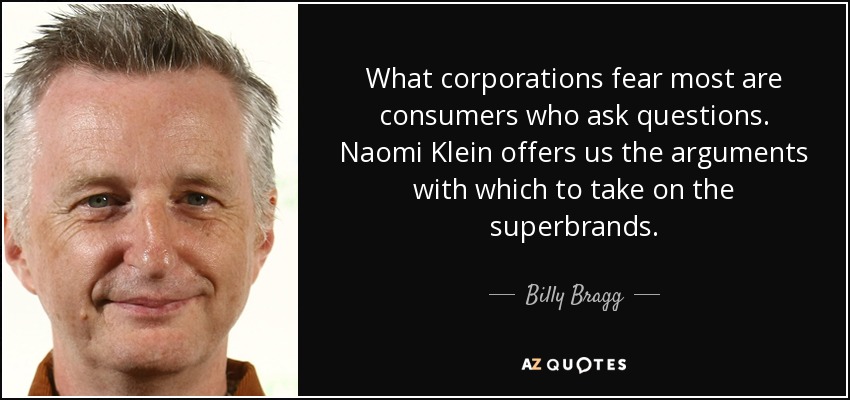
What corporations fear most are consumers who ask questions. Naomi Klein offers us the arguments with which to take on the superbrands.
In many respects, designing heirloom products means saying no to designing consumer crap that you know will not last very long.
When you have a lot of construction going on, it sends a message of vitality that builds up consumer confidence. It gets people to spend money when they see that energy, that things are happening.
... in a capitalist society a man is expected to be an aggressive, uncompromising, factual, lusty, intelligent provider of goods,and the woman, a retiring, gracious, emotional, intuitive, attractive consumer of goods.
An enormous amount of art and literature is erotic in the sense that it stimulates vague sexual emotions, but it has no pornographic intention or effect because "it leaves everything to the imagination." The consumer has to invent his own images, and it is felt, I do not know with what justification, that there is no harm in this.
[The consumer is] the supreme mover of economic order... for whom all goods are made and towards whom all economic activity is directed.
[on the theory of the firm] It is exactly analogous to the analysis of the reactions of a consumer by means of indifferent curves. Indeed, a consumer is merely a 'firm' whose product is 'utility.'
Tax reduction has an almost irresistible appeal to the politician, and it is no doubt also gratifying to the citizen. It means more dollars in his pocket, dollars that he can spend if inflation doesn't consume them first. But dollars in his pocket won't buy him clean streets or an adequate police force or good schools or clean air and water. Handing money back to the private sector in tax cuts and starving the public sector is a formula for producing richer and richer consumers in filthier and filthier communities. If we stick to that formula we shall end up in affluent misery.
The lady ... is not a producer; in most communities productive labor is by consent unladylike. On the other hand she is the heaviest of consumers, and theorists have not been wanting to maintain that the more she spends the better off society is.
The question isn't whether or not to censor artists who espouse misogynistic views. The question is whether or not we support them as listeners and consumers.
People need to buy and want to. The selling itself becomes the entertainment, the sought-after good... In the Internet world there won't be any other way to peddle. To be successful advertising itself will have to supply real value to the consumer.
We're consumers. We are by-products of a lifestyle obsession.
She had me at Sweet Valley High. Gay playfully crosses the borders between pop culture consumer and critic, between serious academic and lighthearted sister-girl, between despair and optimism, between good and bad. . . . How can you help but love her?
That is simple. In the Colonies we issue our own money. It is called Colonial Scrip. We issue it in proper proportion to the demands of trade and industry to make the products pass easily from the producers to the consumers. In this manner creating for ourselves our own paper money, we control its purchasing power, and we have no interest to pay.
During the ten years I lived in the U.K., I frequently attended an Anglican church just outside of London. I enjoyed the energetic singing and the thoughtful homilies. And yet, I found it easy to be a pew warmer, a consumer, a back row critic.
All object printed: Love me. Look me. Million speaking objects,begging. Crown American consumer with power of king, to rescue choose and give home or abandon here for expire.
When consumers know things, they tend to make informed choices, and that could affect corporate profits. I'm sorry, but your right to know is always going to be outweighed by their right to hide it from you.
Early access is very valuable, there are a lot of consumers who would love to see something early.
If the life-supporting ecosystems of the planet are to survive for future generations, the consumer society will have to dramatically curtail its use of resources - partly by shifting to high-quality, low-input durable goods and partly by seeking fulfillment through leisure, human relationships, and other nonmaterial avenues. We in the consumer society will have to live a technologically sophisticated version of the life-style currently practiced lower on the economic ladder.
The people who benefit from this state of affairs have been at pains to convince us that the agricultural practices and policies that have almost annihilated the farming population have greatly benefited the population of food consumers. But more and more consumers are now becoming aware that our supposed abundance of cheap and healthful food is to a considerable extent illusory.
A person who has been seduced by the consumer value system, whose identity is dissolved in an amalgam of the accouterments trappings of mass civilization, and who has no roots in the order of being, no sense of responsibility for anything higher than his own personal survival, is a demoralized person. The system depends on this demoralization, deepens it, is in fact a projection of it into society.
What is urgently needed is a bold new move from a consumer economy to a conserver economy in all of the developed countries, and particularly in the United States.
We must recognize that the goal of a cleaner environment will not be achieved by rhetoric or moral dedication alone. It will not be cheap or easy and the costs will have to be borne by each citizen, consumer and taxpayer. How clean is clean enough can only be answered in terms of how much we are willing to pay and how soon we seek success... It is simplistic to seek ecological perfection at the cost of bankrupting the very tax-paying enterprises which must pay for the social advances we seek.
What, then, is the effect of pesticides? Pesticides have created a legacy of pain, and misery, and death for farm workers and consumers alike. The crop which poses the greatest danger, and the focus of our struggle, is the table grape crop. These pesticides soak the fields. Drift with the wind, pollute the water, and are eaten by unwitting consumers. These poisons are designed to kill, and pose a very real threat to consumers and farm workers alike.
While business advertises, charity is taught to beg. While business motivates with a dollar, charity is told to motivate with guilt. While business takes chances, charity is expected to be cautious. We measure the success of businesses over the long term, but we want our gratification in charity immediately. We are taught that a return on investment should be offered for making consumer goods, but not for making a better world.
Follow AzQuotes on Facebook, Twitter and Google+. Every day we present the best quotes! Improve yourself, find your inspiration, share with friends
or simply: