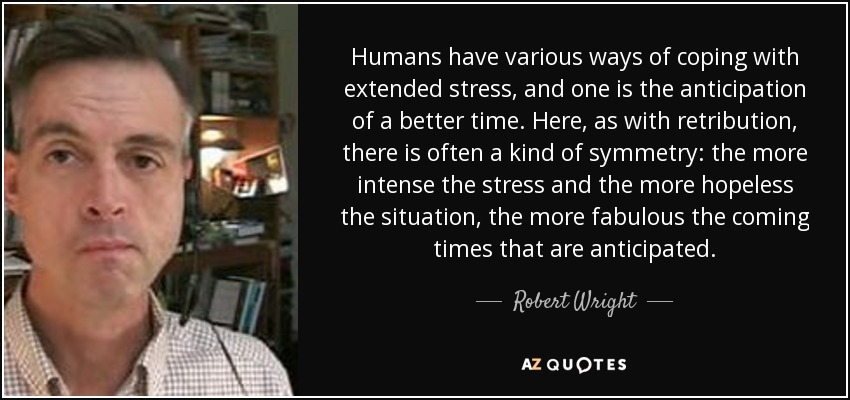
Humans have various ways of coping with extended stress, and one is the anticipation of a better time. Here, as with retribution, there is often a kind of symmetry: the more intense the stress and the more hopeless the situation, the more fabulous the coming times that are anticipated.
I went back to the stage because it was my way of dealing with the success I had, my way of coping. It was a way of escaping the responsibilty of what was happening.
I don't think people realize, when they're just getting started on an eating disorder or even when they're in the grip of one, that it is not something that you just "get over." For the vast majority of eating-disordered people, it is something that will haunt you for the rest of your life. You may change your behavior, change your beliefs about yourself and your body, give up that particular way of coping in the world. You may learn, as I have, that you would rather be a human than a human's thin shell. You may get well. But you never forget.
Denial is a critical part of the human coping mechanism. Without it, we would all wake up terrified every morning about all the ways we could die. Instead, our minds block out our existential fears by focusing on stresses we can handle—like getting to work on time or paying our taxes.
If we use resources productively and take to heart the lessons learned from coping with the energy crisis, we face a future confronted only, as Pogo, once said, by insurmountable opportunities. The many crises facing us should be seen, then, not as threats, but as chances to remake the future so it serves all beings.
There's a victory and defeat-the first and best of victories, the lowest and worst of defeats-which each man gains or sustains at the hands not of another, but of himself.
One idea I explore in my stand-up show is whether, if you try looking at the universe rationally and avoid coping mechanisms like mysticism or religion, you can still be happy knowing you are going to die after a brief time on this spinning ball.
I was powerless over my childhood but the coping strategies that I developed, to survive, all of which were creative and brilliant and got me through, as an adult those became my defects of character. Those became my shortcomings, control and all that kind of stuff... and that's my responsibility. I was a blameless child in what happened in the home; I take responsibility for my behaviors as an adult.
The Lord knows our bearing capacity, both as to coping and to comprehending, and He will not give us more to bear than we can manage at the moment, though to us it may seem otherwise. Just as no temptations will come to us from which we cannot escape or which we cannot bear, we will not be given more trials than we can sustain.
In a world where survival is always seen as a struggle, and in which some pitfalls always exist, if something brings into question our confidence in our own coping ability, it will threaten our safety.
Humor helps us get through life with a modicum of grace. It offers one of the few benign ways of coping with the absurdity of it all.
Such a person needs meditation more than anyone else because they are headed for a crisis. If stress and anxiety are so great that you can't even imagine a calm clear mind, that indicates you are reaching your coping limits, and need to begin something like meditation just for the stress reduction benefits.
When I was in my 20s, I thought that being known for 'Swimming Pool' was kind of a burden. Like, OK, everyone thinks I am this tanned bimbo and I was having problems coping with that image.
I think that's why Meryl Streep is working so much, because she looks like a woman we can all relate to. I look at her and I think, 'I'm chasing my kids, I've moved my parents in with me, I'm coping with food spills - that looks like me in real life'. Meryl looks like an unmade bed, and that's what I look like. To me, that looks true.
It is not always easy to be who we are, but as we grow up and mature and develop coping mechanisms that enable us to survive and thrive in a complicated world, we have the responsibility to reach back and help others still struggling along the way. In so doing, we can also help ourselves. Above all, we cannot allow each generation to grow up in a world where they feel they are alone while we carry so much knowledge, history, and foundation that we can, and must, pass on to them.
The saying goes that history repeats itself; personal histories do the same. We can gather the lessons of others' lives through observation, conversation, and by seeking advice. We can use the automatic system to find out who the happy people are, and the reflective system to evaluate how they got to be that way. Pursuing happiness need not be a lonely endeavor. In fact, throwing in our lot with others may be a very good way of coping with the disappointments of choice.
A family's responses to crisis or to a new situation mirror those of a child. That is to say, the way a small child deals with a new challenge (for instance, learning to walk) has certain predictable stages: regression, anxiety, mastery, new energy, growth, and feedback for future achievement. These stages can also be seen in adults coping with new life events, whether positive or negative.
I think if you have a comic perspective, almost anything that happens you tend to put through a comic filter. It's a way of coping in the short term, but has no long term effect and requires constant, endless renewal. Hence people talk of comics who are "always on." It's like constantly drugging your sensibility so you can get by with less pain.
Most Americans stopped looking at what was happening through a variety of coping mechanisms - starting with women entering paid work and then everyone working longer hours and using their homes for raising equity and generating more money through debt. The typical household basically staved off the day of reckoning.
Tad Homer-Dixon is a rare kind of public intellectual, who combines real expertise with a commitment to communicate to the widest possible readership. In The Ingenuity Gap he wants us all to wake-up to the fearful possibility that our blithe trust in science and technology may be misplaced. Human ingenuity may not be capable of coping with two emerging crises of this century and the next: population growth and environmental despoliation. Read Homer Dixon's wake-up call and you will see the future very differently.
Leadership is about coping with change
The nature of the enemy's warfare in your life is to cause you to become discouraged and to cast away your confidence. Not that you would necessarily discard your salvation, but you could give up your hope of God's deliverance. The enemy wants to numb you into a coping kind of Christianity that has given up hope of seeing God's resurrection power.
Music for me is not just being on a stage and singing. It's my coping mechanism.
Myth, legend, and ritual ... function to maintain a status quo. That makes them singularly bad in coping with change, indeed counterproductive, for change is the enemy of myth.
The issues facing working women and their families are closest to my heart. I decided to focus intently on the challenges military wives face because they juggle the same pressures as their nonmilitary peers, all while coping as single parents while their loved ones are overseas. I wanted to help make their voices heard.
Follow AzQuotes on Facebook, Twitter and Google+. Every day we present the best quotes! Improve yourself, find your inspiration, share with friends
or simply: