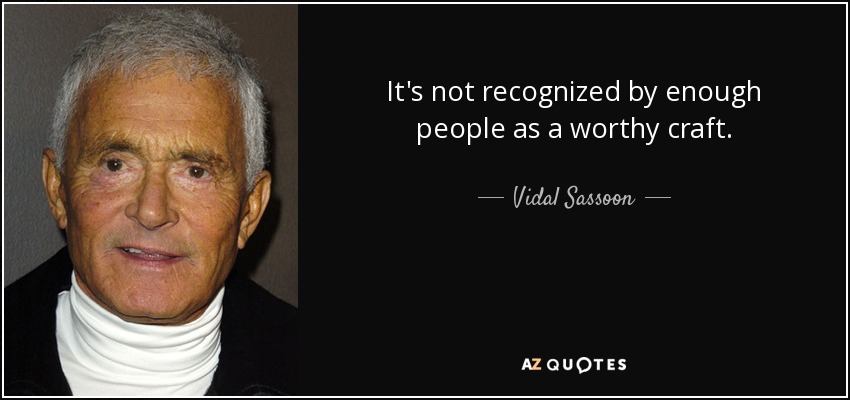
It's not recognized by enough people as a worthy craft.
Racist writing is a craft failure.
Tending 100-year-old vines, I've been fortunate to craft highly rated, small production, estate grown wines since 1998. A labor of love, our wines are sustainably farmed, carry the story of my family in every glass and are simply the most satisfying of all my personal endeavors.
The purpose of every industrial revolution is to make craft and skills obsolete, and thereby make people interchangeable and cheap.
Singing into a microphone and learning to play an instrument and learning to do your craft, that's the most important thing for people to do.
The competition, the naysayers, the owners who talk too much. The people who don't think a 36-year-old can do what I do. I take a lot of pride in my craft, I work really hard at my craft everyday, and I'm a true professional.
The ultimate aim of all artistic activity is building! ... Architects, sculptors, painters, we must all get back to craft! ... The artist is a heightened manifestation of the craftsman. ... Let us form ... a new guild of craftsmen without the class divisions that set out to raise an arrogant barrier between craftsmen and artists! ... Let us together create the new building of the future which will be all in one: architecture and sculpture and painting.
Art without heart is craft.
An art which isn't based on feeling isn't an art at all... feeling is the principle, the beginning and the end; craft, objective, technique - all these are in the middle.
The first several scenes are about sexual addiction. They're not specifically political at all... I didn't sit down and think, ''I am going to write something about the religious right.'' I started out by writing something about sexual addiction, and it evolved... I don't look at a calendar and say: ''Oh! There's going to be an election in 1996. I think now, in 1993, I'll start writing a play that'll be ready for it.''
[Henry] James is much more complex than Jane Austen. That's why it's not so easy to adapt him. People expect a nice period piece, but that's not always the case. There's a deep human mystery in his work.
[Using humor to explore serious issues] disarms people. It's a way in. It's gentle, but at the same time it's subversive, and I like that duality.
I now know that to do a worthwhile family history I must interpret the past without falling into either demonizing or unquestioning acceptance. . . . As a playwright, what I object to right now is any form of fundamentalism, whether it's nationalistic, religious or ethnic. . . . I think it is ridiculous - and fundamentalist, by the way - to say that I am not changed by the culture around me.
On their own, each [character] is a victim of no importance. But when you bring them together, they become a dangerous weapon. Jeanne is the vowel and Sophie the consonant. Psychologists know this phenomenon well. Each individual is harmless, but together they create an explosive chemical reaction. It's like Bonnie and Clyde, like Thelma and Louise.
I was not interested in doing the plot of Oedipus in blackface. I did wonder, what would these people have been like if they hadn't been in that situation?... One could look at Oedipus, or at my character Augustus, as a cynical schemer who did everything because he was hungry for power. But that's just too easy. I'm more interested in how humans can embody conflicting goals and emotions.
At best, the relationship between drama critic and playwright is a pretty twiggy affair. When I'm asked whom I write for, after the obligatory, I write only for myself, I realize that I have an imaginary circle of peers - writers and respected or savvy theatre folk, some dramatic writers and some not, some living, some long gone. . . . Often a writer is aware as he works that a certain critic is going to hate this one. . . . You don't let what a critic might say worry you or alter your work; it might even add a spark to the gleeful process of creation.
I thought if I can do something more playful and light like my play BEYOND THERAPY, it might be a money maker. I think one of the reasons BEYOND THERAPY has legs - it's been very successful for me around the country - is because it's a friendly play, rather sunny.
I'm back in fashion again for a while now. But I imagine that three or four years from now I'll be out again. And in another fifteen years I'll be back. If you try to write to stay in fashion, if you try to write to be the critics' darling, you become an employee.
And how deeply do I let business considerations affect [screenwriting] choices that might otherwise be more or less esthetic? . . . Do I choose the upbeat rather than the downer ending because I know it will score better at the preview? Can the idea be sold in a single sentence? Can it compete with space aliens and tornadoes and missions impossible?
The fear of a work becoming dated is one of the most effective tools for keeping people from writing political work.
I am not a historian. I happen to think that the content of my mother's life - her myths, her superstitions, her prayers, the contents of her pantry, the smell of her kitchen, the song that escaped from her sometimes parched lips, her thoughtful repose and pregnant laughter - are all worthy of art.
If this were a [Hollywood] studio film, I wouldn't have pushed my father into a table, I would have beat him up. My father wouldn't have kissed my girlfriend; he would have raped her.
What was once a cottage industry dedicated to the discovery and development of new voices and works has become instead the raison d'etre for many a playwright's existence . . .. And since readings have become playwrights' main source of exposure, the nature of playwriting has changed to fit readings' needs. Investigation into what is eminently theatrical has been substituted - more and more these days - by what can simply come across and read well.
I would also suggest that any aspiring writer begin with short stories. These days, I meet far too many young writers who try to start off with a novel right off, or a trilogy, or even a nine-book series. That's like starting in at rock climbing by tackling Mt. Everest. Short stories help you learn your craft.
Every flying machine has its own unique characteristics, some good, some not so good. Pilots naturally fly the craft in such a manner as to take advantage of its good characteristics and avoid the areas where it is not so good.
Follow AzQuotes on Facebook, Twitter and Google+. Every day we present the best quotes! Improve yourself, find your inspiration, share with friends
or simply: