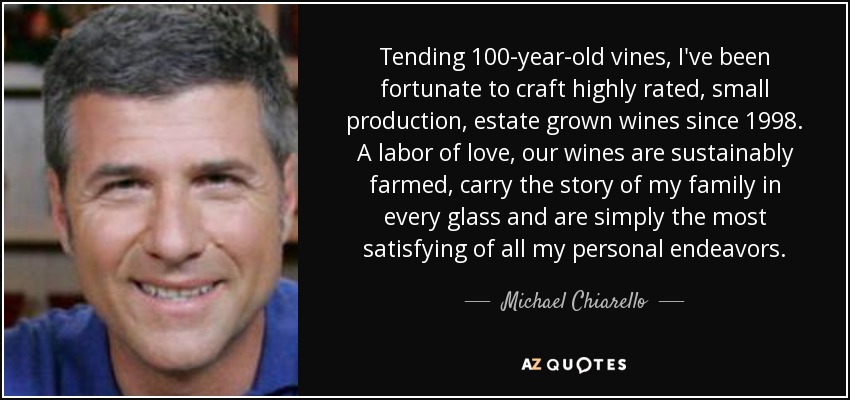
Tending 100-year-old vines, I've been fortunate to craft highly rated, small production, estate grown wines since 1998. A labor of love, our wines are sustainably farmed, carry the story of my family in every glass and are simply the most satisfying of all my personal endeavors.
The purpose of every industrial revolution is to make craft and skills obsolete, and thereby make people interchangeable and cheap.
Singing into a microphone and learning to play an instrument and learning to do your craft, that's the most important thing for people to do.
The competition, the naysayers, the owners who talk too much. The people who don't think a 36-year-old can do what I do. I take a lot of pride in my craft, I work really hard at my craft everyday, and I'm a true professional.
The ultimate aim of all artistic activity is building! ... Architects, sculptors, painters, we must all get back to craft! ... The artist is a heightened manifestation of the craftsman. ... Let us form ... a new guild of craftsmen without the class divisions that set out to raise an arrogant barrier between craftsmen and artists! ... Let us together create the new building of the future which will be all in one: architecture and sculpture and painting.
Art without heart is craft.
An art which isn't based on feeling isn't an art at all... feeling is the principle, the beginning and the end; craft, objective, technique - all these are in the middle.
Harvey [Weinstein] didn't want to release [MY SON THE FANATIC]; he held it for two years because he wanted a happy ending, although I don't know what that means. Does that mean the taxi driver leaves his wife or doesn't leave his wife? I think it has a happy ending.
Actually, who hasn't been through the ghastly experience of sitting in front of a blank page, with its toothless mouth grinning at you: Go ahead, let's see you lay a finger on me? A blank page is actually a whitewashed wall with no door and no window. Beginning to tell a story is like making a pass at a total stranger in a restaurant.
The dream of a writer is to be surprised by his characters. All of a sudden, they are living their own lives; they are not prisoners anymore. . . . Tati taught me how to observe, how to sit in a cafe in Paris and to look at the passersby and to guess what their story is, even a little moment of their story.
[VIA DOLOROSA]'s pushing Broadway as far as it can be pushed. I stand before you as a reporter, and you have to decide whether I'm an honest reporter or not. And if you're convinced that I am honest, then I think that you will listen to me in a way that you wouldn't have listened to a fiction where scenes are made. . . . I've thought quite long and hard about what I want to say in this play. And if it means that every single sentiment that I produce is put minutely under an ideological microscope, that's fine.
Broadway remains the closest thing we have to a national theatre, the place where the greatest number of people can potentially see new work. For an American playwright to say it doesn't matter is simply to capitulate to the current situation.
Talk isn't work. Work is when you have pages in the evening that you didn't have in the morning.
It's a movie, OK? I went to see GONE WITH THE WIND, but did I really believe there was a guy named Rhett Butler who said, "Frankly, my dear, I don't give a damn"? No. Movies need heroes and villains, and real life doesn't usually have heroes and villains. Real life has a lot of shades of gray, and moves have black and white even when they're in color.
I am the same artist with the same nagging questions I had in my early 20's. What's real and what isn't? How do we tell what's real in our lives? How do we see things as they are? What is my role in life? If the Signature hadn't forced the issue by devoting its season to my plays, I could at least believe I had changed. Really, they're all the same! What is SIX DEGREES OF SEPARATION but THE HOUSE OF BLUE LEAVES with money?
Consider: for all the gobbledegook [film studio] executives spout about backstory, all that we, the audience, want to know is what happens next. That's the only thing that's going on. . . . Character is nothing other than action, and character-driven means The plot stinks, and you'd better hope the star is popular enough to open the movie in spite of it.
Obviously VIA DOLOROSA is completely artificial. It is as highly wrought as any of my plays. But basically all the artifice is to disguise itself so you don't feel it's there. You're attempting to make the artifice like a pane of glass that simply leads you through to the subject - not to decorate the bloody glass.
There's this sense of being strange, which is at the heart of every creative person. Every writer, every actor, every director knows who Ripley is. We've made careers and lives out of pretending, making things up, inhabiting other people's stories and lives. That's what I do every day. . . . The story is so audacious and subversive: a central character who behaves badly and isn't apparently caught. That intrigued me no end.
Real life has always let me down. That's why I do the monologues. I have always said I would rather tell a life than live a life. But I have to live a life in order to tell one.
What I find interesting is how close you can run the laughter along the seam of seriousness, and occasionally cross it, so that half the house genuinely doesn't know whether to laugh or cry. Custard pie humour is fairly universal, but at the other end, which I'm more interested in, there's the humour that hovers on the darkness, that walks in the shadow of something else, not always that obvious.
Regarding pushing the form, ideas interest me more than form. I think you can write a very subversive play in a three-act structure. The content makes the play. I feel the form is simply dressing, because ultimately, you want to communicate to the audience, and sometimes the best way to do that is to present a provocative idea in a format that is comfortable for them to receive. Then the idea will come through directly, right in solar plexus. After all, I want to make a living as an artist, and that means speaking to the audience in a form they can understand.
I would also suggest that any aspiring writer begin with short stories. These days, I meet far too many young writers who try to start off with a novel right off, or a trilogy, or even a nine-book series. That's like starting in at rock climbing by tackling Mt. Everest. Short stories help you learn your craft.
Every flying machine has its own unique characteristics, some good, some not so good. Pilots naturally fly the craft in such a manner as to take advantage of its good characteristics and avoid the areas where it is not so good.
And more than once in the course of time, the same theme reappears: among the mystics of the fifteenth century, it has become the motif of the soul as a skiff, abandoned on the infinite sea of desires, in the sterile field of cares and ignorance, among the mirages of knowledge, amid the unreason of the world - a craft at the mercy of the sea's great madness, unless it throws out a solid anchor, faith, or raises its spiritual sails so that the breath of God may bring it to port.
Clarity precedes mastery. Craft clear and precise plans/goals/deliverables. And then block out all else.
Follow AzQuotes on Facebook, Twitter and Google+. Every day we present the best quotes! Improve yourself, find your inspiration, share with friends
or simply: