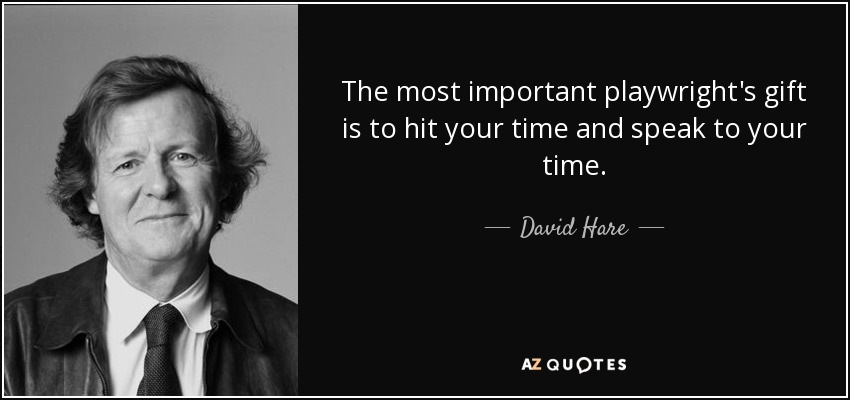
The most important playwright's gift is to hit your time and speak to your time.
On their own, each [character] is a victim of no importance. But when you bring them together, they become a dangerous weapon. Jeanne is the vowel and Sophie the consonant. Psychologists know this phenomenon well. Each individual is harmless, but together they create an explosive chemical reaction. It's like Bonnie and Clyde, like Thelma and Louise.
I was not interested in doing the plot of Oedipus in blackface. I did wonder, what would these people have been like if they hadn't been in that situation?... One could look at Oedipus, or at my character Augustus, as a cynical schemer who did everything because he was hungry for power. But that's just too easy. I'm more interested in how humans can embody conflicting goals and emotions.
At best, the relationship between drama critic and playwright is a pretty twiggy affair. When I'm asked whom I write for, after the obligatory, I write only for myself, I realize that I have an imaginary circle of peers - writers and respected or savvy theatre folk, some dramatic writers and some not, some living, some long gone. . . . Often a writer is aware as he works that a certain critic is going to hate this one. . . . You don't let what a critic might say worry you or alter your work; it might even add a spark to the gleeful process of creation.
I thought if I can do something more playful and light like my play BEYOND THERAPY, it might be a money maker. I think one of the reasons BEYOND THERAPY has legs - it's been very successful for me around the country - is because it's a friendly play, rather sunny.
I'm back in fashion again for a while now. But I imagine that three or four years from now I'll be out again. And in another fifteen years I'll be back. If you try to write to stay in fashion, if you try to write to be the critics' darling, you become an employee.
And how deeply do I let business considerations affect [screenwriting] choices that might otherwise be more or less esthetic? . . . Do I choose the upbeat rather than the downer ending because I know it will score better at the preview? Can the idea be sold in a single sentence? Can it compete with space aliens and tornadoes and missions impossible?
The fear of a work becoming dated is one of the most effective tools for keeping people from writing political work.
I am not a historian. I happen to think that the content of my mother's life - her myths, her superstitions, her prayers, the contents of her pantry, the smell of her kitchen, the song that escaped from her sometimes parched lips, her thoughtful repose and pregnant laughter - are all worthy of art.
If this were a [Hollywood] studio film, I wouldn't have pushed my father into a table, I would have beat him up. My father wouldn't have kissed my girlfriend; he would have raped her.
What was once a cottage industry dedicated to the discovery and development of new voices and works has become instead the raison d'etre for many a playwright's existence . . .. And since readings have become playwrights' main source of exposure, the nature of playwriting has changed to fit readings' needs. Investigation into what is eminently theatrical has been substituted - more and more these days - by what can simply come across and read well.
Work with good directors. Without them your play is doomed. At the time of my first play, I thought a good director was someone who liked my play. I was rudely awakened from that fantasy when he directed it as if he loathed it. . . . Work with good actors. A good actor hears the way you (and no one else) write. A good actor makes rewrites easy. A good actor tells you things about your play you didn't know.
Lots of my friends and family belong to churches, and some of them are part of the so-called Christian Right. In this preacher, I wanted to show a good man struggling to reconcile his commitment to the community with the political agenda of his church. He does not see that as a dilemma, but I do.
I'm giving up acting. . . . I'm 66 and there are a number of celebrations I've got to get down on paper, and acting doesn't allow me to do that. It was a hell of a drug, performance. It's a great thrill, especially for a storyteller. But it can go. Directing can go. Writing can't go. And in terms of what lies ahead, I want to have a burning focus - almost like smoke coming up from the paper as I write.
Some can just knock it out and some have to lock themselves in a room and get to a fever pitch of self-loathing before they turn in a first draft. . . . each writer's process is screwed up in its own way.
This is about the daily ins and outs of a marriage. I don't want to give away the ending, but they are trying either to make the marriage work or make the separation work. Our job is to make that interesting.
I went in right up front and said, This can't be about some guy in bandages. I didn't even want to do a horror movie. I took the concept and made a romantic adventure film. I like action heroes who don't take themselves too seriously. I wanted to make everyone take the mummy seriously, but it couldn't just be a guy in bandages. But the main thing was to build in surprises. That's one of the great things you can do with special effects.
People think I write fantasy, but I don't; some things may be exaggerated or distorted in the same way that painters distort and alter things, but they're realistic figures. They're perfectly recognisable.
I work sometimes from outlines, which are immediately abandoned. Sometimes, when I'm trying to find the characters, I'll sketch things out a bit. Sometimes, outlines help me aim a little bit, but I tend to find it's usually much more interesting, especially with the first draft, to spew it onto the page. I used to get very nervous that, if I write this first rough draft and I die that night, whoever finds it might think that I thought it was good. For me, it's much more important to get some general shape onto the page and later take all the time I need to refine it, fix it, and rewrite it.
I write in order to understand the images. Being what my agent . . . somewhat ruefully calls a language playwright, is problematic because in production, you have to make the language lift off the page. But a good actor can turn it into human speech. I err sometimes toward having such a compound of images that if an actor lands heavily on each one, you never pull through to a larger idea. That's a problem for the audience. But I come to playwriting from the visual world - I used to be a painter. I also really love novels and that use of language. But it's tricky to ask that of the theatre.
I'm like a blue-collar writer. I just sit down every day and I write.
Harvey [Weinstein] didn't want to release [MY SON THE FANATIC]; he held it for two years because he wanted a happy ending, although I don't know what that means. Does that mean the taxi driver leaves his wife or doesn't leave his wife? I think it has a happy ending.
Actually, who hasn't been through the ghastly experience of sitting in front of a blank page, with its toothless mouth grinning at you: Go ahead, let's see you lay a finger on me? A blank page is actually a whitewashed wall with no door and no window. Beginning to tell a story is like making a pass at a total stranger in a restaurant.
The dream of a writer is to be surprised by his characters. All of a sudden, they are living their own lives; they are not prisoners anymore. . . . Tati taught me how to observe, how to sit in a cafe in Paris and to look at the passersby and to guess what their story is, even a little moment of their story.
[VIA DOLOROSA]'s pushing Broadway as far as it can be pushed. I stand before you as a reporter, and you have to decide whether I'm an honest reporter or not. And if you're convinced that I am honest, then I think that you will listen to me in a way that you wouldn't have listened to a fiction where scenes are made. . . . I've thought quite long and hard about what I want to say in this play. And if it means that every single sentiment that I produce is put minutely under an ideological microscope, that's fine.
Follow AzQuotes on Facebook, Twitter and Google+. Every day we present the best quotes! Improve yourself, find your inspiration, share with friends
or simply: