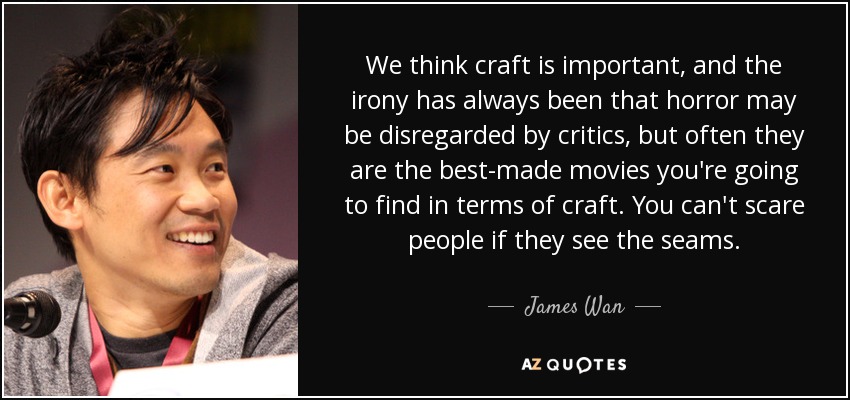
We think craft is important, and the irony has always been that horror may be disregarded by critics, but often they are the best-made movies you're going to find in terms of craft. You can't scare people if they see the seams.
I don't write for publishers, certainly not for critics, and not for readers, But I am delighted that so many people have found my books enjoyable and want to continue to read them.
The simplest kind of guidance (critique) comes every day, and many times a day in the form of discomfort.
Criticism challenges current findings. The effort to defend one's position can lead to deeper insights or consideration of options previously not considered.
People call you this or that. But I can't respond because then it seems like I'm defensive, you know, what does it matter, really?
The naysayers, they don't mean a thing.
The only players I hurt with my words are the ones who have an inflated opinion of their ability.
People who are criticizing... don't really get it, because if they did, they would like it.
We read critics for the perceptions, for what they tell us that we didn't fully grasp when we saw the work. The judgments we can usually make for ourselves.
He [Zampano] probably would of insisted on corrections and edits, he was his own harshest critic, but I've come to believe errors, especially written errors, are often the only markers left by a solitary life: to sacrifice them is to lose the angels of personality, the riddle of a soul. In this case a very old soul. A very old riddle.
Critics don't want to see directors they like make too much of a left turn. That's good for criticism.
IMBECILITY, n. A kind of divine inspiration, or sacred fire affecting censorious critics of this dictionary.
Do the thing itself. Don’t pay much mind to critics or what anyone says about it. Just do it, in any form possible, and watch others doing it. Take it in viscerally, get it by osmosis. Don’t ever read your own reviews, certainly not the good ones.
I don't like it when they [media critics] see me as this little person who doesn't know what to do with herself -- like I have no idea what I want, like I'm just a puppet ... That's demeaning to me, because that ain't how it is, and it never was.
If you write something and they all tell you it is bad - editors, critics, everybody - think it over and you may become convinced that they are right (though you are not to be ashamed or discouraged for a minute, but keep on writing).
Some find it easier to bend their knees than their minds. Exciting exploration is preferred to plodding implementation; speculation seems more fun than consecration, and so is trying to soften the hard doctrines instead of submitting to them. Worse still, by not obeying, these . . . lack real knowing. Lacking real knowing, they cannot defend their faith and may become critics instead of defenders!
We have to look at our own inertia, insecurities, self-hate, fear that, in truth, we have nothing valuable to say. When your writing blooms out of the back of this garbage compost, it is very stable. You are not running from anything. You can have a sense of artistic security. If you are not afraid of the voices inside you, you will not fear the critics outside you.
There are two sorts of beauty; one is the result of instinct, the other of study. A combination of the two, with the resulting modifications, brings with it a very complicated richness, which the art critic ought to try to discover.
We often feed the critic gourmet meals and starve the rest.
Don't let fear of failure discourage you. Don't let the voice of critics paralyze you - whether that voice comes from the outside or the inside.
I learned that lesson a long time ago. When you write popular fiction, you're going to get bashed by critics.
There is something particularly unique about the films of Hong Sang-soo...it's got to do with his masterful sense of storytelling... as the critic Manny Farber once said of Hitchcock's ROPE Hong Sang-soo's pictures unpeel like an orange.
All I am in private life is a literary critic and historian, that's my job...And I'm prepared to say on that basis if anyone thinks the Gospels are either legends or novels, then that person is simply showing his incompetence as a literary critic. I've read a great many novels and I know a fair amount about the legends that grew up among early people, and I know perfectly well the Gospels are not that kind of stuff.
In my experience when critics raise these objections, they invariably violate one of seventeen principles for interpreting the Scriptures....For example, assuming the unexplained is unexplainable....failing to understand the context of the passage....assuming a partial report is a false report...neglecting to interpret difficult passages in light of clear ones; basing a teaching on an obscure passage; forgetting that the Bible uses nontechnical, everyday language; failing to remember the Bible uses different literary devices.
If critics and competitors can't match your results, they will often denigrate the way you achieve them. Fast, intuitive types are called lazy. Dedicated burners of the midnight oil are called obsessed. And while it's obviously not a bad idea to hear and consider the opinions of others, you should be suspicious when these criticisms emerge right on the heels of success.
Follow AzQuotes on Facebook, Twitter and Google+. Every day we present the best quotes! Improve yourself, find your inspiration, share with friends
or simply: