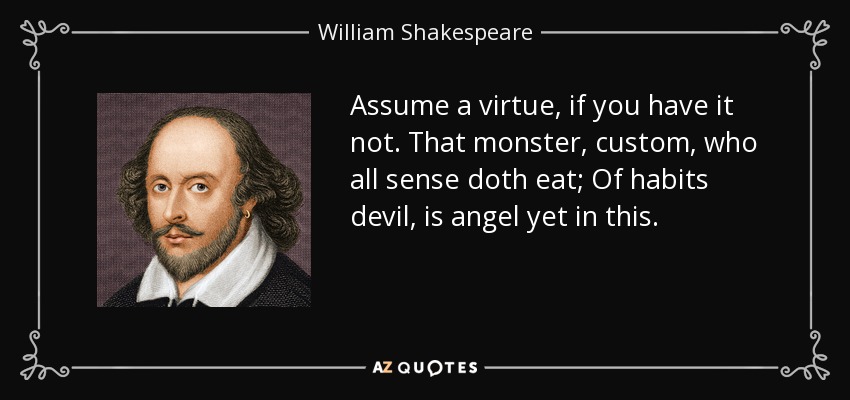
Assume a virtue, if you have it not. That monster, custom, who all sense doth eat; Of habits devil, is angel yet in this.
In his Philosophy of Style, Herbert Spencer gives two sentences to illustrate how the vague and general can be turned into the vivid and particular: In proportion as the manners, customs, and amusements of a nation are cruel and barbarous, the regulations of its penal code will be severe. In proportion as men delight in battles, bullfights, and combats of gladiators, will they punish by hanging, burning, and the rack.
Laws and customs may be creative of vice; and should be therefore perpetually under process of observation and correction: but laws and customs cannot be creative of virtue: they may encourage and help to preserve it; but they cannot originate it.
Our ideals, laws and customs should be based on the proposition that each generation in turn becomes the custodian rather than the absolute owner of our resources - and each generation has the obligation to pass this inheritance on in the future.
The game (baseball)was a custom of his clan, and it gave outlet for the homicidal and sides-taking instincts which Babbitt called "patriotism" and "love of sport."
You are still young, so you think only of your own self. You do not notice the tribulations that occur all around you, to other people. Do not protest; it is true. I am not condemning you. I was as selfish as you, when I was your age. It is the custom of the young to be selfish... But someday you will understand that nobody passes through this world without suffering-no matter what you think of them and their supposed good fortune.
There is no more ridiculous custom than the one that makes you express sympathy once and for all on a given day to a person whose sorrow will endure as long as his life. Such grief, felt in such a way is always present, it is never too late to talk about it, never repetitious to mention it again.
Were the judgments of mankind correct, custom would be regulated by the good. But it is often far otherwise in point of fact; for, whatever the many are seen to do, forthwith obtains the force of custom. But human affairs have scarcely ever been so happily constituted as that the better course pleased the greater number. Hence the private vices of the multitude have generally resulted in public error, or rather that common consent in vice which these worthy men would have to be law.
Culture changes, fashions change, customs change. Great music is immortal.
RITE, n. A religious or semi-religious ceremony fixed by law, precept or custom, with the essential oil of sincerity carefully squeezed out of it.
Perhaps no custom reveals our character as a Nation so clearly as our celebration of Thanksgiving Day.
This means that they are bound by law and custom to plough the fields of their masters, harvest the corn, gather it into barns, and thresh and winnow the grain; they must also mow and carry home the hay, cut and collect wood, and perform all manner of tasks of this kind.
USAGE, n. The First Person of the literary Trinity, the Second and Third being Custom and Conventionality. Imbued with a decent reverence for this Holy Triad an industrious writer may hope to produce books that will live as long as the fashion.
Again and again in history some people wake up. They have no ground in the crowd and move to broader deeper laws. They carry strange customs with them and demand room for bold and audacious action. The future speaks ruthlessly through them. They change the world.
Nothing is more detestable to the physical anthropologist than... the wretched habit of cremating the dead. It involves not only a prodigal waste of costly fuel and excellent fertilizer, but also the complete destruction of physical historical data. On the other hand, the custom of embalming and mummification is most praiseworthy and highly to be recommended.
Unless we can psychologically accommodate change, we ourselves begin to die, inwardly. What I am saying is that objects, customs, habits, and ways of life must perish so that the authentic human being can live. And it is the authentic human being who matters most, the viable, elastic organism which can bounce back, absorb, and deal with the new.
We do not need to understand other people and their customs fully to interact with them and learn in the process; it is making the effort to interact without knowing all the rules, improvising certain situations, which allows us to grow.
When we want to infuse new ideas, to modify or better the habits and customs of a people, to breathe new vigor into its national traits, we must use the children as our vehicle; for little can be accomplished with adults.
Plenty is the original cause of many of our needs; and even the poverty, which is so frequent and distressful in civilized nations, proceeds often from that change of manners which opulence has produced. Nature makes us poor only when we want necessaries; but custom gives the name of poverty to the want of superfluities.
In the west, Apollo and Dionysus strive for victory. Apollo makes the boundary lines that are civilization but that lead to convention, constraint, oppression. Dionysus is energy unbound, mad, callous, destructive, wasteful. Apollo is law, history, tradition, the dignity and safety of custom and form. Dionysus is the new, exhilarating but rude, sweeping all away to begin again. Apollo is a tyrant, Dionysus is a vandal.
In sum, all actions and habits are to be esteemed good or evil by their causes and usefulness in reference to the commonwealth, and not by their mediocrity, nor by their being commended. For several men praise several customs, and, contrarily, what one calls vice, another calls virtue, as their present affections lead them.
Custom, then, is the great guide of human life. It is that principle alone, which renders our experience useful to us, and makes us expect, for the future, a similar train of events with those which have appeared in the past.
The imagination of man is naturally sublime, delighted with whatever is remote and extraordinary, and running, without control, into the most distant parts of space and time in order to avoid the objects, which custom has rendered too familiar to it.
It is the custom of the immortal gods to grant temporary prosperity and a fairly long period of impunity to those whom they plan to punish for their crimes, so that they may feel it all the more keenly as a result of the change in their fortunes.
It behaves more like a tribe than a democratic institution...responding to custom rather than reason and using its own liturgy and language for the conduct of its domestic affairs.
Follow AzQuotes on Facebook, Twitter and Google+. Every day we present the best quotes! Improve yourself, find your inspiration, share with friends
or simply: