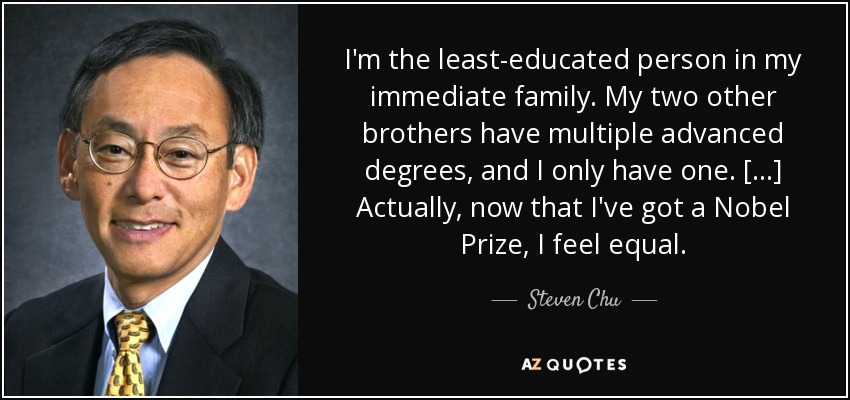
I'm the least-educated person in my immediate family. My two other brothers have multiple advanced degrees, and I only have one. [...] Actually, now that I've got a Nobel Prize, I feel equal.
How a designer gets from thought to thing is, at least in broad strokes, straightforward: (1) A designer conceives a purpose. (2) To accomplish that purpose, the designer forms a plan. (3) To execute the plan, the designer specifies building materials and assembly instructions. (4) Finally, the designer or some surrogate applies the assembly instructions to the building materials. What emerges is a designed object, and the designer is successful to the degree that the object fulfills the designer's purpose.
People write or speak sentences in order to produce an effect, and the success of a sentence is measured by the degree to which the desired effect has been achieved.
Our world is integrated to an unprecedented degree, while the global political awakening is injecting into interstate relations an intense amount of tension, emotion, even irrationality, which could cumulatively produce circumstances that preclude an effective and genuinely shared universal response to new global problems.
History is filled with examples of men and women who rendered highly effective performance without the conventional badges of accomplishment in terms of certificates, diplomas, or degrees. Diplomas and tests are useful servants, but Congress has mandated the commonsense proposition that they are not to become masters of reality.
There are many degrees of Probable, some nearer Truth than others, in the determining of which lies the chief exercise of our Judgment.
Every kind of science, if it has only reached a certain degree of maturity, automatically becomes a part of mathematics.
The Only cure for nihilism is for liberal democratic societies - their electorates, their judiciary, and their political leadership- to insist that force is legitimate only to the degree that it serves defensible poltical goals. Thus implies a constant exercise of due diligence.
Thus, while I thought myself employed only in forming a Nomenclature, and while I proposed to myself nothing more than to improve the chemical language, my work transformed itself by degrees, without my being able to prevent it, into a treatise upon the Elements of Chemistry.
To estimate the value of Newton's discoveries, or the delight communicated by Shakespeare and Milton, by the price at which their works have sold, would be but a poor measure of the degree in which they have elevated and enchanted their country; nor would it be less grovelling and incongruous to estimate the benefit which the country has derived from the Revolution of 1688, by the pay of the soldiers, and all other payments concerned in effecting it.
I strenuously object to the very word "grotesque" which has become hackneyed to the point of nausea...I would prefer my music to be described as "Scherzo-ish" in quality, or else by three words describing the various degrees of the Scherzo - whimsicality, laughter, mockery.
The Berbers, among whom even today one finds light skins and blue eyes, do not go back to the Vandal invasions of the fifth century A.D., but to the prehistoric Atlantic Nordic human wave. The Kabyle huntsmen, for example, are to no small degree still wholly Nordic (thus the blond Berbers in the region of Constantine form 10 % of the population; at Djebel Sheshor they are even more numerous).
global warming. every day i leave my house and think, "was it this hot last year?" the heat this summer here in LA and in most of the US has been unbearable. i can't remember another time when it was 105 degrees fahrenheit out here (40.5 celsius), and that's the kind of weather we've been having pretty much every day.
Severe isn't a word normally associated with a cold. Severe is for weather or third-degree burns...No one responds 'severe' when someone asks how her cold is.In fact, nine out of ten Americans respond to 'How's your cold' with 'It sucks.' So there should be an It Sucks cold formula.
In ancient times there was no public education, except that of the forum, the theater, and the street, and the general degree of illiteracy was very high. The early men of science were left very much to themselves and such a phrase as "the scientific culture of Alexandria in the third century B.C." does not cover any reality. In a sense, this is still true today; the real pioneers are so far ahead of the crowd (even a very literate crowd) that they remain almost alone.
The Hellenistic world was international to a degree, polyglot and inspired by many religious faiths. ...the Greek ideals were pagan and the Hellenistic age witnessed their death struggle against Asiatic and Egyptian mysteries , on the one side, and against Judaism , on the other.
You become a serious programmer by going through a stage where you are fully aware of the degree to which you know the specification, meaning both the explicit and the tacit specification of your language and of your problem. "Hey, it works most of the time" is the very antithesis of a serious programmer, and certain languages can only support code like that.
Regeneration is the fountain; sanctification is the river (in deeper or shallower degree). 'Entire sanctification' is the river in fullest flow.
People are self-centered to a nauseous degree. They will keep on about themselves while I'm explaining me.
Common sense is a phrase employed to denote that degree of intelligence, sagacity, and prudence which is common to all men.
Becoming an artist cannot be taught. A degree and diligence is not a guarantee that one can become an 'artist.
Even though I'm a realist, I try to let the medium show and allow it a certain degree of freedom.
I think being an only child created in me a degree of self-reliance, which I'm glad of. It made me perfectly happy with my own company and perhaps was good conditioning for the protracted solitude of writing books as slowly as I do.
The act of greatest subversion ... is the one of indifference. A man, or a group, finds it unbearable that someone can be simply uninterested in his, or its, convictions. ... There is a degree of complicity, or mutual respect, between the believer and the man who attacks his beliefs (the revolutionary), for the latter takes them seriously.
History is valuable, to begin with, because it is true; and this, though not the whole of its value, is the foundation and condition of all the rest. That all knowledge, as such, is in some degree good, would appear to be at least probable; and the knowledge of every historical fact possesses this element of goodness, even if it posses no other.
Follow AzQuotes on Facebook, Twitter and Google+. Every day we present the best quotes! Improve yourself, find your inspiration, share with friends
or simply: