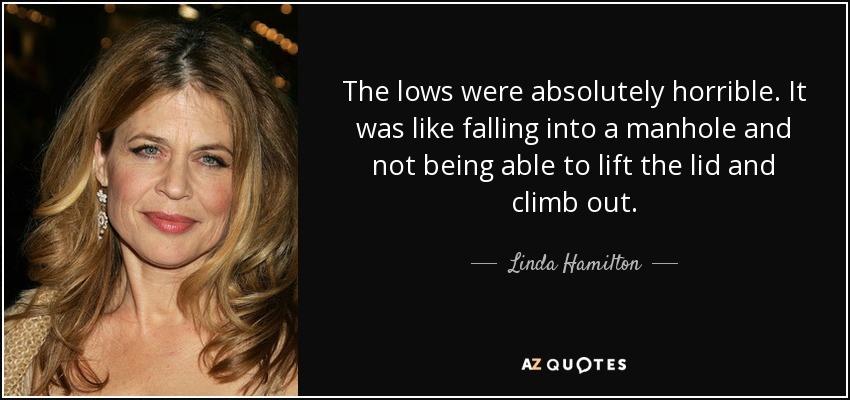
The lows were absolutely horrible. It was like falling into a manhole and not being able to lift the lid and climb out.
There's no grand excellence to it. In my experience it was just almost the gulaggy boringness of it that'll kill you. You're just in this murk. And you're with other humans, but you lose all your human skills and it's just like you're in this plastic bag and you can't quite connect with people. You lose your ability to transmit electricity or something, and to receive it.
On one level my sense of despair had been dispelled by therapy, yet on another it had not been replaced by either the desire for a future or the concept of one. I felt more aware of who I was, but that in itself-dominated as it was by sensations of fragmentation and isolation-filled me with no great hope, and in many ways only fuelled an appetite for destruction.
It's all a matter of history. Brandy is no solace. Librium only lies me down like a dead snow queen. Yes! I am still the criminal.
..Since depression is a genetic biological illness, like diabetes, or low thyroid, it wasn't lack of character, laziness, or something I could "snap out of"-it would be like trying to snap out of a toothache.
Depression is an illness that robs one of the meaning of life. Heal the illness. As the depression heals, enthusiasm, well-being, and a sense of life's purpose will return.
There are many misconceptions about depression-mostly negative. Unfortunately, because depressed people think negatively about depression and its treatment, they don't get help, which allows the depression to worsen, which leads to more negative thinking, which produces a vicious cycle of suffering.
And I just can't live in this present. I would go mad if I did.
..we are trained as children to get good grades, get a good job, get a good spouse, get children, get ahead. In all this getting we get something else: anxiety and depression.
True depression is a terribly real thing. Some of the noblest men and women in the world have been prone to it ... They may have no reason for feeling more unhappy at that particular period than at any other. Their worldly circumstances may be just what they have been for a long time past, and perfectly satisfactory. But there suddenly closes down on them a fog of the mind which exaggerates and distorts everything.
I began to think that melancholy was a dialect that only some people knew-or could even hear-and in my conversations, I sought these people out.
I imagine there's a market for total depression. I grew up on George Jones and that really dark stuff.
You can have manic depression without having an ounce of creativity
Depression is close to me, but suicide hasn't been.
I don't like standing near the edge of a platform when an express train is passing through. I like to stand right back and if possible get a pillar between me and the train. I don't like to stand by the side of a ship and look down into the water. A second's action would end everything. A few drops of desperation.
I met my wife in Washington, D.C. I was a senior in college. WW II was about to descend upon us. Jobs were starting to open up after a prolonged depression.
But then back on lithium and rotating on the planet at the same pace as everyone else, you find your credit is decimated, your mortification complete: mania is not a luxury one can easily afford. It is devastating to have the illness and aggravating to have to pay for medications, blood tests, and psychotherapy. They, at least, are partially deductible. But money spent while manic doesn't fit into the Internal Revenue Service concept of medical expense or business loss. So after mania, when most depressed, you're given excellent reason to be even more so.
It was as if my father had given me, by way of temperament, an impossibly wild, dark, and unbroken horse. It was a horse without a name, and a horse with no experience of a bit between its teeth. My mother taught me to gentle it; gave me the discipline and love to break it; and- as Alexander had known so intuitively with Bucephalus- she understood, and taught me, that the beast was best handled by turning it toward the sun.
He wondered if this was what clinical depression felt like, a total numbness, a weary lack of hope.
I cling to depression, thinking it a form of truth.
I realized how for all of us who came of age in the late sixties and early seventies the war was a defining experience. You went o r you didn't, but the fact of it and the decisions it forced us to make marked us for the rest of our lives, just as the depression and World War II had marked my parents.
Having a book is somewhat like having a baby, as many woman writers have observed before me: the conception, the long preparation, the wait, the growing heaviness (not of body in this case but of the spirit and the manuscript) toward the end, the initial delight at the sight of the product, fully formed and seemingly perfect, and then the usual postpartum depression. What will people whose opinion I care about, and those whose views I don't value but have weight in the world of reader, think of it?
Someone is always at my elbow reminding me that I am the grand-daughter of slaves. It fails to register depression with me. Slaver y is sixty years in the past. The operation was successful and the patient is doing well, thank you. The terrible struggle that made me an American out of a potential slave said "On the line!" The Reconstruction said "Go!" I am off to a flying start and I must not halt in the stretch to look behind and weep.
Unless you are political or intellectual, events like the Depression are seen as personal events. We thought of the Depression as something that made the pipes freeze; we thought it hit us because Daddy didn't move his taxi stand and because he broke his hip. It was only later I found out it was a national phenomenon.
Strong emotional experiences are for the most part impersonal. Anyone who has hated another person so much that only chance stands between that person and death knows this, as does whoever has fallen into the catastrophe of a deep depression, anyone who has loved a woman to the dregs, anyone who has beaten others bloody or ever come up behind another person with muscles trembling. "Losing one's head," language calls it. Emotional experience is, in itself, poor in qualities; qualities are brought to it by the person who has the experience.
Follow AzQuotes on Facebook, Twitter and Google+. Every day we present the best quotes! Improve yourself, find your inspiration, share with friends
or simply: