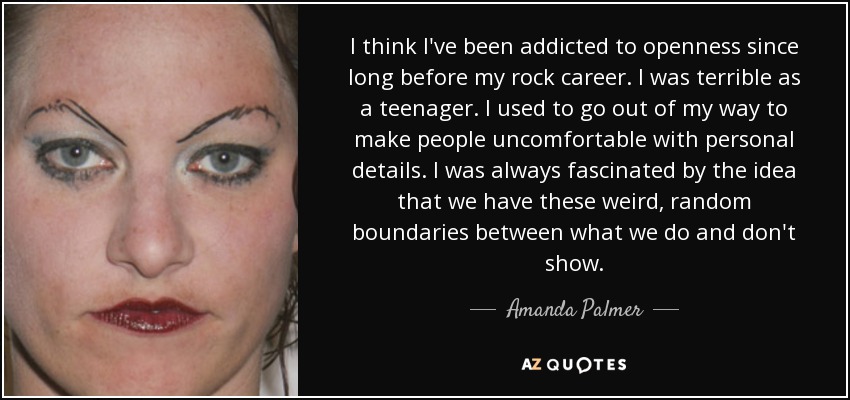
I think I've been addicted to openness since long before my rock career. I was terrible as a teenager. I used to go out of my way to make people uncomfortable with personal details. I was always fascinated by the idea that we have these weird, random boundaries between what we do and don't show.
Our visual cortexes are wired to quickly recognize faces and then quickly subtract massive amounts of detail from them, zeroing in on their essential message: Is this person happy? Angry? Fearful? Individual faces may vary greatly, but a smirk on one is a lot like a smirk on another. Smirks are conceptual, not pictorial. Our brains are like cartoonists - and cartoonists are like our brains, simplifying and exaggerating, subordinating facial detail to abstract comic concepts.
I have a lot of trouble understanding all the detail of finance and administration - but if you combine intellectual and professional capacity with a social conscience, you can change things: countries, structures, economic models, colonial states.
If theory is the role of the architect, then such beautiful proofs are the role of the craftsman. Of course, as with the great renaissance artists, such roles are not mutually exclusive. A great cathedral has both structural impressiveness and delicate detail. A great mathematical theory should similarly be beautiful on both large and small scales.
..I sought a world philosophy-or an integral philosophy-that would believably weave together the many pluralistic contexts of science, morals, aesthetics, Eastern as well as Western philosophy, and the world's great wisdom traditions. Not on the level of details-that is finitely impossible; but on the level of orienting generalizations: a way to suggest that the world really is one, undivided, whole, and related to itself in every way: a holistic philosophy for a holistic Kosmos, a plausible Theory of Everything.
Personal revelation, consecration of performance, attention to detail, and dependency on God-with these qualities you cannot fail.
It's a proprietary strategy. I can't go into it in great detail.
My motivation to keep hiking was rooted in the magnificent details of the Appalachian Mountains, and the more I poured myself out - the more energy I gave the trail - the more it gave me in return.
The science delusion is the belief that science already understands the nature of reality in principle, leaving only the details to be filled in.
People who imagine themselves to be self-made seldom enjoy examining the process of manufacture in detail.
Imagine a country where the majority of the population reaps the majority of the benefits for their hard work, creative ingenuity, and collaborative efforts. Imagine a country where corporate losses arent socialized, while gains are captured by an exclusive minority. Imagine a country run as a democracy, from the bottom up, not a plutocracy from the top down. Richard Wolff not only imagines it, but in his compelling, captivating and stunningly reasoned new book, Democracy at Work, he details how we get there from here - and why we absolutely must.
The details of our struggle to survive and prosper, in what has been a difficult and sometimes bitter relationship with a system of laws and practices that deny us access to the tools necessary for productive and industrious life, are available to any serious student of history or sociology.
You don't know what it is to store up a lot of details and then come upon something real.
See every crack, every detail. I learned to really see and not just look at my business.
You have to record as many details as possible and achieve an order, without taking away the complexity of the real. To voice the real and at the same time to create an image that is a world in itself, with its own coherence, its autonomy and sovereignty; an image that thinks
I don't have a great eye for detail. I leave blanks in all of my stories. I leave out all detail, which leaves the reader to fill in something better.
If it is true that an influx of doubt and uncertainty actually marks periods of healthy growth in a science, then evolutionary biology is flourishing today as it seldom has flourished in the past. For biologists collectively are less agreed upon the details of evolutionary mechanics than they were a scant decade ago. Superficially, it seems as if we know less about evolution than we did in 1959, the centennial year of Darwin's on the Origin of Species.
I am never in a hurry to reach details. First and above all I am interested in the large masses and the general character of a picture; when these are well established, then I try for subtleties of form and color. I rework the painting constantly and freely, and without any systematic method.
In short, what the living wage is really about is not living standards, or even economics, but morality. Its advocates are basically opposed to the idea that wages are a market price-determined by supply and demand, the same as the price of apples or coal. And it is for that reason, rather than the practical details, that the broader political movement of which the demand for a living wage is the leading edge is ultimately doomed to failure: For the amorality of the market economy is part of its essence, and cannot be legislated away.
You can't remember sex. You can remember the fact of it, and recall the setting, and even the details, but the sex of the sex cannot be remembered, the substantive truth of it, it is by nature self-erasing, you can remember its anatomy and be left with a judgment as to the degree of your liking of it, but whatever it is as a splurge of being, as a loss, as a charge of the conviction of love stopping your heart like your execution, there is no memory of it in the brain, only the deduction that it happened and that time passed, leaving you with a silhouette that you want to fill in again.
In the 19th century the anatomy of the eye was known in great detail and the sophisticated mechanisms it employs to deliver an accurate picture of the outside world astounded everyone who was familiar with them.
Photography has an amazing ability to capture the fine detail of surface textures. But far too often these intricate patterns are loved by the photographer for their own sake. The richness of texture fascinates the eye and the photographer falls easy prey to such quickly-caught complexities. The designs mean nothing in themselves and are merely pictorially attractive abstractions. A central problem in contemporary photography is to bring about a wider significance in purely textural imagery.
It’s one of those things where when you’re training and fighting, you can’t worry about your bills, your mortgage, did you get your girlfriend pregnant, your pet’s cancer, or anything. Nothing else matters but that dude trying to kick you in the face or throw you on your head or trying to rip your arm out of the socket. It becomes a singularity of purpose, which an ADD kid like me rarely gets. I like that moment of clarity in fights, and I truly have that. I lose myself in the details of those 15 minutes and you don’t worry about what people think of you.
My students know I have a life, they know I've written about my life. They know some detail, probably more than they know about their physics teacher, but I would've told them anyway!
Exegetical commentaries on the books of the Bible come in all shapes and sizes. Harold Hoehner's new volume on Ephesians has both a distinctive shape and a monumental size. Its value lies in its attention to detail and its full discussion of all relevant and disputed points. The volume will be an invaluable resource for scholars and students. Not all Hoehner's conclusions will command consent, but he has produced a stout and readable volume that all will turn to for guidance and help.
Follow AzQuotes on Facebook, Twitter and Google+. Every day we present the best quotes! Improve yourself, find your inspiration, share with friends
or simply: