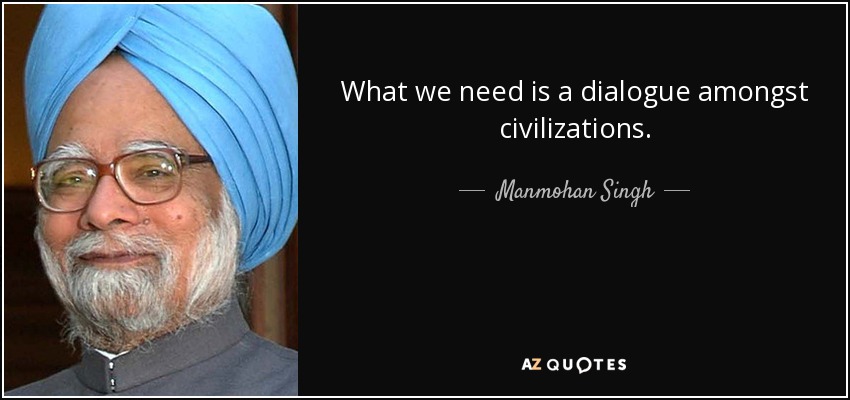
What we need is a dialogue amongst civilizations.
I sincerely hope that the difficulties that are there in Iraq and Iran can be resolved, that Iraq will see a new era of hope in which its people will enjoy a full sovereignty. And also the problems that there is with Iran can be resolved through dialogue through giving diplomacy a chance.
We [with Neal Dodson and Corey Moosa] wanted to draw people in with a dialogue - whether it's a creative process or a social issue or innovation of some kind; whether it was how we told the stories or what stories we told. We produced some online videos.
If my book generates any sort of dialogue among Afghans, then I think it will have done a service to the community.
People always say, "Can writing be taught?" I always think, I can teach you how to write a better sentence, how to do dialogue, how to do character, but I can't teach you how to be a decent person, and I can't teach you how to have something to say.
A lot of the reason why the debate is acrimonious is because of the 24/7 news cycles, blogs, and people being able to just throw something out there in order to get attention. And I'm not going be out there doing the same thing, trying to trash my successor or call attention to myself. I hope that's a positive contribution to the dialogue.
I think as actors we need to close read scripts and we need to fully understand the intricacies of dialogue as well as the symbolisms of what the actor wears and what they hold in their hand because that only adds more layers to the character.
We need political leadership that will move the world away from war into solving its problems through dialogue and negotiation, to build friendship with people, which is not what we've had with this war on terror.
When you face a creative change at the house, you have to start a dialogue, and talk with the designer about how he envisions the brand to make sure that you're on the same page. It's the way the designers talk about the brand, and what they see, and their emotions, how they perceive the house.
I try to simplify things for the children. For instance, [I arrange] for them to have almost no dialogue, or to somehow give them very precise indications, because usually they ask for that.
I actually had some funny dialogue [ in Stardust Memories], a little piece, and we shot all day in this big ballroom. Gordon Willis was the director of photography, and at the end of the day, Gordon turned to Woody Allen and said, "We cannot accomplish all of this in this space. It's impossible." And we'd been rehearsing and trying to shoot this thing all day. So Woody said, "Okay, let's do something else." He looked at me and said, "Come back tomorrow, I'll put you in something else." And he did.
We can have national dialogue where different Syrian parties sit and discuss the future of Syria. You can have interim government or transitional government. Then you have final elections, parliamentary elections, and you're going to have presidential elections.
In 2000 the then Prime Minister of Japan [Yoshirō Mori] asked me to return to this process, this conversation, these talks, and to do so, incidentally, on the basis of the 1956 declaration. I agreed. Since then we have conducted dialogue in this regard but I cannot say that our Japanese partners and friends have remained within the limits of the 1956 declaration.
Everything that we [with Shindzo Abe] are talking about has come to us as a result of the events of 70 years ago. In some way or other, during these 70 years we have been involved in some kind of dialogue on the issue, and that includes the conclusion of a peace treaty.
I feel like it had an impact, in that it started the attention that has been paid to what was happening. It started to get us into this whole conversation about prison reform, the whole bipartisan dialogue that's been happening over the past five, six years about this, where you have a Van Jones and a Newt Gingrich, and you have the Rick Perrys and so forth getting up and talking about the need to reform.
From 1940 to about 1960, I had been writing just regular comics, the way my publishers wanted me too. He didn't want me to use words of more than two syllables if I could help it. He didn't want me to waste time on worrying about good dialogue or characterization. Just give me a lot of action, lot of fight scenes.
I've always felt that music is more expressive than dialogue. I've always said that my best dialogue and screenwriter is Ennio Morricone. Because, many times, it is more important a note or an orchestration than a line said.
When you think about the person responsible for creating the character and the dialogue, Bill Monahan, who's a Boston guy, obviously, his words roll off my tongue quite nicely.
Children are receptive to talking about gender creativity, confirming the importance of the book as a means to instigate this dialogue at an early age.
The big problem with literature is people tend to take the dialogue from the book, forgetting that everything that surrounds it is literate, therefore not knowing quite how to put that on screen.
["Fear & Loathing in Las Vegas"] is a very hard book to translate to film because there's so much interior monologue. The what if factor. I tried to write it cinematically and let the dialogue carry it but I forgot about the interior monologue. It's kind of hard to show what's going on in the head. I think we should do it like a documentary.
I began to read [Bible] as a critic, an in-house critic. So I got to a place where when I got to the university, I just couldn't reconcile that book and some of its points of view with stuff I was learning in my academic career. And so then you have a choice: either you give up your academic career and close your mind and become a constant fundamentalist, or you give up your religion and become a citizen of the modern world and get a modern education, or just spend the rest of your life balancing the two things together, forcing them into a dialogue.
Laurence [Fishburn] helped redo some of the dialogue [in John Wick 2], he and Keanu [Reeves] workshopped it. And he couldn't have been more respectful couldn't have been more brilliant on set. I said, "look, I'm gonna have to work you a little bit here cause I only get you for three days." He never left set, was always engaging, always working on his lines, it was awesome.
My decision was, and the decision of the different institutions, and the decision of the different officials in Syria - I'm on top of them - was to have dialogue, to fight terrorists, and to reform as a response at the very beginning, response to the allegations, let's say, at that time, that they needed reform in Syria, we responded.
By blood and faith, Jews are God's chosen, and have no need for 'dialogue' with any gentile.
Follow AzQuotes on Facebook, Twitter and Google+. Every day we present the best quotes! Improve yourself, find your inspiration, share with friends
or simply: