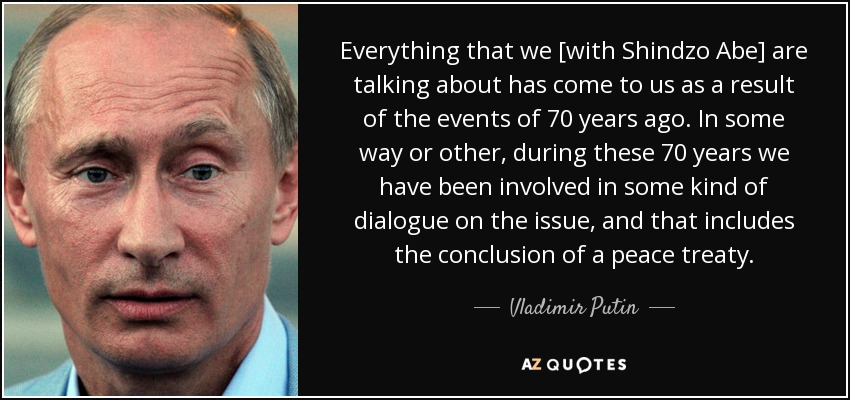
Everything that we [with Shindzo Abe] are talking about has come to us as a result of the events of 70 years ago. In some way or other, during these 70 years we have been involved in some kind of dialogue on the issue, and that includes the conclusion of a peace treaty.
Plato in his dialogue The Phaedo says that whereas sticks and stones are both equal and unequal, (so maybe what that means is that each stick is going to be equal to some other sticks and unequal to some other sticks, so equal to the stick on the left maybe but shorter than the stick on its right) the form of equal is going to be just equal, and it won't partake of inequality at all. And it will be the cause of equality in things that are equal, for example, equal sticks and stones.
What we tried to do in 13th was get to the bottom of that. What were they motivated by? But certainly the attention that the Attorney General's office paid to it allowed for there to be some dialogue across the aisle that I think were the first steps then in change.
To the extent that our political dialogue is such where everything is under suspicion, everybody is corrupt and everybody is doing things for partisan reasons, and all of our institutions are full of malevolent actors - if that's the storyline that's being put out there by whatever party is out of power, then when a foreign government introduces that same argument with facts that are made up, voters who have been listening to that stuff for years, who have been getting that stuff every day from talk radio or other venues, they're going to believe it.
I look for the essence of a story and a human angle that I think audiences can relate to. I also look at how the dialogues flow in the film as a whole and between the characters, and most importantly I always consider what I can bring to the character from a creative point of view.
When you think about the person responsible for creating the character and the dialogue, Bill Monahan, who's a Boston guy, obviously, his words roll off my tongue quite nicely.
Children are receptive to talking about gender creativity, confirming the importance of the book as a means to instigate this dialogue at an early age.
I would love to see more dialogue around the "responsibilities" of art consumers - how can audiences better financially support artists we love, artists who are doing the work, so that artists have a more solid foundation upon which to make art?
This film [Teknolust] in particular, showing the way in which having a sexual dialogue with someone can be something developing and changeable and maybe uncomfortable and complicated. Just complicated and human, no more and no less.
I really love James Joyce, Dubliners and other work. And I was interested in the way the dash was used in English topography - in his work particularly - and I realized there was no compulsion to use those ugly dot-dot curlicues all over the place to designate dialogue. I began to look around, and found writers who could make transitions quite clear by the language itself. I'm a bit of a maverick now. I'm always trying to push the medium.
The big problem with literature is people tend to take the dialogue from the book, forgetting that everything that surrounds it is literate, therefore not knowing quite how to put that on screen.
It [9/11] transcended the political and moved into the metaphysical. There was a kind of cosmic, demonic quality of mind at work here, which refused to have any interest in dialogue and political organization and persuasion. This was bloody-minded destruction for no other reason than to do it.
I began to read [Bible] as a critic, an in-house critic. So I got to a place where when I got to the university, I just couldn't reconcile that book and some of its points of view with stuff I was learning in my academic career. And so then you have a choice: either you give up your academic career and close your mind and become a constant fundamentalist, or you give up your religion and become a citizen of the modern world and get a modern education, or just spend the rest of your life balancing the two things together, forcing them into a dialogue.
Laurence [Fishburn] helped redo some of the dialogue [in John Wick 2], he and Keanu [Reeves] workshopped it. And he couldn't have been more respectful couldn't have been more brilliant on set. I said, "look, I'm gonna have to work you a little bit here cause I only get you for three days." He never left set, was always engaging, always working on his lines, it was awesome.
The mistake we make with many people - not just Russia - is that we believe we have the model, and there is a sort of a condescension in our dialogue with other societies, which was especially painful in several administrations to Russia. I think in Russia, the Yeltsin period is not considered a period of great achievement, but a period of corruption and humiliation.
Today the world has to accept what India has been saying about terrorism. India's dialogue on terrorism, the losses India has suffered due to terrorism, the losses suffered by humanity, the world is now acknowledging that.
When NASA makes discoveries they are profound and they make headlines, everyone takes notice. It drives dialogue and, today, it would drive the blogosphere. It would drive the projects the kids do in school. So you wouldn't even need programs to try and stimulate curiosity. You wouldn't need programs to try to convince people that science literacy is good. Because they're going to want to participate on this epic adventure that we call space exploration.
I found out about it probably 9 - 10 months before we shot the film [Don't Kill It] because it was postponed a couple of times, which was actually a good thing because once it all finally came together, I had to get in there and roll off different pages of dialogue and monologues pretty quickly.
I think being mediocre and in the middle would be the worst. It's more interesting to get strong reactions, and to have the mixture of people who get it and the people who don't get it. And to invite a dialogue.
I like telling the story in a visual way. I don't like explaining a lot in dialogue.
When you have a full page of well-written dialogue that has a thought process to it, it is pretty easy to memorize. It's a lot easier to memorize than if you're in a scene and other people are talking, and you have maybe one word or one sentence that you have to interject at the right time and in a natural way.
One of my favorite literary theorists, Mikhail Bakhtin, wrote that the defining characteristic of the novel is its unprecedented level of "heteroglossia" - the way it brings together so many different registers of language. He doesn't mean national languages, but rather the sublanguages we all navigate between every day: high language, low language, everything. I think there's something really powerful about the idea of the novel as a space that can bring all these languages together - not just aggregate them, like the Internet is so good at doing, but bring them into a dialogue.
As recently as the '70s, people were forced to see information that they didn't agree with in newspapers and the like. Now there is so much information you really can build your own walled garden that just has the stuff that reinforces your view. I think it applies to all of us. People are really going into these separate camps, and that's the big social challenge in this age of too much information. How do we crack that and create a common dialogue?
I remain optimistic that ultimately free speech and a free press where individuals have access to the dialogue will have a self-correcting quality.
I feel that all the messages in the Conversations with God dialogues came from God. And many of them have been considered radical.
Follow AzQuotes on Facebook, Twitter and Google+. Every day we present the best quotes! Improve yourself, find your inspiration, share with friends
or simply: