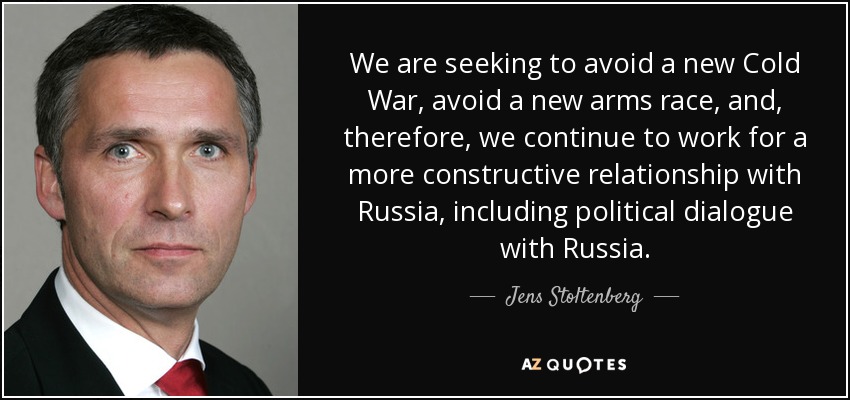
We are seeking to avoid a new Cold War, avoid a new arms race, and, therefore, we continue to work for a more constructive relationship with Russia, including political dialogue with Russia.
First and foremost, note that Plato always wrote dialogues, and never attempted to produce a theoretical or scientific treatise. This is a big clue for me. From beginning to end, Plato was aware of the limits of theoretical and technical reasoning, and his dialogues are a massive exploration.
Writing dialogue is like writing a song, which I've done.
BoJack especially is a very dialogue based show. A lot of the comedy comes from conversations, and a lot of story comes from misunderstandings and people trying to connect with each other, and there was a really interesting challenge trying to write a script with no dialogue.
Although Kim Jong Un is a very unreasonable leader and has a firm, unreasonable belief that nuclear and missile weapons will protect him and his regime, we will continue to employ all possible means - sanctions, pressure, as well as dialogue - to draw North Korea to the negotiating table for denuclearization. To resolve the issue, we have to add dialogue to the current menu of sanctions and pressure.
When it comes to dialogue between South and North Korea and between the United States and North Korea, these can go on parallel tracks. South Korea and the United States can each play a role.
My job on a film is to be responsible for all the sounds in the movie besides the music. Together with my team, we work on the dialogue, foley, sound effects, and sound design. We work closely with the director and picture editor in the prep period, and then together with them, the sound mixers, and music crew, we collaborate on the final mix of the film.
I would almost say that in our solo activities there is an overarching line of thought that is Porter Ricks itself. Our solo work delivers the details. So occasionally we have to go back to our corners and study and research these details to be able to bring it back into the Porter Ricks project, and into the dialogue.
Hillary Clinton is got to make the case for herself that nobody else can make, and for voters to see somebody who looks more three-dimensional, that's not simply a caricature that had been sort of a part of the American dialogue for the last 25 years.
The so-called resistance is very broad and we don't agree on everything, but there's a moment of opportunity when people are paying attention. It's time for us to really get serious about political education and about our own moral education in this moment, and to seize this opportunity to organize and be in deep dialogue with a whole lot of people who never even thought about being politically engaged or active before. There's real hope there and real opportunity.
I don't really believe in dialogue; I am too Nietzschean for that. We need to have a warrior conception of philosophy.
I think film writing, you're thinking in pictures, and stage writing, you're thinking in dialogue. In film writing, it's also, you only get so many words, so everything has to earn its place in a really economical way. I think for stage writing, you have more leeway.
I cannot please everybody, but it is important to have one eye. This builds a faithful following and, consequently, good clientele. That's why the conversation - the dialogue with visitors and customers - is so important.
The issues of poetry, and music, and dialogue with one another is the essential thrust of any song. The breakdown becomes the epoch, the language, the cultural tapestry from which it's echoing, if you will. I often say it's the eyes of the poet's and the ears of the composer's. This narration is what fascinates me endlessly.
Being a classical musician I'm fascinated with how my colleagues, not just singers, but every musician finds ways to express something else or something new or the same ol', same ol' in classical music. I'm always in dialogue with other musicians at least orally, if I can't be with them and a lot of dead musicians as well. I've learned a lot from dead people on recordings.
Anyone who deals with the climate crisis has an internal dialogue between hope and despair, because the challenge is so huge and the danger is so great and the stakes are so high. But I have always resolved that in favour of hope, and actually I'm more hopeful now than I was a decade ago when the solutions were visible on the horizon, but you had to seek reassurance that the technology experts that they're coming, they'll be here.
Folks, Russia is perhaps the second most powerful nuclear country in the world. If you don't have dialogue, you have to be fools.
I'm basically talking to the audience, standing alone, describing the weather. It's very rudimentary, the dialogue, saying what the weather is like that day.
Because of the way that I work with the actors and because a scene is not in this rigid and literal interpretation of something written, I can constantly change stuff, which means I can get a scene absolutely perfect, and then when we go to shoot it, the requirements of the shot mean it would be useful to extend the dialogue or take a line out or swap things around. So the camera doesn't serve the action. The action serves the camera. That's important. So it becomes more and more organic and integrated.
Obviously, the US does not want a shooting war with North Korea. But there has to be some path out of this situation that is also presented that is peaceful. We have sanctions, we have deterrence, but the third leg of any resolution to this problem has to be dialogue. It seems prudent for the US to not only threaten North Korea, but to also offer a way forward.
In terms of my peer group, nobody's parents were dying of old age. There was no dialogue to have among friends. I had that experience, and then 10 years later, I started thinking about writing about it. It's obviously an indelible thing when that happens, and I wasn't looking for material at the time or anything; it just started becoming relevant to me.
I think subjectivity plays into everything. It's unavoidable; you couldn't avoid it if you tried. I think, potentially, a lot more commercial movies, it seems to be that the people making the films are trying to elicit the same reaction. I think a lot of the most interesting work in art and in films are often kind of polarized opinions and affect people in very different ways, which may be less successful commercially, but they elicit a dialogue that's quite interesting.
I do remember when I first read the script of the 92 In The Shade. I was in the house at Nicholas Beach, and that gang was starting to break up, and I read this terribly well-written dialogue, not figuring out that films are about structure and the thing was totally unstructured, and I thought, "Who is this writer? God, he's great."
I can't compete with the Michael Bays of the world in regard to special effects and that kind of stuff. But you can compete in the dialogue and the one liners and the original characterisations and I think that's what people are responding to.
I like Quentin Tarantino, especially the early films, but I'm a big fan of Billy Wilder and Preston Sturges... you know, people were writing great dialogue back then. It's as if people only have the memory of the last 15 years. So, before Tarantino no one was writing witty dialogue? That's ridiculous. Why do we have to keep referring to Tarantino?
Follow AzQuotes on Facebook, Twitter and Google+. Every day we present the best quotes! Improve yourself, find your inspiration, share with friends
or simply: