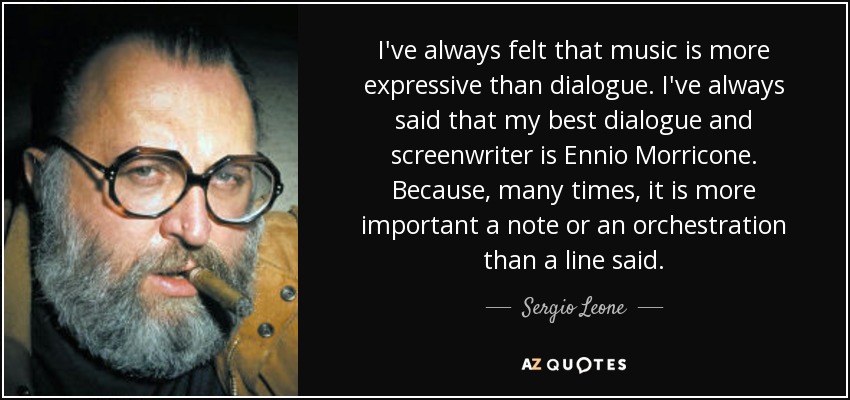
I've always felt that music is more expressive than dialogue. I've always said that my best dialogue and screenwriter is Ennio Morricone. Because, many times, it is more important a note or an orchestration than a line said.
I like writing dialogue - I can hear my characters so clearly that writing dialogue often feels as much like transcribing something as it does like creating it.
Die Hard With A Vengeance shooting was a great time, because we had an interesting script. The first script was called Simon Says, and something was going on, because some days we'd get to work, but we wouldn't actually have dialogue. We would go to Bruce's Willis trailer, and they'd say, "Okay, you have to go from 168th Street to 97th Street today. We're going to do it in the cab, and Sam, you say this. Bruce, what do you want to say?" And that's how Bruce's "hey, Zeus!" thing came up.
What we need is a dialogue amongst civilizations.
People reflect themselves in the work and [it] becomes a tool for communication and dialogue. You bring it out here and you see people walking around taking photos, kids running, everyone being a part of it.
We [with Neal Dodson and Corey Moosa] wanted to draw people in with a dialogue - whether it's a creative process or a social issue or innovation of some kind; whether it was how we told the stories or what stories we told. We produced some online videos.
If my book generates any sort of dialogue among Afghans, then I think it will have done a service to the community.
I spent the better part of a week trying to figure out how to organize these stacks of 30 years of conversations and dialogues. I finally began clustering them in these different categories, and I ended up with the ones you listed.It's interesting to me the kinds of questions I haven't been called to wrestle with. For example, I don't know what this says, but I'm not asked a lot of political questions.
I read the script [of Dirk Gently's Holistic Detective Agency] and went, "I haven't read anything this good, in a long time." I thought it was absolutely brilliant. The dialogue is so sparkling, smart and witty. You also have these insane, crazy characters, like energy sucking vampires and holistic assassins. It's all completely weird.
I enjoy writing dialogue; it comes naturally to me.
I think as actors we need to close read scripts and we need to fully understand the intricacies of dialogue as well as the symbolisms of what the actor wears and what they hold in their hand because that only adds more layers to the character.
We need political leadership that will move the world away from war into solving its problems through dialogue and negotiation, to build friendship with people, which is not what we've had with this war on terror.
When you face a creative change at the house, you have to start a dialogue, and talk with the designer about how he envisions the brand to make sure that you're on the same page. It's the way the designers talk about the brand, and what they see, and their emotions, how they perceive the house.
I try to simplify things for the children. For instance, [I arrange] for them to have almost no dialogue, or to somehow give them very precise indications, because usually they ask for that.
Dialogue comes naturally to me and I can hear the characters' voices in the scenes.
I might find that I have a habit of being jealous and comparing myself with other people and riveting my attention on how much somebody else is accomplishing or doing, or how much better they are at such and such. First, I might recognize the story - the mental images and internal dialogue - and say, "Okay, comparing mind." Then, rather than staying caught in the content, I'll bring my attention into my body and open to the immediate feelings that are there.
I think we don't do a service to dialogue between science and faith to characterize sincere people by calling them names. That inspires an even more dug-in position.
In 2000 the then Prime Minister of Japan [Yoshirō Mori] asked me to return to this process, this conversation, these talks, and to do so, incidentally, on the basis of the 1956 declaration. I agreed. Since then we have conducted dialogue in this regard but I cannot say that our Japanese partners and friends have remained within the limits of the 1956 declaration.
Plato in his dialogue The Phaedo says that whereas sticks and stones are both equal and unequal, (so maybe what that means is that each stick is going to be equal to some other sticks and unequal to some other sticks, so equal to the stick on the left maybe but shorter than the stick on its right) the form of equal is going to be just equal, and it won't partake of inequality at all. And it will be the cause of equality in things that are equal, for example, equal sticks and stones.
I feel like it had an impact, in that it started the attention that has been paid to what was happening. It started to get us into this whole conversation about prison reform, the whole bipartisan dialogue that's been happening over the past five, six years about this, where you have a Van Jones and a Newt Gingrich, and you have the Rick Perrys and so forth getting up and talking about the need to reform.
When you think about the person responsible for creating the character and the dialogue, Bill Monahan, who's a Boston guy, obviously, his words roll off my tongue quite nicely.
This film [Teknolust] in particular, showing the way in which having a sexual dialogue with someone can be something developing and changeable and maybe uncomfortable and complicated. Just complicated and human, no more and no less.
I have underscored my commitment to dialogue and cooperation with our neighboring Turkey, a country that plays an important role for the future of our region. But I still stress that the promotion of this important relations can only take place on the basis of mutual respect without threats of war and questioning of sovereign rights.
I look for the essence of a story and a human angle that I think audiences can relate to. I also look at how the dialogues flow in the film as a whole and between the characters, and most importantly I always consider what I can bring to the character from a creative point of view.
I actually had some funny dialogue [ in Stardust Memories], a little piece, and we shot all day in this big ballroom. Gordon Willis was the director of photography, and at the end of the day, Gordon turned to Woody Allen and said, "We cannot accomplish all of this in this space. It's impossible." And we'd been rehearsing and trying to shoot this thing all day. So Woody said, "Okay, let's do something else." He looked at me and said, "Come back tomorrow, I'll put you in something else." And he did.
Follow AzQuotes on Facebook, Twitter and Google+. Every day we present the best quotes! Improve yourself, find your inspiration, share with friends
or simply: