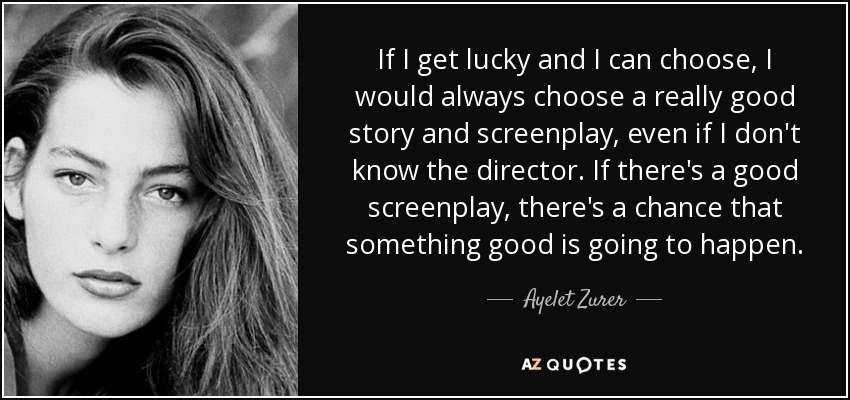
If I get lucky and I can choose, I would always choose a really good story and screenplay, even if I don't know the director. If there's a good screenplay, there's a chance that something good is going to happen.
If you don't have a brilliant screenplay, then you either have amazing actors who give you the chance to improve whatever is on the page, or an interesting director who has enough faith in the project that they can carry it through and get it somewhere. One of those factors needs to happen. If not, it's sad.
There's a different set of writers and a different director for the films, but Marvel has turned it into a pretty spectacular job.
I'm not interested in the director's commentary stuff. I think that stuff is really boring. And, if the director explains too much, it takes a certain mystery away from the interpretation that is very important for the audience to have. The audience should have their own interpretation.
There's obviously something that feels very good about being with a new filmmaker who's very excited, but I also think there's something very comforting in a director who's been around a few times. Both have their pros and cons.
It was very important to me to choose a director like Gary [Ross], whose instincts come from character, who's a storyteller, and who puts characters first.
Deb Zane, our casting director on the Hunger Games was very sanguine, from the beginning, about just blocking out what everybody else says that they want.
Each one of my films is personal; each one of my films is emotionally autobiographical. And I like directors who do that.
I think when you pay attention to the shots, you're aware of the fact that there's a director. Really, it's the director's job to disappear and allow the movie to just feel.
For me, it's important that a movie is the congregate of all art forms, from writing to art composition to music to performing. Trying to keep a balance of all those is what I think a director's job is.
I think there's a perception of me that I'm the dark lord of all that is scary and gory, but that's completely false. I love musicals. My house is very bright and lit. It's not what people would really expect from a Saw director, but I think that's what allows me to do the things that I do.
Every director is different, but the insights from new people on set give you a different opinion and perspective, which is always embraced, in some way.
My husband is a director, and I understand what it takes to direct. It's a skill set where you have to be able to talk to actors and understand them, and I don't. It's a very different way of being in the world, and I much prefer writing and producing.
Actors can make five movies a year. A director can make one movie, every two years. It's a whole different level of commitment and of sweat equity, and therefore there's a direct correlation to passion.
And then, with a European director and Norwegian actors speaking in Norwegian, it was going to be very interesting. So, whatever initial trepidation or fear I may have had was alleviated by those factors. I just said, "This is something to get on board with."
f you're making the scene as a director, you're looking for alternatives, once you've got to that place that's very much in Rowan's [Atkins] head, to see if you can take it further, in some places. Sometimes you do absolutely know there's something there. You just feel it in your bones.
I have no reason as a director to have films go up in versions that I don't like. My only experience of film after ten years is honestly that if a picture doesn't get second-guessed you're looking at four Oscars, and if a picture does get second-guessed, you're not. I've got an advanced degree in that lesson.
Yeah, well I can't see a situation where I wouldn't at least re-write as a director something I was going to direct. At the moment, I wouldn't direct anything that I hadn't written. I can now say, as everybody else says, that it all depends on the script.
It's not often that you get a director, singing the praises of his executives.
Russian directors, we are shooting the same streets. The same things. Tom Jacobson has a fresh eye and found very interesting and very cool locations and angles and characters.
I have always firmly believed that every director should be judged solely by their work, and not by their work based on their gender. Hollywood is supposedly a community of forward thinking and progressive people yet this horrific situation for women directors persists. Gender discrimination stigmatizes our entire industry. Change is essential. Gender neutral hiring is essential.
Among today's directors I'm of course impressed by Steven Spielberg and Scorsese, and Coppola, even if he seems to have ceased making films, and Steven Soderbergh - they all have something to say, they're passionate, they have an idealistic attitude to the filmmaking process. Soderbergh's Traffic is amazing. Another great couple of examples of the strength of American cinema is American Beauty and Magnolia.
The only episode which was completely my idea was for Mitch Pileggi, the actor who portrays Skinner, the Assistant Director of the FBI. He appears often in the series, but only for a few scenes. You know virtually nothing about him. I wanted him to have an episode that was his alone, so I wrote Avatar for him. He even has a scene that's pretty . . . hot [knowing smile]. He was very happy.
Paris is the playwright's delight. New York is the home of directors. London, however, is the actor's city, the only one in the world. In London, actors are given their head.
You have to be submitted for the Pulitzer, and unbeknownst to us, a choral director whom I know had submitted us.
Follow AzQuotes on Facebook, Twitter and Google+. Every day we present the best quotes! Improve yourself, find your inspiration, share with friends
or simply: