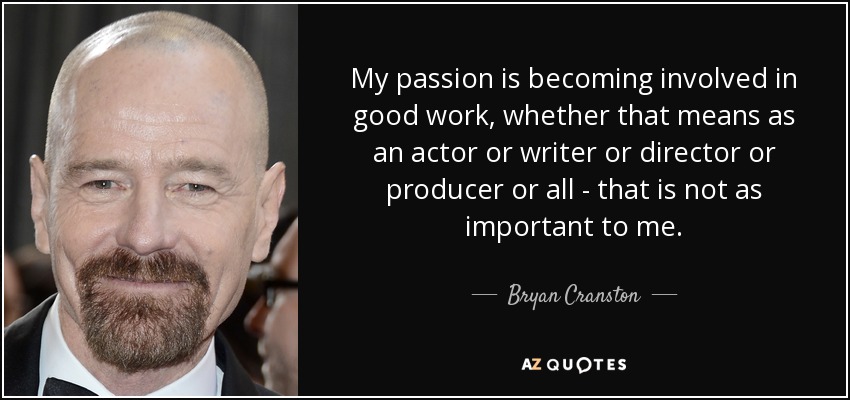
My passion is becoming involved in good work, whether that means as an actor or writer or director or producer or all - that is not as important to me.
If you have a screaming angry director, everyone else will be panicked as well.
I love Malcolm Lee and jumped on the opportunity to work with him as a director.
Once there are more African Americans and Asian Americans behind the scenes as producers, writers, and directors, I think more inclusive casting will happen.
I'd love to do a Michel Gondry film. That would be ideal! I'd love to do an Almodovar film; you know, I think he's very, very talented. I don't care that people say he's pretentious. So what? He's a good director; he can be pretentious.
Some of my best experiences are with writer/directors. Guy Ritchie is one. I feel they have a clearer view of what they want to do. They haven't got to try and interpret someone's writing; it's all theirs. I really admire that.
As somebody who makes his living in the movie business and wants to contribute to it, I think that the best chance I have of doing that is just consistently working with great directors.
Being known as a writer did change the relationships I had with directors. The rap on actors is that they always want to inflate their parts. But when directors know you write screenplays and have a different view of things, you really get invited into the huddle in a much fuller way. And those collaborations end in friendships.
I guess confidence is the only thing that I take from project to project, but I'm always open to learning everybody's style - the director, the actor I'm working with.
And as a first time director I needed to work with someone that I felt comfortable with, and that I could get along with. It was a perfect match [with Sam Rockwell]; I am so thrilled I got to work with him. He is a really nice and incredible guy.
I think a playwright must be his own dramaturg. I believe in a theater where the director and the playwright work together to create what they need.
There are so many ways to help, by either sharing your skills or expertise, joining our board of directors or advisory boards, and donating. Regardless of what or how you share with ISF, we recognize that we don't have all the answers, and that solutions lie not in commonality but in diversity. Welcoming a broad range of thinkers, creators, and doers is what makes this organization thrive.
I like the fact that I have two names because I find that in this industry you have to have dual personalities especially being a transitional entertainer, being an actor going into music. It's not that I'm pretending to be somebody else but it's just that the people that I act with, the Directors, Producers and Agents, can't really relate to what I talk about.
My favorite part about costume designing is the artistry of the job. You meet with a director and a visionary to discuss ideas. You research the characters and figure out the components of their look through your own vision. You create a color palette for a film, television or stage medium and discuss it with the director of photography who then lights your colored subjects.
Directors always used to be like the police to me - the enemy, the people to tell me what to do when I didn't want to do it. But I've lived with one for a while now and I guess I can put myself more in their position. You shouldn't be too sympathetic to them.
I think every director has a different methodology.
But then foreign critics right away made sweeping comparisons to haiku, noh theater, and directors like Ozu, as if the movie were somehow representative of Japan - which was, well, not what I was after. Similarly, with After Life, I deliberately set out to make a movie that was unlike what I imagined the foreign conception of Japan to be, and I figured non-Japanese wouldn't find it interesting at all.
The contemporary Japanese directors who are well-known in the West - say, Kiyoshi Kurosawa, Takeshi Kitano, Naomi Kawase - are mostly unknown to Japanese, particularly of the younger generation.
I have written screenplays. Most recently for Errol Morris, who was thinking about doing his first fiction movie, and with a young director who wanted to adopt Project X. Errol was a hoot. I loved talking with him. We were a good match, too, because we both kept joking that we'd found the only other person on earth more ambivalent than we were about the project.
Snow Cake is a lovely film. Really proud of that. We shot it in 21 days. I thought Sigourney was amazing in it. And very, very accurate. I think there was some element that thought she had pushed it too far. But not at all when you do the amount of homework she had done and spent the amount of time she did with adult autistics. She was right on the money. And I think Marc Evans is a terrific director. He's a sweet, open, honest man and a really good director of actors.
Certainly as actors, and maybe as directors, you've got to hang on to something childlike. You've got to know what play is. I haven't worked with Mike Leigh, but I know him very well and there's something open in his eyes about what's in front of him. And the same is true of Alfonso in a Mexican, mad way. There's an enthusiastic response to something. Neil Jordan, the same, when he gets excited . You just want to know there's a human being in there.
I do feel there's certainly some films where you can feel that the directors don't care about the genre and they don't care about their characters.
There are some directors who don't like the set much. They like post-production, where you have all the ingredients in the can - you've got all the footage, all the music, the various effects - and then you have to do the alchemy necessary to make it all good, a long and very key process of putting everything together and making it into the cogent thing that you want.
It was really executed well, from the art direction to the wardrobe to everyone else. And I have to say, two really exceptional directors who did three each. Roxann [Dawson] did the first three and Jeremy [Webb] did the second three. And I think they really were very meticulous in getting the right tone because it is both. It isn't dour and it isn't grim, but it's not a romp either. It's truthful and it has room for both of those things.
If you're onstage and you're improvising and nothing's happening, people are racing for the door. But the director can go shopping later and pick up pieces and moments and insert them.
Follow AzQuotes on Facebook, Twitter and Google+. Every day we present the best quotes! Improve yourself, find your inspiration, share with friends
or simply: