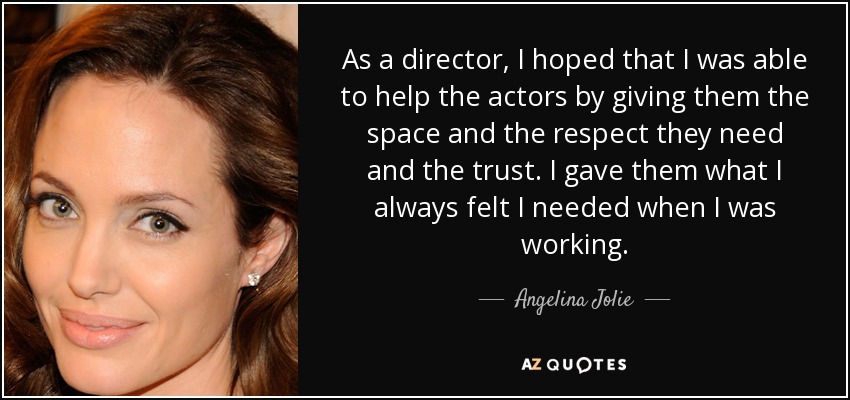
As a director, I hoped that I was able to help the actors by giving them the space and the respect they need and the trust. I gave them what I always felt I needed when I was working.
There are many, many different kinds of movies and directors and styles. I don't mind that a movie looks like a movie.
As an actor, Sean [Penn] is brilliant. And he's really an excellent director, as well. We got along really well.
What I like about being an actress is that it keeps you feminine. Being a director and producer makes you manly and very masculine and I don't like that quality in a woman. But I'll do it when the film is very close to me.
[Make a sitcom] was really the idea of Executive Producer Joe Roth who owned the property over at Revolution Studios and said he was thinking about taking it to TV. And after he said that he already had [writer/director] Ali Leroi on board, and that he was going after Terry Crews, to me it was a no-brainer. I said, "Let's put this together!"
It's just that the nature of being a director is being incredibly overwhelmed with getting the shots right, dealing with the locations, and then there's a two-year-old in the scene, and all that stuff - you know, there's a lot of kids in scenes.
Most directors do work in pairs. There's usually some form of this, sometimes it literally comes down to you both show up in the morning and one of you is like, "I'm a little tired and overwhelmed today, so I might need you to just be a little step ahead of me and speak with more confidence because I'm not quite there." So, there's quite a bit of that in other teams.
A lot of solo directors have a really strong creative producer with them. Jay and I have less of a need for that because we have each other.
I was so disappointed [with movie Forsaken], but maybe I hadn't talked enough with the director. I don't know. But, Kiefer worked it out. Kiefer took it and re-edited it. I don't know whether he talks about that. He's probably more discreet than I am because Jon is a friend of his. Now, it fulfills what I was hoping for, and what we were working on and doing.
I really like directors who give you a certain amount of autonomy because I think a lot about my characters and I think a lot about scenes and choices.
In my experience, directors who are the most comfortable with themselves and confident in their work give you and everybody on the crew the freedom and the space to create. It's the people who are more insecure who feel the need to control and micromanage.
If you are the writer/director especially, no one cares more about the project than you do. You know it in and out. You created it. So always listen to input but don't be afraid to veto and fight decisions that you know instinctively are wrong.
I'm not a feminist, but I just think it's a really cool process working with a woman as a director.
I didn't go to acting school, so it was great to be able to rehearse for a month or two, to workshop, and be with a director who even gave me acting exercises.
Any film that you see is never just the director. If it's a film that you love, it's not so easy to say, "Oh it's directed by this person - that means everything that person directs is going be wonderful."
Wow. Ted Cruz falsely suggested Marco Rubio mocked the bible and was just forced to fire his communications director. More dirty tricks.
So getting that balance between what is honoring scripture and the Word and also acknowledging the fact that by the virtue of putting it on film there's going to be a variation and adaptation, I mean, it's a fine dance and a balance. Our producers and directors have worked so hard to get that right and I'm really proud. I think it's a pretty good job.
Just someone trying to shoot in 70mm deserves the nomination, and he[Quentin Tarantino] is shooting interiors, like tight interior shots, for that matter. Obviously [Quentin] is the director and demanding the shots, but all credit for the beauty of that film [Hateful Eight] goes to the director of photography.
I think the whole nostalgia for the forty year gap for [Sylvester] Stallone was bigger than the movie [Creed], but it's good because the movie still gets recognized with Stallone's involvement. I'm sure the director [Ryan Coogler] is still proud of his film, but it's very hard to nominate a director.
When a director writes, there's a compulsory arbitration. You have a right to challenge any of the arbitrators, but they pick three of four arbitrators who read all the drafts with no names attached and then allocate credit.
The rule of thumb for a director or producer - which prevents them from just sticking their names on everything - is that you have to contribute substantially more than 50 percent of the character dialogue and story.
I was aware of the possible biases you could get as a commercial director, like being too concerned about the technical aspects of the form rather than anything of substance. If you keep working in commercials, you can get trapped in a very superficial way of thinking. I always used commercials as an exercise for filmmaking, like going to the gym.
I don't really think I have the personality. I am not very external. I don't want to dance on the table and do impressions. So I think that the way I approach it is really loving story. That's my first love - the words. The words and the story and how to create images. I guess I come at that as a director. I think that's much more in my personality to be a director, so that's kind of informed my acting.
I’ve had unsatisfying experiences, but mostly it’s about communication, which is why I make an effort to talk to the director beforehand to make sure we see eye-to-eye as creative individuals. If [good] communication isn’t present, you can lose something and end up very unhappy.
When I do go to L.A., it is usually for a reason - to meet with a director or something - but I'm always so happy to go back to London.
Follow AzQuotes on Facebook, Twitter and Google+. Every day we present the best quotes! Improve yourself, find your inspiration, share with friends
or simply: