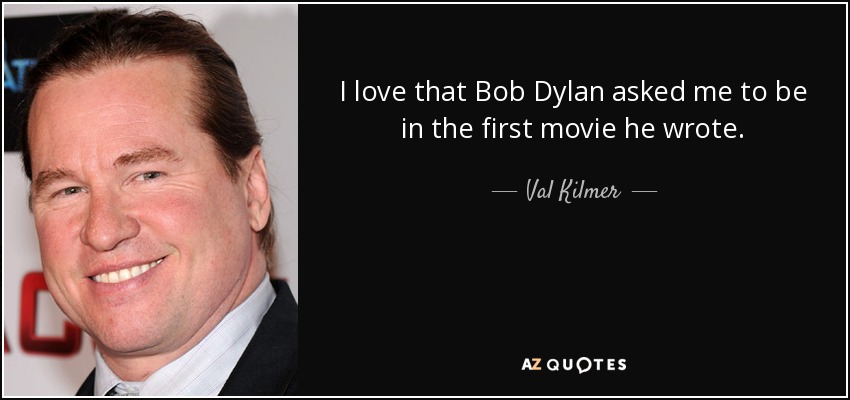
I love that Bob Dylan asked me to be in the first movie he wrote.
Bob Dylan was the source of pop music's unpredictability in the Sixties. Never as big a record-seller as commonly imagined, his importance was first aesthetic and social, and then as an influence.
I was a huge Beatles fan. The Stones, Dylan. Later on, I got into Stevie Wonder, and Bill Withers - he's one of my heroes. Al Green, too.
I love Bob Dylan. Who doesn't? He tapped into some kind of vein and it keeps on keeping on. There's nobody like him. He's unique, and just... way out cool.
In some of the greatest recordings ever made, the performance is a part of the recording. Dylan's 'Rainy Day Women No. 12 and 35' is all about the esthetic of that performance. You can hear the room.
Well, I met Frank Sinatra and Bob Dylan in the space of 15 minutes. Frank Sinatra kissed me on the lips. He kissed me on the lips. And then he gave me a filterless cigarette. And then I met Bob Dylan. I came off all lightheaded and had to go sit on his dressing-room steps.
My love was Bob Dylan, but as I got older I realized a good ballad was a good ballad.
Growing up, I was inspired by The Beatles and Bob Dylan. Damian Rice was a huge influence for me musically.
Music television is all about the media-oriented version of what it is to be a rock star; it's not about what Bob Dylan or Jimi Hendrix were about - which included great images, sure, but they had spiritual and political and revolutionary content, too.
I suspect many readers might associate [Bob Dylan] with one of the shortest phases of his career, the time from 1963 to '65 when he wrote his most famous "protest songs," like "Blowin' in the Wind" and "The Times They Are a-Changin.'"
The question now becomes about defining your terms. What is literature? Unless we allow it to encompass the oral tradition from which it grew, which means taking it back to Homer and beyond, it demands the written word - poetry and prose. [Bob] Dylan is no slouch at the written word, both in its own right, and transcribed from his lyrics, which have often been acclaimed as poetry and may well stand up as such. But that is not his métier.
The first thing I did when I got inside was turn on the kitchen light. Then I moved to the table, putting my dad's iPod on the speaker dock, and a Bob Dylan song came on, the notes familiar. I went into the living room, hitting the switch there, then down the hallway to my room, where I did the same. It was amazing what a little noise and brightness could do to a house and a life, how much the smallest bit of each could change everything. After all these years of just passing through, I was beginning to finally feel at home.
Bob Dylan will be thirty years old this month..." "That's the most depressing thing I've ever heard.
Jake La Botz is a creator of dark poetry and haunting song, the kind of music that gets in your bones and rides you for days, a sound and vision only those who've been to the bottom and clawed their way back up can generate. His midnight gifts evoke Hank Williams and Skip James as much as Tom Waits and Dylan. Not everybody will get this music - because not everybody is ready for the truth.
I tried to charm the pants off Bob Dylan, but everyone will be disappointed to learn that I was unsuccessful. I got close - a couple of fast feels in the front seat of a Cadillac.
[Bob Dylan] is principally a recording artist, and if he weren't, it is unthinkable he would have had such an impact. He is to be heard first and read second. Well, what about plays, you could reasonably ask. Is [William] Shakespeare not great literature? Yes, obviously: but his work is great literature even to those who have never known it performed. The same is evidently not true of Dylan.
Courtney Love's name should be right next to Bob Dylan when they say best lyricist of all time.
Somehow you can tell the difference when a song is written just to get on the radio and when what someone does is their whole life. That comes through in Bob Dylan, Paul Simon, Willie Nelson. There is no separating their life from their music.
The general sentiment among the Yeas is, no accolade is too high for their man; and the Nobel being, literally, the gold standard among prizes, it is surely his [Bob Dylan] due.
I have seen quite a few folk whom I know to be both fair minded and, as it happens,[Bob] Dylan fans, take up cudgels for this position. To them, it's not necessarily that Dylan doesn't merit the highest honour. It's that he doesn't merit this specific highest honour [Nobel prize], in the way a champion pole vaulter shouldn't be given a medal for the long jump. It is in this group that the Wahey!s are mainly to be found, firing off jests, or mock solemnly reciting Dylan's sillier lyrics as if these are entirely representative of his oeuvre.
I learned how difficult it is to be an artist. There are always compromises. The record company wants you to do this, your fans want you to do this, your family, you can't concentrate on your work. It's a hard thing to be an artist and not give up. That's why I have so much respect for people like Dylan and Neil Young and Tom Waits, because they keep at it. I have a new respect for a true artist.
I admire those old road dogs, Willie Nelson, Bob Dylan. That's their life.
When I was playing with Bob Dylan in, like, 1966, I was, like, 20 years old.
It's got to be hard to be a band that's trading on your 40-year-old hits, where there's a certain thing that's expected of you. But that's why I admire Bob Dylan's live performances - he's steadfast about mixing up the songs, not just sticking to his greatest hits, and reinterpreting them to the extent that you really can't recognize them until halfway through. It's like, I DARE you to sing along.
I'm unhappy as Dylan Thomas was, because I'm not, but I've had my brushes with sadness.
Follow AzQuotes on Facebook, Twitter and Google+. Every day we present the best quotes! Improve yourself, find your inspiration, share with friends
or simply: