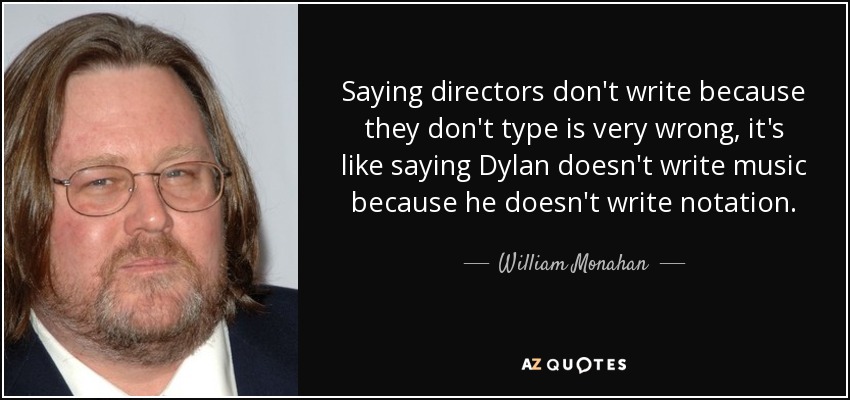
Saying directors don't write because they don't type is very wrong, it's like saying Dylan doesn't write music because he doesn't write notation.
By the time someone gave me some samples of standard screenplays I was already beyond that stuff, because I was not only a tinkerer in ways to do things, I'd started from Dylan Thomas. As a screen dramatist he was a very intense visualist, with great timing and fluency.
I realized a lot of my friends were going to nightclubs and listening to house music. I was hanging out with them and going to clubs as well but I didn't really understand that kind of music. I was listening to country music and was heavily into Hank Williams, bluegrass, and Bob Dylan. So I just decided I really needed to understand what this music I was hearing in the clubs was all about.
If it works for the piece of music, I'm going to use it. I don't want to be limited any more than [Bob] Dylan wanted to be limited by not using an electric guitar.
After the Beatles and Dylan, there's this assumption that you are a singer-songwriter, or that if someone else is writing your rhymes, you're a fake rapper.
Nina Simone was an entertainer. Bob Dylan was an entertainer. Anyone that can occupy a piece of music and make the air catch on fire at that moment is a true entertainer. That's how I view it. That's what I was meant to do. I love doing it. That's why I'm on earth.
When I started writing again, especially when I listened to French music and Bob Dylan and Leonard Cohen, I realized that these lots talked about themselves. The greatest artists, they didn't sing; they only spoke.
I always want to keep things unwritten. I'm inspired by Bob Dylan, who's kept evolving and changing his sound. I think that's what you should do as an artist. Why be comfortable?
I think, especially among the New York intelligentsia at that time, that there was a reason Bob Dylan went to New York to happen, because there was a culture developed there around the ideas of civil rights, around the idea of democracy growing out of Emerson and Thoreau, these ideas of the fanfare for the common man.
Some artists respond to critics' questions about their art. I think Bob Dylan would alwys refuse to respond to questions of that sort, he always has.
Bob Dylan tells interviewers what he wants to tell them, not what they necessarily want to know. His responses are really part of the art, and often have a relationship to the songs that have just come out or are about to come out.
Bob Dylan, Nobel laureate. A new fact so shocking that even the year's most notable deaths have not outdone it for the volume (in both senses) of instant reaction; so divisive, it makes Brexit, the Labour leadership and the US Presidential election seem lesser ruptures.
The Yeas are relatively uniform. They view [Bob] Dylan as one of the greatest artists of his or any era, who deserves to be taken as seriously as any litterateur. Where they vary is in some cases not even accepting the distinction: Dylan in their eyes is a literary titan, and the award of the Nobel Prize for Literature is simply official affirmation of what they already knew.
The general sentiment among the Yeas is, no accolade is too high for their man; and the Nobel being, literally, the gold standard among prizes, it is surely his [Bob Dylan] due.
First of all, there are those who simply don't care for [Bob] Dylan, or at least, don't think he's that great. Some of the former sound very much as if they are afflicted with the kind of contrarianism inevitably bred by cultural orthodoxy - Dylan is overwhelmingly rated a giant and a marvel, the acclamation of whom they feel to be de rigueur; and rather than judge for themselves, they embrace the opposite view.
Plenty more of the Nays sound perfectly sincere, though. They may genuinely dislike [Bob] Dylan; they may even enjoy or admire him, but just don't think he's all that. Fair enough. The reaction of such folk seems to be chiefly amazement tinged with befuddlement: they've given him what? You're kidding me.
The [Nobel] prize is for literature.[Bob] Dylan is a songwriter. Here is where the argument starts to get interesting, because here is where it is no longer a question of either cultural orthodoxy or personal taste.
I have seen quite a few folk whom I know to be both fair minded and, as it happens,[Bob] Dylan fans, take up cudgels for this position. To them, it's not necessarily that Dylan doesn't merit the highest honour. It's that he doesn't merit this specific highest honour [Nobel prize], in the way a champion pole vaulter shouldn't be given a medal for the long jump. It is in this group that the Wahey!s are mainly to be found, firing off jests, or mock solemnly reciting Dylan's sillier lyrics as if these are entirely representative of his oeuvre.
The question now becomes about defining your terms. What is literature? Unless we allow it to encompass the oral tradition from which it grew, which means taking it back to Homer and beyond, it demands the written word - poetry and prose. [Bob] Dylan is no slouch at the written word, both in its own right, and transcribed from his lyrics, which have often been acclaimed as poetry and may well stand up as such. But that is not his métier.
[Bob Dylan] is principally a recording artist, and if he weren't, it is unthinkable he would have had such an impact. He is to be heard first and read second. Well, what about plays, you could reasonably ask. Is [William] Shakespeare not great literature? Yes, obviously: but his work is great literature even to those who have never known it performed. The same is evidently not true of Dylan.
Without music, there is not the faintest chance [Bob Dylan] words would now be garlanded as they are.
Lyrics should not need to stand on their own; many of [Bob] Dylan's do, but in common with other great lyricists, he has written plenty that falters on the page but soars in song.
The same is true of ranking him thus against any work of literature. [Bob Dylan] has been made, through no fault of his own, the object of odious tokenism.
Funny thing about Bob Dylan, the newest Nobel laureate in literature: He's been a master of self-invention for more than 50 years, creating personae, wearing them like masks, and then discarding them as soon as they grew too familiar.
I suspect many readers might associate [Bob Dylan] with one of the shortest phases of his career, the time from 1963 to '65 when he wrote his most famous "protest songs," like "Blowin' in the Wind" and "The Times They Are a-Changin.'"
Follow AzQuotes on Facebook, Twitter and Google+. Every day we present the best quotes! Improve yourself, find your inspiration, share with friends
or simply: