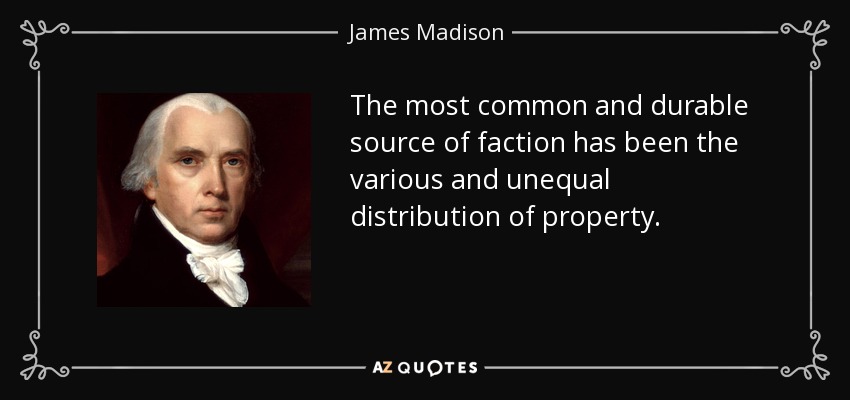
The most common and durable source of faction has been the various and unequal distribution of property.
Those who hold and those who are without property have ever formed distinct interests in society.
We are free today substantially, but the day will come when our Republic will be an impossibility. It will be an impossibility because wealth will be concentrated in the hands of a few. A Republic cannot stand upon bayonets, and when the day comes when the wealth of the nation will be in the hands of a few, then we must rely upon the wisdom of the best elements in the country to readjust the laws of the nations to the changed conditions.
The movement of the progressive societies has hitherto been a movement from Status to Contract.
Men of great genius and large heart sow the seeds of a new degree of progress in the world, but they bear fruit only after many years.
In proportion as the people are accustomed to manage their affairs by their own active intervention, instead of leaving them to the government, their desires will turn to repelling tyranny, rather than to tyrannizing: while in proportion as all ready initiative and direction resides in the government, and individuals habitually feel and act as under its perpetual tutelage, popular institutions develop in them not the desire of freedom, but an unmeasured appetite for place and power.
We ought to be very cautious and circumspect in the prosecution of magic and heresy. The attempt to put down these two crimes may be extremely perilous to liberty.
Republics come to an end by luxurious habits; monarchies by poverty.
A critical knowledge of the evolution of the idea of property would embody, in some respects, the most remarkable portion of the mental history of mankind.
The growth of property and the desire for its transmission to children was, in reality, the moving power which brought in monogamy to insure legitimate heirs, and to limit their number to the actual progeny of the married pair.
Free enterprise is a natural result of the American form of government, which says in so many words that the more men do for themselves, the less government does for them, the better off we will all be.
Nine-tenths of the people are at present freeholders... The time is not distant when this country will abound with mechanics and manufacturers who will receive their bread from their employers. Will such men be the secure and faithful guardians of liberty? Give the votes to people who have no property, and they will sell them to the rich who will be able to buy them.
The gods hate unjust men.
What counts in a man or in a nation is not what the man or the nation can do, but what he or it actually does.
Adam Smith's was a real universalism in intent. Laissez Faire was intended to establish a world community as well as a natural harmony of interests within each nation... But the "children of darkness" were able to make good use of his creed. A dogma which was intended to guarantee the economic freedom of the individual became the "ideology" of vast corporate structures of a later period of capitalism, used by them, and still used, to prevent a proper political control of their power.
Marxism was the social creed and the social cry of those classes who knew by their miseries that the creed of the liberal optimists was s snare and a delusion... Liberalism and Marxism share a common illusion of the "children of light." Neither understands property as a form of power which can be used in either its individual or its social form as an instrument of particular interest against the general interest.
It's long been common practice among many to draw a distinction between "human rights" and "property rights," suggesting that the two are separate and unequal - with "property rights" second to "human rights."
We must adopt reforms which will expand the range of opportunities for all Americans. We can fulfill the American dream only when each person has a fair chance to fulfill his own dreams. This means equal voting rights, equal employment opportunity and new opportunities for expanded ownership, because in order to be secure in their human rights, people need access to property rights.
How right the working classes are in their "materialism." How right they are to realize that the belly comes before the soul, not in the scale of values but in point of time!
The people of America are a people of property; almost every man is a freeholder.
If the Federal Reserve pursues a policy which Congress or the President believes not to be in the public interest, there is nothing Congress can do to reverse the policy. Nor is there anything the people can do. Such bastions of unaccountable power are undemocratic. The Federal Reserve System must be reformed, so that it is answerable to the elected representatives of the people.
The Federal Reserve is the overlord of the money supply. If these two are not steering in the same direction, they can either neutralize each other or have the economy lurching in all directions. This is not a rational system for setting economic policy. It has given us trouble in the past, as the text will establish, and will inevitably in the future.
Individual initiative alone and the mere free play of competition could never assure successful development. One must avoid the risk of increasing still more the wealth of the rich and the dominion of the strong, whilst leaving the poor in their misery and adding to the servitude of the oppressed.
Unless we increase our economy's productivity-its vitality and competitiveness-we will face pressure for increasing controls.
In the present state of human society, however, We deem it advisable that the wage-contract should, when possible, be modified somewhat by a contract of partnership, as is already being tried in various ways to the no small gain both of the wage-earners and of the employers. In this way wage-earners are made sharers in some sort in the ownership, or the management, or the profits.
Follow AzQuotes on Facebook, Twitter and Google+. Every day we present the best quotes! Improve yourself, find your inspiration, share with friends
or simply: