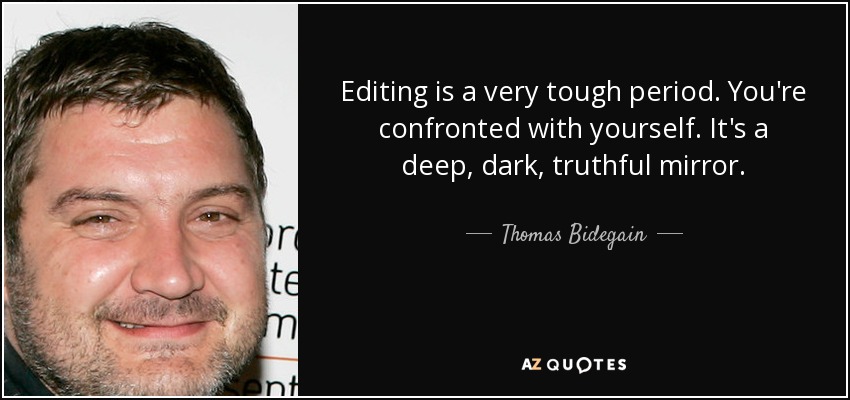
Editing is a very tough period. You're confronted with yourself. It's a deep, dark, truthful mirror.
Most of my material is , it doesn't necessarily involve a lot of editing. So even the show with the World Meeting of Families in Philadelphia, I don't have to worry about some of the material being inappropriate.
With film, so much is in the director's hands. Once something is cut together - unless you're in the editing room - you don't really remember what the alternatives are.
I did a run of a play over the summer in a really tiny theater in New York and that was rejuvenating for me. I directed a short series for Hulu called Paloma and being in an editing room, I learned a lot about acting.
It's like the query letter problem that I just mentioned, magnified a hundredfold. You might be good at telling a story, but that doesn't mean you know anything about marketing. Or layout. Or editing. Or publicity. Or selling your books for foreign markets.Everyone can point to a few examples of people that have done very well for themselves self-publishing. But honestly, those folks are lucky as lottery winners.
"Kindness" can mean a lot of different things. In this case, I felt I had to present his [Donald Trump's] supporters in as fair a light as possible - many of them hadn't been interviewed before and that entailed some interviewer-courtesy in the editing and so on.
I don't know. I don't go around looking at my pictures. I sometimes think I'm a mechanic. I just take pictures. When the time comes, for whatever reason, I get involved in editing and getting some prints made and stuff. There are things that interest me. But I don't really mull over them a lot.
I have a company where I'm trying to get projects off the ground. Me and my partner Madeleine Sackler, we just shot our first feature in a maximum security prison where about 95% of the cast were incarcerated men. We're editing that and there's a doc going with it.
The thing about how that process works is that it's more about the editing and time for judging the ideas. Most pieces I publish each week have been around for months. This is a response to the beginning of the strip, when I was making them so quickly. I would just conceive a piece, finish it, and then the next day see it in the paper. That was when I was doing dailies four days a week.
Basically, I composed the musical structure in one pass. The rest was editing and small adjustments. And when the play was read by actors with the music, the sequence timed-out perfectly.
Whenever I'm not shooting, I'm in the editing room with my footage. While the crew is taking 15 minutes to an hour to set up the next shot, I'm behind the Avid, putting the flick together.
I tend to elongate the sentences as I'm writing and editing, and there is just something about the feeling of writing longhand that I really love.
I have produced all my music videos. Love to get behind the camera and get involved in the editing process.
When I edit the poems - and I do edit, which some people don't mean when they use the term "stream of consciousness" - I'm usually editing toward greater accuracy, which sometimes means more fragmentation, because that is the way I think.
I write first drafts feverishly fast, and then I spend years editing. It's not that sentence-by-sentence perfectionist technique some writers I admire use. I need to see the thing, in some form, and then work with it over and over and over until it makes sense to me - until its concerns approach me, until its themes come to my attention. At that editing stage, the story picks itself and it's just up to me to see it, to find it. If I've done a good job, what it all means will force me to confront it in further edits.
There were definitely scenes I struggled with more than others: the car accident and the thunderstorm are two that come to mind. It's difficult to write about a thunderstorm. There are only so many ways to describe it and our vocabulary is so limited. And the car accident scene required a tense, manic quality that had to be conveyed in the language, as well as the character's dialogue and actions. I was editing these scenes long after I thought I was finished with them.
My photographs are not really about photography. They are about editing. I use photography but they are all taken from the TV screen. Anybody can do that, but it's the order I put the pictures in to try to create a new kind of movie, something that you can put on your wall.
I confess that Roy [Stryker] was a little bit dictatorial in his editing and he ruined quite a number of my pictures, which he stopped doing later. He used to punch a hole through a negative. Some of them were incredibly valuable. He didn't understand at the time.
One of the advantages of shooting digitally was that we had a lot of time. When you shoot, even if you do a good performance, it may get lost in the editing room. It's just one more way that a potentially good film might go astray.
I never go to the monitor. I just look at the camera monitor and my favorite part of all of the directing, except for the writing and editing of it, is right when we're rolling and they do lines and I'll say "Try this, try this, try this."
And I watch all the dailies and I grade the jokes or the moments, you know, on a scale from... so I know exactly what we have. And so I can then go into the editing room and be like "I want you to do this moment, this moment, this joke, that joke. I'd like to see 3 versions."
And then my editor really likes that because he's left alone to do what...to create those things instead of me breathing over his shoulder and I like it because I don't have to sit in the editing room all day. I get to watch just dailies.
It was really interesting to be editing the film [Trust] in New York and directing the play in Chicago, and one definitely informed the other. The play probably benefitted more because I realized what scenes could be cut, and I cut those scenes from the play.
During the preproduction when I'm shooting and then once we wrap we go away. And then the visual effects guys take over. And then they add all those little bits and pieces. They come up with ideas during the cut in the editing, and they said while would be really cool if we did this thing here where the blade pops out. So then you see the movie and say wow that's a really neat idea. I wish we would have thought of that.
When I made YouTube videos, I am the one who's uploading it, I'm the one who's editing it, so I'm very in control of what I'm sharing and not sharing. Whereas in music, it's a lot more of pouring my heart out and kind of just putting it out there for the best.
Follow AzQuotes on Facebook, Twitter and Google+. Every day we present the best quotes! Improve yourself, find your inspiration, share with friends
or simply: