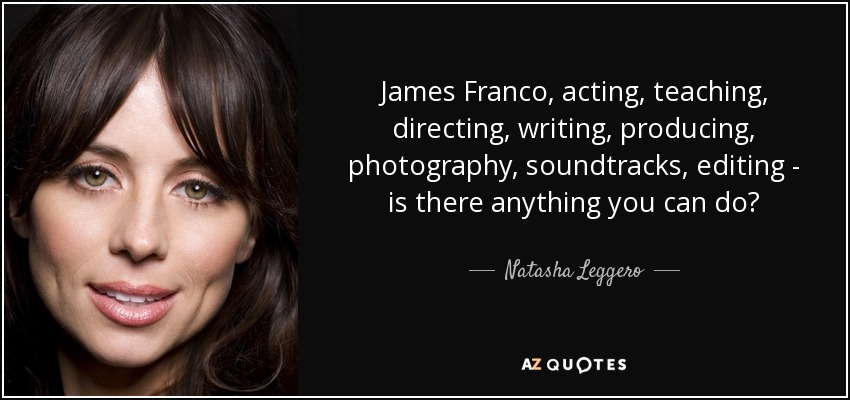
James Franco, acting, teaching, directing, writing, producing, photography, soundtracks, editing - is there anything you can do?
I think I have an obligation, to the people who have consented to be in the film, to make a film that is fair to their experience. The editing of my films is a long and selective process. I do feel that when I cut a sequence, I have an obligation to the people who are in it, to cut it so that it fairly represents what I felt was going on at the time, in the original event. I don't try and cut it to meet the standards of a producer or a network or a television show.
Fabricating reality was criminal; editing it, commonplace.
If you notice phrases, ideas, and anecdotes that closely resemble those that appear elsewhere in my writing, it's not a matter of sloppy editing. I'm repeating myself. I'm reshuffling words in the hope that just once I might say something exactly right. And I'm still wrestling with dilemmas that are not easily resolved or easily dismissed. I run at them again and again because I am not finished with them. Any may never be. Work-in- progress on a life-in-progress is what my writing is about. And some progress in the work is enough to keep it going on.
Obviously, where art has it over life is in the matter of editing. Life can be seen to suffer from a drastic lack of editing. It stops too quick, or else it goes on too long. Worse, its pacing is erratic. Some chapters are little more than a few sentences in length, while others stretch into volumes. Life, for all its raw talent, has little sense of structure. It creates amazing textures, but it can't be counted on for snappy beginnings or good endings either. Indeed, in many cases no ending is provided at all.
The structure of a play is always the story of how the birds came home to roost.
Peeping through my keyhold I see within the range of only about 30 percent of the light that comes from the sun; the rest is infrared and some little ultraviolet, perfectly apparent to many animals, but invisible to me. A nightmare network of ganglia, charged and firing without my knowledge, cuts and splices what I see, editing it for my brain. Donald E. Carr points out that the sense impressions of one-celled animals are not edited for the brian: 'This is philosophically interesting in a rather mournful way, since it means that only the simplest animals perceive the universe as it is.
Could I do with a little life editing? Would that give me a little more freedom? Maybe a little more time?
What would the world be like if you had to develop a power yourself before you could use it? Just as a silly example: How would the comment section on YouTube change if, to use it, you had to have the schooling necessary to have a basic understanding of how computers and the internet work? More seriously, would anyone smart enough to know how to design and build a tank, or a laser guided anti-aircraft missile, or a computer and video editing software be stupid enough to join ISIS? In fact, if such knowledge was required—would it even be possible for there to be standing armies?
An editor should tell the author his writing is better than it is. Not a lot better, a little better.
The main thing I try to do is write as clearly as I can. I rewrite a good deal to make it clear.
Songwriting is like editing. You write down all this stuff - all this bad, stupid stuff - and then you have to get rid of everything except the very best.
There are a lot of layers in the film [Dream of Life]. And during editing we would try to tame all the layers, try to make things a little bit more understood. We would move scenes around. We'd try all these things.
Because the filming process was so organic and there was no script, the film [Dream of Life] was literally telling us what it wanted to be in the editing room.
The editing process was a free-for-all, and since I hadn't gone to film [Dream of Life] school or anything like that, I just said, "We'll do this. We'll do that." It was a really great experience that way.
You start to find a rhythm and usually if it makes me laugh or comment in the editing room then I knew that's what's going to happen in the audience. That first reaction is usually the right reaction.
My core competency has really informed my painting. The roots of editing stem from classical paintings - classic painters intended to drive your eye from this conflict to that intrigue, ending with a caprice. That is a montage, that is editing. It became a flipbook in later generations.
And then to see the whole movie, you're pretty much waiting until the end of production. And the major lifting in terms of editing and all that stuff is done before you shoot the movie. That's an unusual way to work.
If you're into writing and making people laugh, or just want to video blog something, you should get a simple digital video camera. And all computers now come with an easy video editing software program. Just mess around with that for a little bit, try to figure it out, then just put stuff online and have fun. Never give up!
The editing process, for me, is both the most fun and the most frustrating. It's the most fun because you get to see it actually piece together. But if one thing is off, it can be frustrating trying to figure out exactly what it is that's bumping you, so you try a hundred different things.
Thomas Jefferson went through the New Testament and removed all the miracles, leaving only the teachings. Take a source, extract what appeals to you, discard the rest. Such an act of editorship is bound to reflect something of the individual doing the editing: a plaster cast of an aesthetic-not the actual thing, but the imprint of it.
As the actor, you can't be worried about the scene that you're going to playing two days from now. You think about what's going on, right now and in the moment. That's what you worry about. Everything is right then and there. In the end, all of the pieces come together, thanks to the editing and James Gunn.
I'm making art and making decisions and editing things. I don't live my life to broadcast it into the art world; I don't see it as my life on the stage.
It's like you might have some great scene that you love but for some reason - and you can't necessarily put your finger on it - the movie's not working or it seems slow or ponderous in some way, and even though it has your favorite scene in there, actually the favorite scene is the culprit. That's the painful thing about editing, is trying to locate those things that are holding the movie back and then having the guts to cut them. And it is painful to do it.
When you're in the editing room, as a director, you get the opportunity to look at your work. As a writer, you can rewrite. But as an actor, unless you're watching playback, you really rely on the director to help you.
Follow AzQuotes on Facebook, Twitter and Google+. Every day we present the best quotes! Improve yourself, find your inspiration, share with friends
or simply: