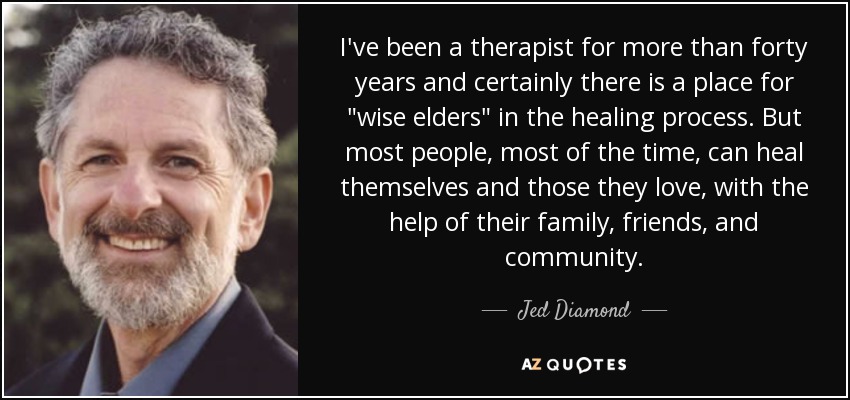
I've been a therapist for more than forty years and certainly there is a place for "wise elders" in the healing process. But most people, most of the time, can heal themselves and those they love, with the help of their family, friends, and community.
Look at the Native American culture. They revere the elders.
When the surgeon general Joycelyn Elders said that drugs should be legalized, I saw somebody else who felt what I feel. But she got fired.
Today there isn't a university where they don't have special courses [Jewish studies or Holocaust studies], hundreds and hundreds of universities, young people today want to know more than their elders did, much more, and therefore I am very optimistic about young people.
We stand in need of such reflections to comfort us for the loss of some illustrious characters, which in our eyes might have seemed the most worthy of the heavenly present. The names of Seneca, of the elder and the younger Pliny, of Tacitus, of Plutarch, of Galen, of the slave Epictetus, and of the emperor Marcus Antoninus, adorn the age in which they flourished, and exalt the dignity of human natures.
The emperor of the East was no longer guided by the wisdom and authority of his elder brother, whose death happened towards the end of the preceding year: and, as the distressful situation of the Goths required an instant and peremptory decision, he was deprived of the favourite resource of feeble and timid minds; who consider the use of dilatory and ambiguous measures as the most admirable efforts of consummate prudence.
First and foremost, you do not have to live up to or emulate the lives of any of your predecessors. But at the very least, you should know about them. You will have your own life, interests, and ideas of what you want or do not want in life. Do what you enjoy doing. Be honest with yourself and others. Don't think of satisfying anyone: your elders, peers, government, religion, or children who will come after you. Develop meaningful ideals, and become conscious of others, their existence, and their lives.
We always reference kids but very rarely ask their opinion. Our inexperience might be what gives us the ability to teach our elders something, due to the fact that we are not jaded or cynical.
There are constant cycles in history. There is loss, but it is always followed by regeneration. The tales of our elders who remember such cycles are very important to us now.
A medical revolution has extended the life of our elder citizens without providing the dignity and security those later years deserve.
What makes a free thinker is not his beliefs, but the way in which he holds them. If he holds them because his elders told him they were true when he was young, or if he holds them because if he did not he would be unhappy, his thought is not free; but if he holds them because, after careful thought, he finds a balance in their favor, then his thought is free, however odd his conclusions may seem.
An infallible Remedy for the Tooth-ach, viz Wash the Root of an aching Tooth, in Elder Vinegar, and let it dry half an hour in the Sun; after which it will never ach more; Probatum est.
As an elder I mistrust the wisdom of age.
It is a most curious experience for a man of seventy-two to be confronted with the greenhorn enthusiasms of his youth. Young people think they are so smart. Alas the doctrines they spout with such fervor turn out to be mostly parroted from their elders.
The playthings of our elders are called business.
Parents have railed against shelters near schools, but no one has made any connection between the crazed consumerism of our kids and their elders' cold unconcern toward others. Maybe the homeless are not the only ones who need to spend time in these places to thaw out.
When a child becomes an adult . . . the elders are fearful. And for good reason . . . not we but they are the germinators of future generations. Will they leave us behind as we did our parents? Consign us to neatly paved retirement villages? Trample us in the dust as they go flying out to their new galaxies? We had better tie them down, flagellate them, isolate them in the family cocoon, . . . indoctrinate them into the tribal laws and make sure they kneel before the power of the elders.
It is out of reality that the most peculiar tale of all is born ... Some call me the Elder Granny, others - the Dryad, but my real name is Memory. It is I who sits on a tree that keeps on growing, and growing, it is I who reminisces and tells stories.
Everyone in Iran is perceived to be a child with a paternal authority vested in the Guardian Council and the Sufi elders. They're supposed to be grateful. They can never for a moment not be afforded this wonderful protection. The father who will never go away. The father who will never quit caring for them.
We [black people] don't respect our elders. Besides artists, we don't respect Frederick Douglass. We don't respect Martin Luther King. You look at every Martin Luther King Boulevard out here, and it's a crack block. That's not because of white people. That's because of black leadership. We just have that problem, and it's something that I am going to spend the rest of my life trying to conquer.
There is only one person an English girl hates more than she hates her elder sister; and that is her mother.
It is children only who enjoy the present; their elders either live on the memory of the past or the hope of the future.
If the Bible teaches the equality of women, why does the church refuse to ordain women to preach the gospel, to fill the offices of deacons and elders, and to administer the Sacraments...?
I was not yet three years old when my mother determined to send one of my elder sisters to learn to read at a school for girls we call the Amigas. Affection, and mischief, caused me to follow her, and when I observed how she was being taught her lessons I was so inflamed with the desire to know how to read, that deceiving - for so I knew it to be - the mistress, I told her that my mother had meant for me to have lessons too. ... I learned so quickly that before my mother knew of it I could already read.
To thousands of elder women in the late sixties and early seventies [the private women's club movement] came like a new gospel ofactivity and service. They had reared their children and seen them take flight; moreover, they had fought through the war, their hearts in the field, their fingers plying needle and thread. They had been active in committees and commissions, the country over; had learned to work with and beside men, finding joy and companionship and inspiration in such work. How could they go back to the chimney-corner life of the fifties?
Follow AzQuotes on Facebook, Twitter and Google+. Every day we present the best quotes! Improve yourself, find your inspiration, share with friends
or simply: