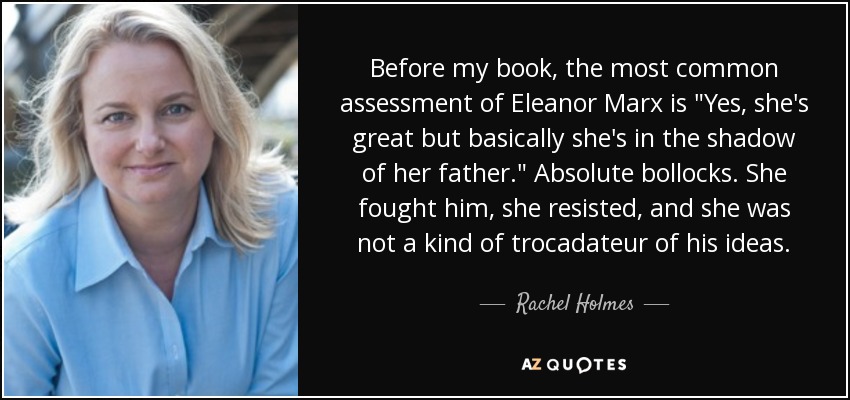
Before my book, the most common assessment of Eleanor Marx is "Yes, she's great but basically she's in the shadow of her father." Absolute bollocks. She fought him, she resisted, and she was not a kind of trocadateur of his ideas.
Eleanor [Marx] was involved in the 1889 Paris congress resolution that established May Day as an annual demonstration of the international solidarity of labour in the demand for a legal eight-hour day.
Just come in there and stand before a live crowd, thousands of people at an Ivy League School, like Eleanor Roosevelt said, always do what you're afraid to do.
I think FDR was very dashing and charming and debonair, and probably reminded her of her father. A great bon-vivant. He loved to party. He loved to sing. He loved to have fun. And he wrote beautiful letters, just as her father did, which - alas and alack - Eleanor Roosevelt destroyed. But she refers to his beautiful letters. And she was charmed by him.
I can't really cook, but the first dish I ever made was for my girlfriend, Eleanor. I made chicken breast wrapped in ham, homemade mashed potatoes, and gravy.
Eleanor Roosevelt loved to write. She was a wonderful child writer. I mean, she wrote beautiful essays and stories as a child. And Marie Souvestre really appreciated Eleanor Roosevelt's talents and encouraged her talents. Also, she spoke perfect French. She grew up speaking French. She's now at a french-speaking school where, you know, girls are coming from all over the world. Not everybody speaks French.
Well, when Eleanor Roosevelt's mother dies, she goes to live with her Grandmother Hall. And her Grandmother Hall is in mourning. She's in widow's weeds. She's in her 50s, but appears very old. And she's exhausted from raising rather out-of-control children. Her favorite daughter, Anna, has died (Eleanor's mother), and she has living at home two other sons, Vallie and Eddie. And they are incredible sportsmen, incredible drinkers, out-of-control alcoholics.
It's interesting to me that really one of the first things she [Eleanor Roosevelt]did as First Lady was to collect her father's letters and publish a book called The Letters of My Father, essentially, hunting big game, The Letters of Elliott Roosevelt. And it really was an act of redemption, really one of her first acts of redemption as she entered the White House. She was going to redeem her father's honor. And publishing his letters, reconnecting with her childhood really fortified her to go on into the difficult White House years.
I think Eleanor Roosevelt always had a most incredible comfort writing letters. I mean, she was in the habit of writing letters. And that's where she allowed her fantasies to flourish. That's where she allowed her emotions to really evolve. And that's where she allowed herself to express herself really fully, and sometimes whimsically, very often romantically. And it really starts with her letters to her father, who is lifelong her primary love.
And in her [Eleanor Roosevelt] letters, she writes the most, you know, fanciful letters: when we are together, and when we are reunited, and you know, I will be your surrogate wife. Of course she doesn't use that word, but I will be the mother to my brothers, and I will be your primary love.
And during the campaign of 1936, she writes that she and her brother would always rather be out doing things when they're sick, rather than take to their beds. And I think Eleanor Roosevelt always responded to pain by doing more, by doing something, by being active. And I think she just couldn't bear to look at her childhood grief. And she didn't.
She writes that one of the moments that she felt most useful was when her mother had a headache, and she would stroke her head and rub her forehead. And I think Eleanor Roosevelt's entire life was dedicated to two things: (one) making it better for all people, people in trouble and in need, like her family.
I mean, her father was an alcoholic, and her mother was the suffering wife of a man who she could never predict what he would do, where he would be, who he would be. And it's sort of interesting because Eleanor Roosevelt never writes about her mother's agony. She only writes about her father's agony. But her whole life is dedicated to making it better for people in the kind of need and pain and anguish that her mother was in.
In one way, it is this sense of order and also love that, I think, really saved Eleanor Roosevelt's life. And in her own writing, she's very warm about her grandmother, even though, if you look at contemporary accounts, they're accounts of horror at the Dickensian scene that Tivoli represents: bleak and drear and dark and unhappy. But Eleanor Roosevelt in her own writings is not very unhappy about Tivoli.
And when Eleanor smiled, something broke inside of him. Something always did.
Eleanor had never thought about killing herself – ever – but she thought a lot about stopping. Just running until she couldn’t run anymore. Jumping from something so high that she’d never hit the bottom.
Eleanor hadn't written him a letter. It was a postcard. GREETINGS FROM THE LAND OF 10,000 LAKES it said on the front. Park turned it over and recognized her scratchy handwriting. It filled his head with song lyrics. He sat up. He smiled. Something heavy and winged took off from his chest. Eleanor hadn't written him a letter, it was a postcard. Just three words long.
I think Eleanor Roosevelt's so popular at Allenswood because it's the first time she is, number one, free. But it's the first time somebody really recognizes her own leadership abilities and her own scholarly abilities.
And her [Eleanor Roosevelt] Grandmother Hall provided her really with a quite wonderful education, and a freedom that, within the framework of Tivoli (which is a framework of discipline and order) is also a very encouraging and loving one.
The Weird Sisters is a chronicle of real women, because it tells the truths of sisters. Eleanor Brown has written a compelling novel about love, despair and birth order—the themes the Bard himself had claimed and burnished.
As a dancer I couldn't outdance Ginger Rogers or Eleanor Powell. As a singer I'm no rival to Doris Day. As an actress I don't take myself seriously...I'm the girl the truck drivers love.
A line from one of my 1997 columns - 'Do one thing every day that scares you' - is now widely attributed to Eleanor Roosevelt, though I have yet to see any evidence that she ever said it and I don't believe she did. She said some things about fear, but not that thing.
Occasionally I’ll be sitting somewhere and I’ll be listening to someone perhaps not saying the kindest things about me. And I’ll look down at my hand and I’ll sort of pinch my skin to make sure it still has the requisite thickness I know Eleanor Roosevelt expects me to have.
Either we're removing a dictator who currently has plans to fund terrorism against American citizens or -- if Bush is completely wrong and Eleanor Clift is completely right -- we're just removing a dictator who plans to terrorize a lot of people in the region, but not Americans specifically. Even for someone like me, who doesn't want America to be the world's policeman, the risk of precipitous action against Saddam Hussein doesn't keep me up at night.
She (Eleanor Roosevelt) got even in a way that was almost cruel. She forgave them.
Follow AzQuotes on Facebook, Twitter and Google+. Every day we present the best quotes! Improve yourself, find your inspiration, share with friends
or simply: