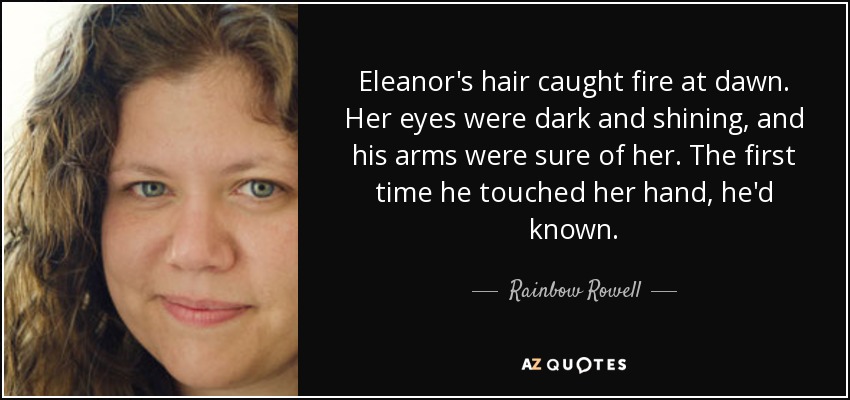
Eleanor's hair caught fire at dawn. Her eyes were dark and shining, and his arms were sure of her. The first time he touched her hand, he'd known.
You think that holding someone hard will bring them closer. You think that you can hold them so hard that you'll still feel them, embossed on you, when you pull away. Every time Eleanor pulled away from Park, she felt the gasping loss of him.
It's our last chance. No. No, I can't... I, no, I need to believe that it isn't our last chance... Eleanor? Can you hear me? I need you to believe it, too.
Eleanor,” he said, just because he liked saying it, “why do you like me?” “I don’t like you.” He waited. And waited… Then he started to laugh. “You’re kind of mean,” he said. “Don’t laugh. It just encourages me.
For the first time in weeks, Park didn't have that anxious feeling in his stomach on the way home from school, like he had to soak up enough Eleanor to keep him until the next day.
He wished that they could go through life like this. That he could physically put himself between Eleanor and the world.
You know?" he repeated. She smiled, so he kissed her. "You're not the Han Solo in this relationship, you know." "I'm totally the Han Solo," she whispered. It was good to hear her. It was good to remember it was Eleanor under all this new flesh. "Well, I'm not the Princess Leia," he said. "Don't get so hung up on gender roles," Eleanor said.” ... “You can be Han Solo," he said, kissing her throat. "And I'll be Boba Fett. I'll cross the sky for you.
No woman has ever so comforted the distressed or distressed the comfortable. on Eleanor Roosevelt.
What advice do you have for writers working on their first novels?If you feel called to write a book, consider it a gift. Look around you. What assistance is the universe offering you as support? I was given an amazing mentor, a poet, Eleanor Drewry Dolan, who taught me the importance of every word. To my utter amazement, there were times she found it necessary to consult three dictionaries to evaluate one word.
At the age of fifty-six Eleanor Stoddard was still a beautiful woman. She owned three hotels in France and another two in England. From nothing at all, she had built an empire. Eleanor had it all. Her one weakness was the young man sleeping beside her.
In 1932, lame duck president Herbert Hoover was so desperate to remain in the White House that he dressed up as Eleanor Roosevelt. When FDR discovered the hoax in 1936, the two men decided to stay together for the sake of the children.
I think that it is true that Eleanor Roosevelt, by being so active on that front, contributed to that impression very substantially. And it's to her credit that she was interested in this, let me say. But once again, I'm not sure the extent to which Roosevelt - I guess he did use her really, particularly on the civil rights front. No question about it, because she was well identified out there, and brought a good many blacks into the Administration, into the White House, into his presence and so on.
Well, I didn't read My Day by Eleanor Roosevelt very carefully. I was away during a lot of that, in the war and so on. She was not all that good a writer. She was a little bit on the banal side, and you know, what happened, and then this happened, and then that happened... But I will say this. She got very well paid for it.
These were in the days before anybody thought to criticize Congressmen, let alone first ladies, for making money on speeches. So Eleanor raked in quite a bit of cash that she may have put, for all I know, to good uses, or maybe not. I just don't know. But I don't think she was any great literary breakthrough.
That was a general impression that one got, that she [Eleanor Roosevelt] was always flitting around the country and descending on some place in the Ozarks that she decided was disadvantaged, and announcing that something had to be done. And she had a very active social conscience, which I think in general is to her credit, although it tended, as many people thought, to just be overdone to the point where it gave rise to this crack that she regarded the whole world as one vast slum project
One has to say that they [Eleanor and Franklin Roosevelt] were pioneering to some extent. They didn't know that some of the housing projects that they were putting up for the poor were going to turn into crack dens and rapists' bowers and things of that sort, which they have since become. But you can't always foresee the future. I'm sure their intentions were the best.
Eleanor Roosevelt had both her admirers and her detractors. And they admired her and detracted from her for many of the same reasons. People who liked her social activism, who thought that she was calling attention to problems that needed solving, were all for her.
People who thought that she was busy going around trying to stir up difficulty where there was none or less than she imagined, were quite critical of her. She was, we must never forget, a public figure. And in democracies, public figures tend to attract criticism as well as praise. The most dangerous thing would be if anybody were regarded as above criticism. And Eleanor Roosevelt is, in recent years, getting there.
I think the fact that she [Eleanor Roosevelt] was a woman probably in those days would have been an additional criticism, although first ladies by definition in those days were women. There's always been a problem and still is, about the role the first lady should play, of course. Everybody's seen it in Jackie Kennedy and Nancy Reagan and, heaven knows, Hillary Clinton. So the problem has not been solved.
I think she [Eleanor Roosevelt] never was called because she probably didn't know an awful lot. The whole burden of the criticism of her on the subject of Communism is naiveté, not participation. And again, being a public figure and our representative at the UN, there was nothing Communist about her, certainly.
Eleanor Roosevelt's very helpful to a lot of children who cannot speak French, who do not write well. And Marie Souvestre is fierce. She tears up students' papers that are not, you know, perfect. And Eleanor Roosevelt goes around, again, being incredibly helpful to children in need, children in trouble. And her best friends are the naughtiest girls who are in trouble. And she is a leader. And she is encouraged to be a leader. And everybody falls in love with her. She's a star.
And she [Eleanor Roosevelt]loves being a star. And she loves being a teacher and a leader and a mentor and a big friend. Also, she's tall. She's one of the tallest girls in the school. And she's an athlete. And she writes many years later, at the end of her life, she writes that the happiest day, the happiest single day of her life was the day that she made the first team at field hockey. And I have to say, as a biographer, that's the most important fact. I
And you can really see in all of these issues that are priorities for Eleanor Roosevelt, where the compromises are painful, the compromises are hard, and the difficulties between them really begin to loom very large by 1936, by 1938.
And if you look at pictures of Eleanor between 1918 and 1921, she becomes anorexic. She really loses a tremendous amount of weight. That's when her teeth really go bad. It's a terrible, terrible time for her. And she has five children, ranging in age from three to 10. It's an emotionally terrible ordeal.
But it's also the beginning of another level of liberation for her]Eleanor Roosevelt], because when she returns to New York, she gets very involved in a new level of politics. She meets Esther Lape and Elizabeth Read, and becomes very involved in the women's movement, and then in the peace movement. And ironically, the years of her greatest despair become also the years of her great liberation.
Follow AzQuotes on Facebook, Twitter and Google+. Every day we present the best quotes! Improve yourself, find your inspiration, share with friends
or simply: