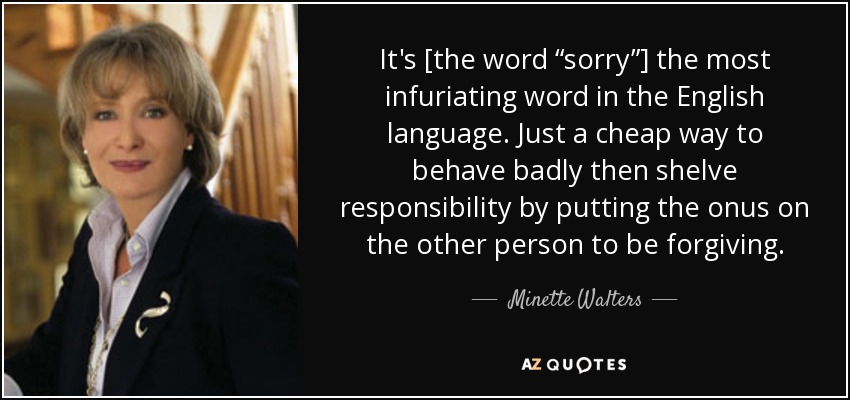
It's [the word “sorry”] the most infuriating word in the English language. Just a cheap way to behave badly then shelve responsibility by putting the onus on the other person to be forgiving.
Everybody gets a little dose of Shakespeare. He's the greatest playwright in the English language, but his politics are fairly square.
Shakespeare, who is probably the greatest writer and poet of the English language, lived in a time that was politically very conservative and it's reflected in his writings.
The illuminated ones can take any form -- a man, a woman, a child, an elder, or even a dog. It is not inconsequential that the English language allows for the dyslexia of the spelling of the word dog: God spelled backward.
The most disgusting four letter word in the English language is 'cage'.
When animals do something noble we say they are behaving ‘like humans’. When humans do something disgusting we say they are behaving ‘like animals’. Clumsy use of the English language perpetuates the myth that animals are inferior and disposable beings.
At last, in 1611, was made, under the auspices of King James, the famous King James version; and this is the great literary monument of the English language.
Put your trust in god are the most dangerous words in the English language.
Words have a longer life than deeds.
Al-Ghazali is the most important philosophical theologian of classical Islam, and Moderation in Belief is among his most important works. It sets out al-Ghazali's Ash?arite theology with unusual clarity and provides important background for such well-known works as his autobiographical Deliverance from Error and his attack on Avicenna in The Incoherence of the Philosophers. This first English-language translation, with notes that bring out the argumentation and background of the work, is thus very much to be welcomed.
Alexander von Humboldt’s wide-ranging Views of Nature is a masterpiece of nineteenth-century natural history, at once science and art. Mark W. Person’s stunning new translation makes the wonders of this classic accessible to the English-language world of the present.
I am now completing research supported by NSF and NEH that is mapping changes in the English language through all of North America, for both mainstream and minority communities.
The reaction to any word may be, in an individual, either a mob-reaction or an individual reaction. It is up to the individual to ask himself: Is my reaction individual, or am I merely reacting from my mob-self? When it comes to the so-called obscene words, I should say that hardly one person in a million escapes mob-reaction.
One man's frankness is another man's vulgarity.
The existing phrasebooks are inadequate. They are well enough as far as they go, but when you fall down and skin your leg they don't tell you what to say.
If a language is corruptible, then a constitution written in that language is corruptible.
It is a safe rule to apply that, when a mathematical or philosophical author writes with a misty profundity, he is talking nonsense.
Learning preserves the errors of the past, as well as its wisdom. For this reason, dictionaries are public dangers, although they are necessities.
You know, we have main English language parties, federalist parties, and traditionally the ones to watch would be the Conservatives, who form the government, and then the Liberals.
I feel that the English language will be able to carry the weight of my African experience. But it will have to be a new English, still in full communion with its ancestral home but altered to suit new African surroundings.
In 1776, at the point of severance, except for an infusion of words from east coast Indian languages, the English language of North America was not in any radical way dissimilar from that of what the American settlers called the mother country.
At all periods of the [English] language it is difficult to assign a beginning date to most new words and meanings. They tend to slip into the language silently, and are placed in date order only when scholars subsequently get to work.
I definitely wish to distinguish American poetry from British or other English language poetry.
No' is the second shortest word in the English language, but one of the hardest to say.
Suddenly I was the man who got the part that every actor in the English language was trying to get. I was really scared. I had talked the talk, and now I had to walk the walk. For three days, I couldn't answer the phone.
Follow AzQuotes on Facebook, Twitter and Google+. Every day we present the best quotes! Improve yourself, find your inspiration, share with friends
or simply: