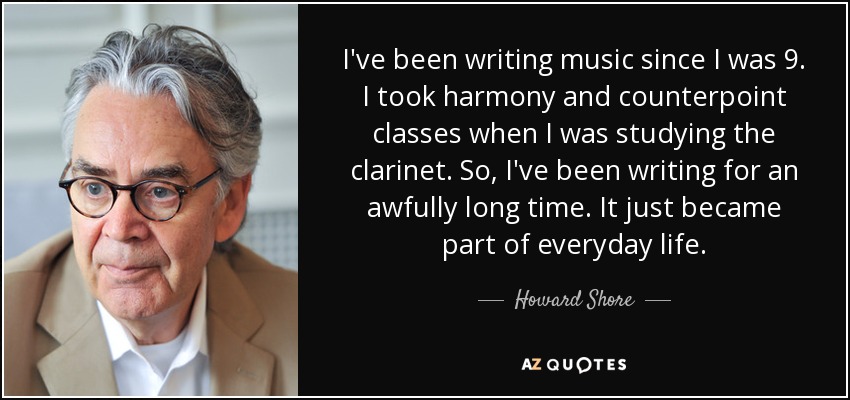
I've been writing music since I was 9. I took harmony and counterpoint classes when I was studying the clarinet. So, I've been writing for an awfully long time. It just became part of everyday life.
The propensity to avoid moral considerations was producing not simply a politically illiterate and authoritarian society, but one that was increasingly saturated in violence and a culture of cruelty. Needless to say, all of these forces intensified the increasing militarization and corporatization of higher education, along with the privatizing of everyday life.
I love to read things that have moral messages, and I love to hear stories where it's not just a hook, you have to follow the story, you have to listen to the message of the song, and get it and use it in your everyday life.
Americans are curious about the texture of everyday life in the Middle East because they rarely get to see it. I wanted readers to feel like they were sitting around the dinner table with me and my friends, hearing what average people really say and really think, [where] the dinner table is the best place to find out.
I chose to write about food: food is inherently political, but it's also an essential part of people's real lives. It's where the public and private spheres connect. I wanted to show readers that the larger politics of war and economics and U.S. foreign policy are inextricably bound to the supposedly trivial details of our everyday lives.
In the Middle East, bread is so essential to everyday life that word for it in Egyptian Arabic is aish, which means life. It's always been the staple grain. But the predicament is that the Fertile Crescent, where wheat cultivation began, has now become the part of the world most dependent on imported wheat.
When you think about justifiable anger in one's personal life, we look at those scenarios in everyday life and through our story with a superhero, we heighten them.
I think The Magicians takes these conventional ideas from this Christian literature of good vs. evil and it sort of shakes it up and asks a deeper, darker question about the nature of not just humanity in the face of good vs. evil, but the challenges of everyday life. And I think there's something incredibly timely about that and incredibly relatable to anyone who's growing up. Because we're all growing up. We're all constantly evolving.
I came from a pretty accepting community, and my school had a lot of openly gay and LGBT-plus people. When I joined YouTube, I saw a lot more hostility than I saw in my everyday life.
The spiritual traditions of all the religions have certain similarities that are unmistakable. They share many of the same basic practices like sacred reading, spiritual guidance, moderation in eating, drinking and sexual expression, and above all, trying to be aware of the presence of God in other people and in everyday life.
I do not put much emphasis on periods of meditation - if you do meditation, it's fine - but the important thing is to bring the awareness into everyday life, into every little action that you do, into the varied challenges of everyday life.
You simply have to surrender to the present moment. Be alert. Watch something in a state of alertness. Always, continuously, bring that into everyday life, not spirituality here and getting on with your life there.
Many people are probably better off avoiding therapists and using the resources and support available to us in everyday life. But therapy can be a chance to think things through with a professional in a calm, supportive and nonjudgmental atmosphere, and that can be helpful.
I think many of us live in a rut. Stuck in a groove we can't get out of, whether it's our job, family drama or the little frustrations of everyday life.
If there is a central theme to what I called "a peaceful warrior's approach to living," and to The Four Purposes of Life, it is that there may be innumerable techniques or methods one can learn (from the Eastern spiritual cultures and from the Western psychological tradition), but that above and beyond all these technologies waits the school of everyday life.
When a country is at war or in economic depression, underdevelopment or tightened security, it sets an affective tone or mood, which seeps through into everyday life via all kinds of channels.
I don't really get a lot of clarity in my everyday life and my interactions with people. Most things that happen to me aren't very straightforward. They're either vastly confusing, or I realize that I'm inventing whatever meaning I'm deriving from whatever happens and it's filtering through my own indulgent perspective.
Once the reality sets in of a superhuman intelligence being in control of every aspect of the infrastructures we rely upon for everyday life, we will simply have to try to come to an accommodation with that entity.
I really think I write about everyday life. I don't think I'm quite as odd as others say I am. Life is intrinsically, well, boring and dangerous at the same time. At any given moment the floor may open up. Of course, it almost never does; that's what makes it so boring.
If you’re reading these words, perhaps it’s because something has kicked open the door for you, and you’re ready to embrace change. It isn’t enough to appreciate change from afar, or only in the abstract, or as something that can happen to other people but not to you. We need to create change for ourselves, in a workable way, as part of our everyday lives.
St. Teresa of Avila wrote: 'All difficulties in prayer can be traced to one cause: praying as if God were absent.' This is the conviction that we bring with us from early childhood and apply to everyday life and to our lives in general. It gets stronger as we grow up, unless we are touched by the Gospel and begin the spiritual journey. This journey is a process of dismantling the monumental illusion that God is distant or absent.
The attitude I take is that everyday life is more interesting than forms of celebration, when we become aware of it. That when is when our intentions go down to zero. Then suddenly you notice that the world is magical.
The advance of technology is based on making it fit in so that you don't really even notice it, so it's part of everyday life.
The goal of prayer is to live all of my life and speak all of my words in the joyful awareness of the presence of God. Prayer becomes real when we grasp the reality and goodness of God's constant presence with 'the real me.' Jesus lived his everyday life in conscious awareness of his Father.
If my dreams can happen to me, your dreams can happen to you. Champions are not made on the track or field; champions are made by the things you accomplish and the way you use your abilities in everyday life situations.
Follow AzQuotes on Facebook, Twitter and Google+. Every day we present the best quotes! Improve yourself, find your inspiration, share with friends
or simply: