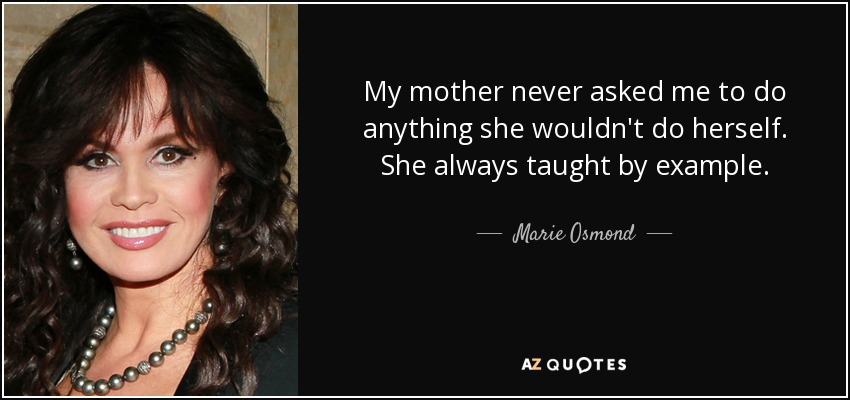
My mother never asked me to do anything she wouldn't do herself. She always taught by example.
As a leader, these attributes - confidence, perseverance, work ethic and good sense - are all things I look for in people. I also try to lead by example and create an environment where good questions and good ideas can come from anyone.
In the examples that I here bring in of what I have [read], heard, done or said, I have refrained from daring to alter even the smallest and most indifferent circumstances. My conscience falsifies not an iota; for my knowledge I cannot answer.
The taboos that I have mentioned are extraordinarily harsh and numerous. They stand around nearly every subject that is genuinely important to man: they hedge in free opinion and experimentation on all sides. Consider, for example, the matter of religion. It is debated freely and furiously in almost every country in the world save the United States, but here the critic is silenced. The result is that all religions are equally safeguarded against criticism, and that all of them lose vitality. We protect the status quo, and so make steady war upon revision and improvement.
When the first people started to argue against slavery, for example, this was a new idea. If you crowd-source, you'd never come up with this. And so the - exactly the kind of progress we've made couldn't be made if we depend it on crowd-sourcing.
I like the fans, but I don't feel an obligation that I have to be an example to them, like say maybe a baseball player would, or a football player or maybe some other type of musicians. I don't feel I have to really set an example that somebody else has to live up to.
Even if they don't know it consciously, people can feel when you are making them into a means to an end only. And people are much less likely to do what you want them to do - for example, to buy the car - when they feel you are reducing them into a means to an end.
Terrorism is an example of that extreme madness. People blow themselves up just to kill others. Unconscious reaction to terrorism is equal madness.
Technology is probably the single biggest driver of productivity gains for the developed countries. For example, I think it's much more important than free trade.
If we have more people on the receiving end of government - more people as the middle class becomes sucked in more and more to these entitlement programs, for example - then we're going to be in a place where it's going to be hard to go back. It's going to be hard to go back again. It's going to be hard to take away stuff. It's not impossible.
We took advantage of [the Indians'] ignorance and inexperience to incline them the more easily toward treachery, lewdness, avarice, and every sort of inhumanity and cruelty, after the example and pattern of our ways.
Every notable advance in technique or organization has to be paid for, and in most cases the debit is more or less equivalent to the credit. Except of course when it's more than equivalent, as it has been with universal education, for example, or wireless, or these damned aeroplanes. In which case, of course, your progress is a step backwards and downwards.
It may be affirmed, without extravagance, that the free institutions we enjoy, have developed the powers, and improved the condition, of our whole people, beyond any example in the world.
I believe that whoever tries to think things through honestly will soon recognize how unworthy and even fatal is the traditional bias against Negroes. What can the man of good will do to combat this deeply rooted prejudice? He must have the courage to set an example by words and deed, and must watch lest his children become influenced by racial bias.
Example is better than following it.
Everything necessarily is or is not, and will be or will not be; but one cannot divide and say that one or the other is necessary.I mean, for example: it is necessary for there to be or not to be a sea-battle tomorrow; but it is not necessary for a sea-battle to take place tomorrow, or for one not to take place--though it is necessary for one to take place or not to take place.
Realism absorbs the ideal by adding a few small imperfections. Example: it paints a few specks of mud on the white gown of the Lady in the Garden.
What passes for identity in America is a series of myths about one's heroic ancestors. It's astounding to me, for example, that so many people really seem to believe that the country was founded by a band of heroes who wanted to be free.
The average parent may, for example, plant an artist or fertilize a ballet dancer and end up with a certified public accountant. We cannot train children along chicken wire to make them grow in the right direction. Tying them to stakes is frowned upon, even in Massachusetts.
Electricity is an example of a general purpose technology, like the steam engine before it. General purpose technologies drive most economic growth, because they unleash cascades of complementary innovations, like lightbulbs and, yes, factory redesign.
I lead by example. My kids know what sweat is. They've seen me come home from so many runs and asked, 'What's on your skin? How did you get it?' And I tell them, 'It's from exercise!' So now my son will come home from a bike ride, take off his helmet and say, 'Look, Mom. I'm sweating! I just worked out!'
Every word that judges value is circular. 'Good' is 'right' is 'proper' is 'just' is 'good'. But check the examples, and they're not circular at all: Every one says 'makes me happy'.
New York is the biggest mouth in the world. It appears to be prime example of the herd instinct, leading the universal urban conspiracy to beguile man from his birthright (the good ground), to hang him by his eyebrows from skyhooks above hard pavement, to crucify him, sell him, or be sold by him.
Sinclair Lewis is the perfect example of the false sense of time of the newspaper world.... [ellipsis in source] He was always dominated by an artificial time when he wrote Main Street.... He did not create actual human beings at any time. That is what makes it newspaper. Sinclair Lewis is the typical newspaperman and everything he says is newspaper. The difference between a thinker and a newspaperman is that a thinker enters right into things, a newspaperman is superficial.
Cliche refers to words, commonplace to ideas. Cliche describes the form or the letter, commonplace the substance or spirit. To confuse them is to confuse the thought with the expression of the thought. The cliche is immediately perceivable; the commonplace very often escapes notice if decked out in original dress. There are few examples, in any literature, of new ideas expressed in original form. The most critical mind must often be content with one or the other of these pleasures, only too happy when it is not deprived of both at once, which is not too rarely the case.
Follow AzQuotes on Facebook, Twitter and Google+. Every day we present the best quotes! Improve yourself, find your inspiration, share with friends
or simply: