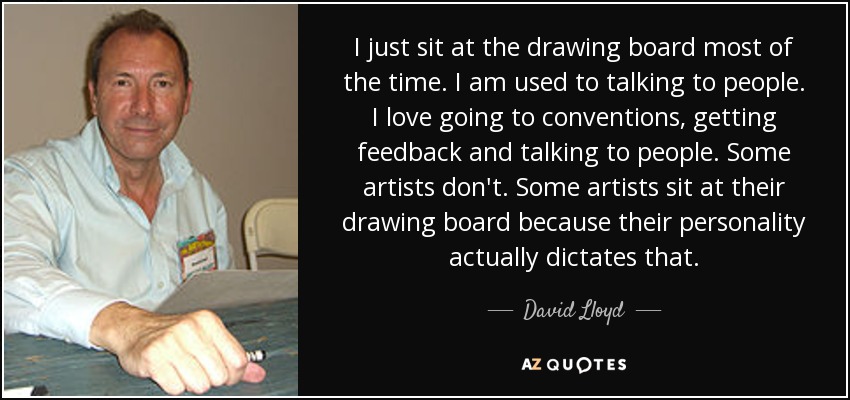
I just sit at the drawing board most of the time. I am used to talking to people. I love going to conventions, getting feedback and talking to people. Some artists don't. Some artists sit at their drawing board because their personality actually dictates that.
The status quo is a product of our culture or our culture is a product of the status quo - I'm sure which is the effect and which is the product - there is probably a feedback loop there that is mutually reinforcing. But we have a culture that says "Hey, look around. This place called Earth was created for you and you can do anything you want with it."
Investing in management means building communication systems, business processes, feedback, and routines that let you scale the business and team as efficiently as possible.
I'm much more concerned about what artists think. But as you get older you tend to get much more isolated; you're not out in the bar, having long drunken arguments on the benefits of your work vs. someone else's. It's hard to know how people are looking at it, and you don't get much feedback. The written critical stuff seems to be the feedback, but that's hard to interpret.
It's been kind of extreme - people either love it or they don't like it at all - and I think that's a good thing. It's my first art project where there's not a middle ground. I find it very interesting. But the negative feedback hasn't at all kept me from doing it, obviously. Because I haven't really gotten any negative feedback that I feel is really warranted.
My writing process is very feedback based - I listen to the audience. I try to understand what's connecting, what's not connecting... and then rewrite, and rewrite, and rewrite. Chris Gethard and I have been on the road a lot together. When we get on the bus at night, we talk about the jokes that didn't work and the joke possibilities that could work. I think this is a little different from other writers.
Going to the office of some stranger and waiting in a line, in a hallway, with five other guys who look just like you, waiting your turn to go in and embarrass yourself, and then waiting around for feedback, which never comes. I really like that. For a young artist, it seems like the perfect thing to be doing, humiliation, over and over and over and over. Which I'm sure can't be the way that some people look at it, but I thought that was so great. The point of it is if you make your own stuff you don't have to deal with other people's bullshit.
I had been digging so much for my show, Minimal Wave - constantly finding fresh old material to play every week - that I ended up discovering all these obscure bands that no one had really heard here. It was very exciting to be able to play their records on the air for a new audience and be able to get instant feedback.
I'm just a dude and I feel like being completely isolated would be kind of a drag. I really do get a lot of energy from feedback from fans. People create music videos and artwork for my music.
There's this idea, particularly in pop music and a lot of these pop father/manager types, that you're selling the person instead of the song. You basically want to create something that the fans relate to because it's exactly like them. So there's a lot of art that's made to be in the image of the audience, but then the audience is imitating this version of themselves. It's a really weird cultural feedback loop, and it's kind of strange to watch. It's a new thing since I was a kid, really a different thing.
I write songs for myself, songs come out of me, I get enjoyment out of it. Basically, that's it - I get enjoyment out of my songs, I know they're good songs, and know that the people around me who I respect are all getting up on these tunes, and the feedback is really good, so that's it. There are people who will receive them, and don't receive them. Not in a spiritual sense, but in a commercial sense - do these songs treat people, and so far they're working.
When I'm blogging, I think book writing is easier and vice versa. Writing is lonely work, and the good thing about blogging is that you have immediate feedback from commenters.
Part of what being a great founder is, is being both able to hold the belief, to think about where it is you want to be doing and want to be going, but also be smart enough that you are essentially listening to criticism, negative feedback, competitive entries.
Recording can be enjoyable, but the hard thing is that you don't get any direct or immediate feedback like you do when you play live. Getting to see people's excitement and see them engage in the show makes me excited to get back out and play.
I'm really lucky because I surround myself onset with people who I really trust to give me feedback, so I'm directing myself.
It's just one of those things like when you're not supposed to laugh, it makes it that much harder to stop laughing. And for some reason Zach [ Galifianakis] and I get in this feedback mood of giggling, and on the set of Hangover we just couldn't get through stuff.
I haven't talked to [Sterling Simm] personally about the situation. We did a couple retweets to make some noise and get a little feedback, but I would definitely consider it. When we had our session for the "All I Know" collaboration he played me a number of records, one being "All These", that were crazy.
A friend will give you immediate feedback and that will be that friend's opinion. An analyst often remains quiet and you hear what you've said and you gain your own insight.
I'm used to writing something, it becomes a record, it comes out. Then I go perform and I play it and I get this immediate feedback from the audience. So that's been the pattern of my life.
With The Help, I knew folks involved in the project peripherally. I wanted to audition for Hilly Holbrook and part of the initial feedback was: "No, Bryce is too nice." That's part of the reason why I really love auditions as well - you get to try out a character and try out different versions of a character.
Humans are able to give very good feedback. You can't tell with an animal what they feel.
The truth is there's so many great TV shows out there now that none of us take absence of awards personally. The most important feedback is the feedback we get from the fans.
As we started working with leaders, providing them with assessment feedback, noticing the impact it was having on them, and their teams, a real story unfolded, and the book All the Leader You Can Be became what it is now - a guide to leaders who want to understand their strengths, and also appreciate how to enhance their leadership.
We become overly reliant on the strengths that got us where we are today. We also become isolated as we move up in the organization. Unless we have the benefit of assessment, and unless we invite feedback on our leadership, we continue to lean on strengths that can actually work against us, and fail to expand our leadership style in a way that makes us more effective.
I don't read reviews or take any feedback from anyone. Here's the thing: The stories don't even care what I think about them. They don't listen to anybody! My job is simply to describe what I'm shown in my head so that folks who read the books get an idea of what I'm seeing. As long as that happens, I'm doing my job as best I can.
Follow AzQuotes on Facebook, Twitter and Google+. Every day we present the best quotes! Improve yourself, find your inspiration, share with friends
or simply: